Month: January 2011

  • Toxic Pineapples

    Toxic Pineapples

    As a nerd and compulsive reader, I’ve always been a fan of knowledge. When choosing to know something or not, I choose know it. I’m reevaluating that stance.

    Not on everything. I still want to know how to drive a car, operate a gas stove without killing myself, and long division. What I don’t want to know is the history of my food. I’m done hearing about the nauseating conditions of pig farms, toxic levels of mercury in my sushi, and exactly what is inside my hot dog.

    I love hot dogs! They’re mouthwatering. They taste like summer, baseball games, and a Saturday afternoon spent grilling out back. Hot dog haters, have you ever tasted a dog fresh off the grill, sizzling with the skin wrinkled and striped black, smothered in ketchup, mustard, and relish? No, I doubt it because if you had you’d never want to know anything about it except how savory the first bite is. You would not want hot dogs ruined by knowing exactly what parts of the pig are in them.

    I’ve accepted that I’m going to die eventually. Nothing I do will grant me everlasting life. Because something has to get me in the end, I’m totally ok with it being too many french fries, fungus laden peanuts, or toxic pineapples.

    The peanut fungus came up in a discussion with a doctor recently. I mentioned a love of peanuts and his brow creased. He asked in what quantity I ate them? Vast quantities. He frowned. Uh-oh.

    Turns out Brazilian peanuts are prone to a fungus that will eat and destroy your liver. Or something to that effect. He was speaking in Portuguese but I could understand something bad enough happens to your liver that he does not eat Brazilian peanuts.

    Thankfully, American peanuts do not have this problem, which means my hoard of Whole Foods Peanut Butter is safe.

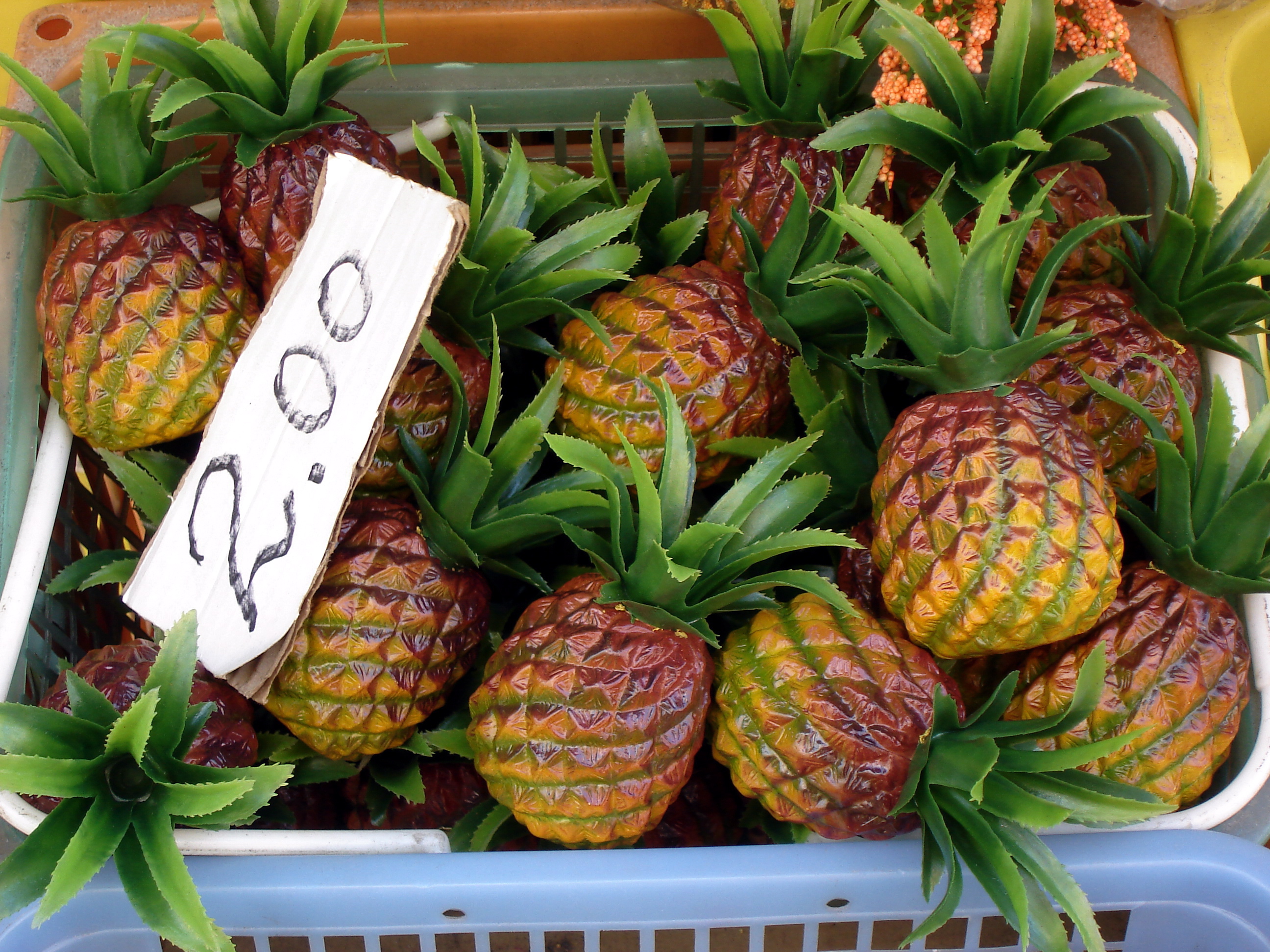
    Jumping on the band wagon of ruining foods Brynn loves, my husband started talking about pineapples. Sliced pineapple is the single greatest frozen yogurt topping. Period. I listened with growing horror as my husband told about a lawyer who works with the local farmers in our state. This lawyer learned the farmers get pineapples to ripen out of season by dousing them with pesticides.

    Wonderful. How can you buy local, when your local farmers coat your fruit in poison, not to keep the bugs off, but for the chemical reaction it produces in the fruit?

    My husband says pineapples should be ok in season. Should be but maybe not. Maybe some farmer wanted to get his pineapples to market first, so he sped things up with a little chemical enhancement.

    This is why I want to remain ignorant about my food. I’m going to go to the gym regularly, drink lots of water, eat sweets in moderation and live as long as that lifestyle lets me. That lifestyle will include hot dogs, peanuts and pineapples and I’m going to savor them in forced ignorant bliss.

  • My Scientifically-Proven, Stable Marriage

    My Scientifically-Proven, Stable Marriage

    I’d like to thank the New York Times for bringing to my attention the fact my marriage is sustainable indefinitely.

    That’s not my romantic idealism talking. No, it’s based on the results of a quiz I took on self-expansion in your relationship. The quiz was developed by a university professor which make the results totally scientifically valid. Since I scored off the charts, I now have irrefutable proof that twinkies will go bad before my marriage does.

    In order to determine what chance your marriage has of sustaining, the quiz measures how much you get out of your relationship. That’s the great truth the psychologists behind the quiz realized. People are happier in relationships they get something out of. Apparently, giving up all your own needs and losing yourself in your relationship is not a recipe for a sustainable relationship. Surprising results given the long term happiness historically achieved by martyrs.

    The creators of the quiz do distinguish between sustainable and lasting marriages. Sustainable implies continuing happiness, while lasting implies children or a faith that condemns you to hell for divorce. Not having any of the things that support a lasting marriage, I had my fingers crossed this quiz would show I have what makes a sustainable marriage. I do.

    You can take the quiz here, but I’ve listed some of the questions below.

    -How much does being with your partner result in your having new experiences?

    -When you are with your partner, do you feel a greater awareness because of him or her?

    -How much does you partner increase your ability to do new things?

    -How much do your partner’s strengths as a person compensate for some of your own weaknesses?

    -How much has being with your partner resulted in your learning new things?

    -How much does your partner increase your knowledge?

    You’re supposed to answer on a scale of 1 – 7 with 7 being “omg! so, so much!” The higher the score the more sustainable the relationship.

    In looking over my results, I realized the surest way to a happy, fulfilling marriage is to marry someone from a different culture. I think I’m on to something big here. Marry even a moderately supportive person from a another culture and there is no way you won’t answer at least a 5 on every question. “Providing new experiences,” “increasing your knowledge,” or creating a “greater awareness”? This stuff happens everyday when your partner has a different culture than your own. I don’t know if the psychologists even realize what they’ve discovered. The most fulfilling relations are cross-cultural ones.

    That really is nice to know. Before this quiz there was all this other research saying how marriages across cultures are statistically less likely to succeed. Based on the different cultures, different religions, languages, the fact we’re both children of divorced parents and the 16 year age difference, the experts seemed to agree my marriage is destined to crash and burn leaving a crater that will alter weather patterns.

    But I can stop worrying now because I have a quiz which proves that I am in a happy and sustainable relationship. I can ignore all those other studies, including the one that says calculating odds on a relationship between two entirely unique individuals is ridiculous.

  • Learning Brazilian History at  the Dentist

    Learning Brazilian History at the Dentist

    Something I enjoy about living in a different culture are the little reminders, even after years, that you’re not from here. Usually it’s a small thing that catches you by surprises and causes a double take. These cultural surprises are often trivial matters that you didn’t even anticipate being different, such as how socks get folded or the absence functional seat belts in the back seats of taxis.

    I wonder how long a person must live in a place before the little “Wait, what?” moments taper off. I’ve been in Brazil for four and a half years but just last week I was thrown by a simple question on a medical history form.

    At the dentist recently, I filled out a new patient form. I’ve become accustomed to routinely answering what I feel are very personal question such as marriage status and profession for everyone including the woman who sold me my bookshelf, but this question stopped me.

    “Cor:_____________”

    Cor in Portuguese means color. A medical history form handed to me by the dentist’s office asked for my color. I blinked in disbelief. I double checked with my husband. “Does this say color?” He told me it did. I asked “Ok, color of what exactly?” even though I knew the answer. He looked at the receptionist who said simply “skin.”

    For an American, an American from Atlanta, Georgia who heard about slavery, the civil rights movements, and racial tensions every year in school and was in high school during the ridiculously overdue process of getting the confederate flag off of the state flag, a doctor’s office asking for skin color is shocking.

    Four years in Brazil and I can still be shocked by a single word on a form. A simple piece of information that would never be asked for in my own culture. Or would it?

    How often is a person in the states asked to designate her race? Isn’t the same question just phrased in what, for Americans, is a more comfortable way? Sure, we’re usually told that question is “optional” and for “statistical purposes only” but the question is still asked.

    In talking to my husband afterwards, I learned that there are actually some Afro-Brazilian groups that are lobbying to get “color” included on forms. When Brazil first became a republic any mention of race was outlawed under the argument it would prevent discrimination. The result, however, was that millions of Brazilians who had been enslaved based solely on their race had no way to receive any programs targeted specifically  to help them overcome circumstances created by race, thus locking them into the lowest levels of society. Now, certain Afro-Brazilian groups want “color” on forms to have data about color and race in Brazil.

    So much history from a form at the dentist. That’s why, even though each cultural surprise is a clear reminder I’m living in someone else’s culture, I welcome them. Each one is a learning opportunity. Not that I always appreciate them. Learning takes energy and often I only have enough energy to be annoyed and call whatever is different stupid. (Both creativity and tolerance suffer when I’m tired.) But on good days having to pay for bottled water leads to a discussion of sewage infrastructure and a dentist’s form opens a dialogue on racial history.

  • My Dentist, My Sadist

    Today, I met the world’s friendliest dentist. Hmm, maybe I should rephrase given that dentists have not traditionally set the bar high when it comes to amicability. Today, I met a dentist who could not have been friendlier had she been inhaling her own laughing gas.

    It was my first trip to the dentist in Brazil. It was my first trip to the dentist in a decade. Maybe not quite that long. It’s hard to remember.

    Anyway, the last dentist I liked had video games and Disney movies playing in her waiting. Since the age of ten, every dentist I’ve had has been competent but distant and all business, in the way I imagine disembowlers must have been.

    My dentist today greeted me with a huge smile and flattering yet oddly enthusiastic declaration of how pretty I am. I think complimenting might be office policy to hook new patients and if so, I was sold. The smiling and over-the-top-compliments were such a welcome change for a dentist’s office; I thanked her and introduced myself to Doctor Gabriella.

    Brazilians use first names right away, even in professional contexts. It gives every encounter a personal feel. In Brazil, I don’t have bankers, dentists and doctors. I have a large network of personal acquaintances with a diverse skill set.

    Gabriella and I chatted about all the obvious first meeting facts: where are you from, how long have you lived here, which country do you like better. (There is no way to answer that last question honestly without offending someone. I just go with “Wow, that’s hard. They’re so many good things about both.”) Right before we got started I mumbled something about how long it had been since my last trip and then I waited for the shaming to begin.

    I’d always assumed that dentists are taught that shame is the only way to make people floss regularly. A patient must be told whatever she is doing, it is not done frequently or well enough and ultimately not sufficient to keep her teeth from falling out of her head. And toothless people go to hell.

    It was quite a shock then when Doctor Gabriella gently plied my lips and cheek away from my teeth and assured me they were very clean. When she spotted a cavity she called it a “little thing” that we can fix quickly. No lectures. A cavity and no lecture. I wonder if this woman knows what a disgrace she is to her profession.

    When we were done she walked me to reception area, asked me to come back for a cleaning and cavity filled, then she gave me a big hug and kiss on the cheek. A Brazilian that hugs. A dentist that is genuinely pleasant. I was completely thrown. I didn’t know how to react. I did know I liked it. So I’m going back for more next Tuesday at 9am.

  • A Brazilian Christmas

    A Brazilian Christmas

    Describing holiday gatherings in my family as hectic would be an understatement. There are multiple sets of grandparents, aunts, uncles and cousins to visit and dine with. The table is buried under enough food for a week-long bacchanalia. Enough dessert is prepared for every person in attendance to have her own cake.

    In comparison, the first Christmas I spent with my in-laws in Brazil was a pleasant afternoon picnic with some acoustic guitar.

    It was surprising to me that my American Christmases are filled with more food, presents and cousins than those of my Brazilian in-laws. It certainly seems to go against the stereotype of family-focused Brazilian culture and allowing-the-disintegration-of-the-family American culture. But which “American” culture am I referring to?

    Middle-class America? Middle-class, Latino, urban American from Miami? The diversity of the US makes it difficult to define what is American and the same is true of Brazil. What is Brazilian? Well, are we talking about the Paulista sushi chef of Japanese heritage or the Carioca taxi driver of Italian/Portuguese ancestry?

    I’m not saying overarching national or regional cultures don’t exist, just that within any culture are seemingly endless subcultures that create huge variety among people and families.

    I realized this year, after hearing many accounts of “Brazilian” Christmases, that my southern family celebrates Christmas in a more “Brazilian” way than my Brazilian husband does.

    Growing up, I’d usually celebrate Thanksgiving in South Georgia on my Grandmother’s pecan farm. As one of the oldest, I got to drive my younger cousins and the kids of my dad’s cousins (who I believe are called second cousins) around in my great-uncle’s golf cart. On my mom’s side, Christmas dinner often included the daughter of my step-dad’s brother-in-law’s sister, a relationship the English language has no term for.

    Because my parent’s are divorced, Christmas day usually included visits no fewer than four houses. One set of grandparents has since moved to Florida, so we’re down to a mere three present opening sessions. Three homes is more than enough to leave my husband shell-shocked with only the strength to sit upright, mumbling to himself, “It’s so much. It’s so much.”

    Whether he was talking about the number of presents, pies, or names of family members to remember I don’t know, but after my first Christmas lunch in Rio with only his immediate family and a single pudding for dessert, I understood his culture shock.

    We now make a point of spending Christmas in the U.S.  Every December we fly to Georgia for lots of family and food. It’s a very Brazilian holiday.