One reason I love writing historical fiction is the chance to discover real people I’d swear were fabricated in someone’s imagination. King João VI of Portugal is one of these people. The man was born to be the comedic relief in someone else’s story. Sure, he was also born into royalty, but he seemed so much more suited for getting laughs than governing.
I discovered Dom João VI while researching for a book set in 1809 Rio de Janeiro. (Aside: King John is the English version of his name and title, which I won’t be using because that makes me think of English kings and Robin Hood but I’m writing about Portugal and there really are just too many people named John or some variation in human history). At the time of my story, João was Prince Regent and had been ruling in place of his mom, Queen Maria I of Portugal, since 1792 when she was declared insane. (Queen Maria is a whole other post.)
What to say about Dom João? He loved to eat. He always carried grilled chicken in his coat pocket for emergency snacking. This becomes even more disgusting after learning he also hated bathing and wouldn’t change his clothes for months. He was terrified of thunder and crustaceans, very inconvenient phobias when living in tropical Rio de Janeiro. João would literally hide in his bedroom during thunderstorms. He referred to himself in third person and was plagued by vertigo and hemorrhoids.
Not surprisingly, João was also the last absolute monarch of Portugal. What is surprising are his nine kids, which is eight more than I’d have guessed for a man universally considered a “peaceful dullard” with a “flaccid visage”.
But the truly shocking and grand achievement of Dom João was surviving. When monarchs all over Europe were getting deposed at best and beheaded at worst, Dom João, the peaceful dullard, kept his crown, and he did it by being the only European monarch in history to move the capitol of his kingdom to a different continent. This man, who hated change so much his servants had to repair holes in his pants while he slept, moved the capital of Portugal from Lisbon to Rio de Janeiro.
João had been communicating with Napoleon in hopes of finding some solution that didn’t get him exiled or killed. Napoleon, the British, and pretty much everyone was under the impression Portugal would surrender to France. In 1808, the Prince Regent played Napoleon just long enough to order his government to pack up, board a ship, and get the hell out of Portugal before Napoleon’s army showed up. As someone who always preferred to delay a decision rather than make one, João gave the court three days to evacuate 10,000 people across the Atlantic.
That’s how Dom João VI found himself living in Rio de Janeiro, Brazil trying to establish court in a colony that had almost no roads between cities, no universities, no printing presses, and no trade with anyone but Portugal. Of course, the total lack of development in Brazil was intentional to keep the colony submissive and easily controlled. No Portuguese monarch ever anticipated having to live in this place where doctor, dentist, and barber was a single, mostly self-taught profession.
But it all changed under Dom João. He allowed roads, universities, and newspapers to flourish in Brazil. In exchange for escorting the court across the Atlantic, Brazilians ports were opened to the British and trade expanded. Academics, artists, and merchants flooded Brazil.
And Brazil declared independence sixteen years after João arrived in Rio. (Printing presses always lead to independence.)
As king finally back in Portugal, João conceded Brazilian independence in 1822 after a bloodless revolution led by the son he left behind in Rio to run the colony. His son’s betrayal probably didn’t bother him too much. At that point his wife had tried to overthrow him a few times so he was surely used to betrayal by immediate family. When he died in 1826, many suspected arsenic poisoning possibly ordered by his wife. (She really hated him.)
He may have lost Brazil for Portugal, but because of the reforms and development João initiated during his time in Brazil which led directly to independence, he’s remembered quite fondly here in spite of his eccentricities.
For my part, I can picture him clearly. His Majesty Dom João VI holding court, unbathed, and referring to himself in third while nibbling buttery chicken pulled out of a stained coat pocket that hasn’t been changed in a month. The perfect comedic relief.
If you’re interested in reading more about João and Brazilian history, I highly recommend 1808: The Flight of the Emperor by Laurentino Gomes.
We were walking the streets of Rio de Janeiro yesterday when my daughter piped up “Hey, it’s Festa Junina!” I shook my head and tolld her Festa Junina was last month. She insisted and pointed to a street vendor whose stall was decorated with primary colored flags and a stereo blaring forro music. My kid was right. This vendor was still celebrating Festa Junina. My husband, a native of Rio, explained it this way. “Whatever the party, it always lasts a month longer in Rio.”
In that spirit, I thought a post about Festa Junina in July makes total sense.
Kiddo’s very first Festa Junina!
Festa Junina celebrations, which happen with varying degrees of enthusiasm throughout Brazil, can be traced back to the Pagan tradition of worshiping the summer solstice. The Catholic church then hijacked this festival by assigning June 24 to Saint John the Baptist, and Portugal brought traditional Saint John celebrations to Brazil during colonization.
This is me eating a sweet soup called Canjica. Basically, take corn, add condensed milk, cloves, and heat it up.
Over the centuries, many Festa Junina traditions and celebrations have become entirely secular and blended with other cultures and annual events that happen at this time in Brazil. For example, June is when the corn gets harvested, and about 97% of traditional Festa Junina food is corn based. Salty and sweet. Eaten off the cob and baked into cakes. In soups and as snacks. Seriously, I had no idea there were so many ways to prepare corn, and they’re all delicious.
While many places in Brazil celebrate Festa Junina on the night of June 23 with an official holiday on the 24th, in the Southeast where I’ve lived, Festa Junina parties happen any Friday or Saturday during the month of June. Or if you’re a university club in Rio, every Friday and Saturday in June.
There are fireworks, dancing, carnival games, straw hats and painted freckles (girls) or a painted moustache (boys), and usually at least one mock wedding. I haven’t read exactly how the mock weddings became a staple of Festa Junina parties, but I have a theory. Saint Anthony is considered the patron saint of marriage because he helps single women get husbands so many offerings and prayers are sent to Saint Anthony on his day, June 13. In addition to June being a time when marriage is on the brain, bringing the corn harvest to market was one of the few times people in rural areas got to meet someone they weren’t related to. Oh, and how convenient to have your wedding at the same time as the already scheduled festival! You can save tons on catering! Thus Festa Junina became a day of many weddings.
At my daughter’s school, it’s always Year 4 that stages a mass mock wedding, and this year it was finally her turn. That meant her Festa Junina costume was a wedding dress with a veil, and she LOVED it. It also meant extra time on stage because in addition to the mock wedding, all grade levels perform a quadrilha, a traditional dance done during Festa Junina but with preschoolers is really just a lot of jumping and arm waving.
In my personal opinion, the best part about Festa Junina is the food, but I feel that way about all carnivals and festivals. Any event that has portable grills and homemade sweets being set up on folding tables arranged around ring toss and fishing games is something I’d be delighted to attend.
Even the teachers dress up!When not performing mock weddings, Tio Rafa can be found coaching soccer.Is there a culture that doesn’t have fishing games at festivals?The grooms waiting for the brides to arrive
One bride is always brought in riding in a wheelbarrow. I have no idea why, but it’s super cute.
At the summer games this year in Rio de Janeiro, fans of 41 different sports will have a chance to watch competition between the best athletes in their sport. The world’s best judokas, golfers, divers, bmx cyclists, track cyclists, mountain cyclists (I had no idea there were so many different ways to cycle), trampoline jumpers, and fencers will be here in Brazil competing for gold. To be completely honest, I’m not sure what the modern pentathloners will be doing exactly, but I’m sure it’s something that I cannot.
Despite the wide variety of sports included in the Olympics, one of the most popular sports in Brazil will not be a part of the games, Capoeira.
Capoeira is a martial art that developed in Brazil in the 16th century. At least scholars believe that’s when it began. There are very few records of the earliest iterations of capoeira because it was developed by Africans transported to Brazil as slaves who used it as a means of both self-defense and cultural preservation. For most of Brazil’s history capoeira was outlawed and practiced in secret. It wasn’t until the 1940s that all official bans on capoeira were lifted, and the government acknowledged capoeira as part of Brazil’s cultural heritage.
I called capoeira a martial art, but I used the term for lack of anything better. Some people refer to it as a dance, and others call it a game. It’s a link to history and a legacy. Capoeira is all of these.
“Negroes fighting, Brazil” c. 1824. Painting by Augustus Earle depicting an illegal capoeira-like game in Rio de Janeiro
The majority of people brought as slaves to Brazil came from West Africa, hence the style of capoeira known as Angola. Slaves were not allowed to continue cultural practices from home and could not practice any activity that could be used in self-defense. Capoeira combined drum rhythms and instruments from a variety of West African cultures and set the powerful spinning kicks and acrobatics to music. Practitioners could claim capoeira wasn’t an attack. It was a dance. Even today, capoeira is always practiced to music and song.
Capoeira expanded in Brazil during the 17th century through communities of escaped slaves known as quilombos. The largest quilombo, Palmares, was home to over 10,000 people. The quilombos were havens of freedom for former slaves and many mounted fierce resistance against the Portuguese. There are few remaining records about life in the quilombos, but historians believe that capoeira was an important part of the communities’ defense.
Portuguese and later Brazilian officials were so frightened by capoeira they outlawed any and everything related to the game. People were arrested for playing capoeira instruments, wearing the colored belts and white pants, or just whistling a capoeira song. Finally, in the 1930’s Mestre Bimba from Salvador convinced the government that capoeira was both an important cultural legacy for Brazil and (because governments respond well to financial incentives) a tourist draw. In 1937, he was allowed to open the first public and officially sanctioned capoeira school in Brazil.
Mestre Bimba developed a new style of capoeira drawing moves from jiu-jitsu, boxing, and batuque, a martial art brought from Africa practiced in the state of Bahia. Mestre Bimba’s style of capoeira became known as Regional. The original style of capoeira, Angola, is characterized by a slower style of play, with lots of low kicks, while the players stay close together. Mestre Bimba’s style of Regional is played much more quickly with more aerial acrobatics. If the capoeiristas you’re watching are doing crazy fast spin and flip kicks that make your mouth fall open, that’s Regional.
While the styles vary in speed and types of movement, both keep the same format and traditions for practicing. Capoeira is always played inside a circle of musicians, singers, other players, and spectators. The music of capoeira is performed on five instruments: berimbau, pandeiro, atabaque, agogô, and reco-reco. The musicians and singer perform continuously as players tag in and out of the circle. One more important fact! Players never actually strike each other while playing. They feint and dodge and kick, but they never land a blow. That’s why the verb “play” is used for capoeira. They’re playing, not fighting.
Last year a petition went around Brazil lobbying for inclusion of capoeira in the Olympics. Many of the most famous mestres were and are against its inclusion. They argued that capoeira is not a sport. There are no winners and losers and to change that would be to change the nature of capoeira, which focuses on community, preserving heritage, fitness, and fun.
Whether a sport, a martial art or a dance, capoeira today is practiced by men and women, kids of all ages, from everywhere in the world. The petition for Olympic inclusion failed, which means no official capoeira exhibition at the 2016 Rio Games, but without doubt there will be opportunities for visitors to watch, whether on beach or in a park square. If you happen to be in Brazil for the Olympics or if you ever happen to hear the tang tang of a berimbau, do yourself a favor and go watch. You’ll get to see impressive athletics, hear great music, and learn a bit of Brazilian history all at the same time.
If you love the Olympics, learning about world cultures, or both, check out the amazing Multicultural Kids Blog!
There’s so much bad news coming out of Brazil lately. The economy is still in tatters. The president is impeached. The interim president is according to most sources a mysogynist, corrupt pig. (And those are the nice names people are using for him.) Any waterbased Olympic events will require the athletes to wear hazmat suits. Zika.
I feel bad for Brazil. She’s like a good friend that’s going through a majorly shitty time in her life. When you have a friend struggling, you try to tell her it’s not all her fault. (#blameportugal) You try to look at her situation analytically. (In Brazil’s case that might make your head explode.) And finally you find the silver lining. Which in Brazil’s case is…Hold on…Give me a minute…
The weather! Brazil, you have amazing weather. And vacation spots. And fruit. Oh, something man-made? Uh…
Snack food. Brazilians have nailed snack food in a way superior to any country I’ve ever lived in. Brazil has upped the snacking game to a point it’s an independent category of food. Look in a Brazilian cookbook and it’s possible to find, main courses, sides, desserts, and salgados.
I’ve been asked by students how to translate salgados into English. You can’t. The best I’ve come up with is “a variety of salty, heavy snack foods that can be either fried or baked and are usually eaten individually as between meal snacks or in miniature forms at parties.” If anyone can suggest a single word in English to convey, please let me know, but I don’t think there is one. And hors d’oeuvre doesn’t cut it. A full-sized salgado is easily a meal in itself. A coffee and coxinha will set you up for hours.
Here’s a rundown on the typical salgados you’ll find in Brazil. I have a broad definition of salgado (see above), and I’m sure a few Brazilian purists will take issue with some of the food I’ve included on my list. Also, I’m sure I’ve forgotten some traditional favorites as well. My apologies.
Pão de quiejo…nom,nom,nom
Pão de Queijo: I’m putting this first because it is one of my absolute favorite things about Brazil. Yup, of all things that come from Brazil, my husband, my daughter, and pão de queijo are my favorites. This is a ball of cheesy, doughy deliciousness that can be served at breakfast, with afternoon coffee, or on party platters. Pão de quiejo can range in size from golf-ball to grown man’s fist, but when it comes to pão de queijo, bigger is always better. Trust me.
It’s important to observe local customs when abroad. Pasteis and caipirinha.
Pastel: A light pastry dough that is stuffed with deliciousness, folded over, and fried. Like pão de qeuijo, pastéis (plural form) can come the size of your palm of the size of your face. Shaped like a half circle or rectangle, the traditional fillings include ground beef, palm heart, mozzarella, shrimp, a kind of cream cheese, and chicken. They are delicious at ten in the morning with sugar cane juice or at seven at night with a caipirinha. I suspect they’re delicious at every hour of the day.
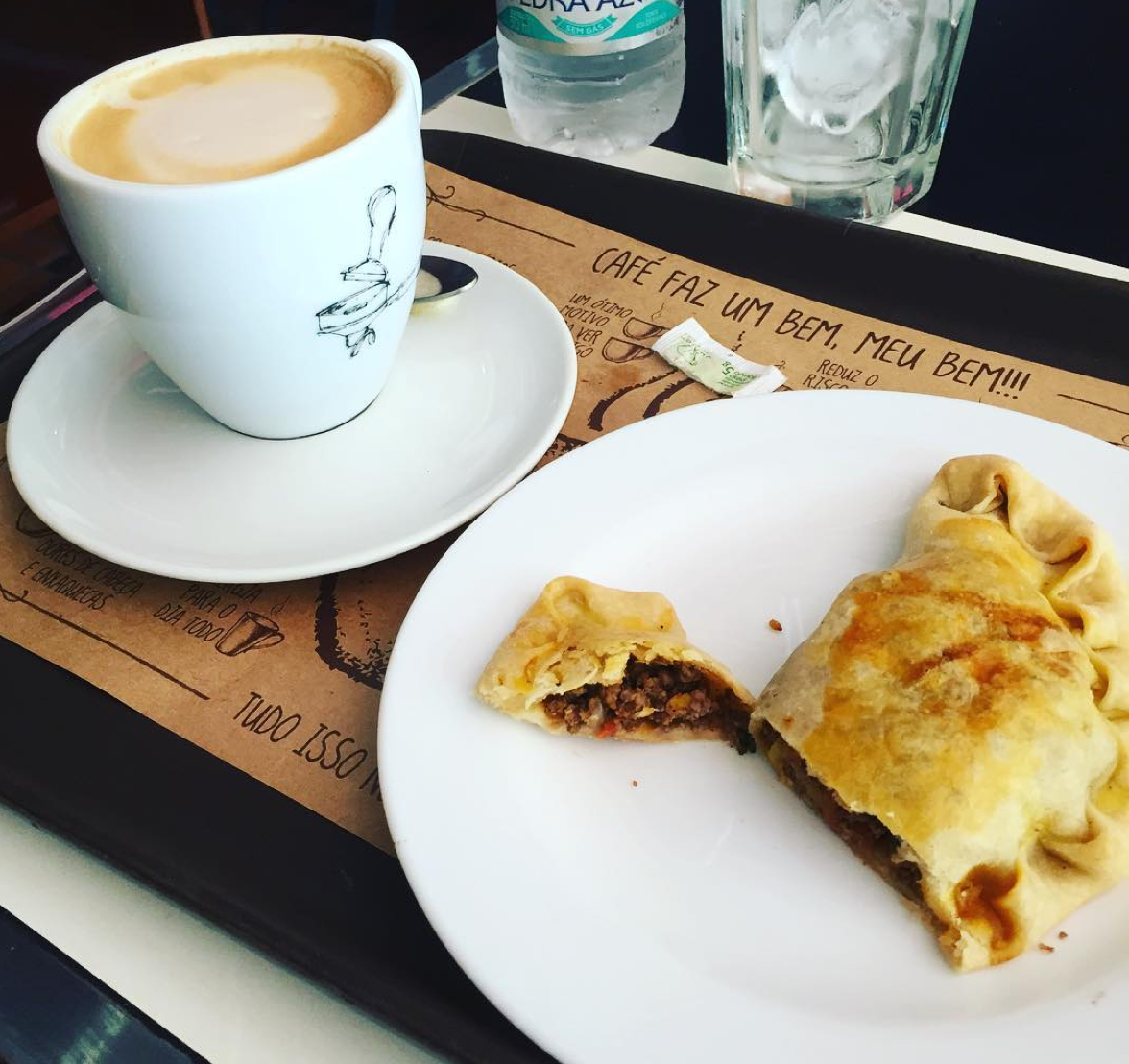
Empanadas go very well with lattes.
Empanada: Ok, this is one of the debatable entries because many people/sites equate empanada (a Spanish dish) and pastel (the Brazilian version). I’ll grant the overall concept is the same. Dough folded around a filling usually shaped in a half circle. But based on my personal experience with snack food in Brazil (which is fairly extensive I’m proud to say), the empanada and pastel are different things here primarily because of the dough. The empanada dough is thicker and not as flaky as the pastel. Also, empanadas seem to be baked whereas pastéis seem to be fried. Am I totally wrong about this? Are they the same? Am I the only one who cares? Also, don’t confuse an empanada with an…
Empada: Again dough, filling, baked, but the empada is more like a pie or casserole. The dough is much thicker and tends to become sticky when wet thus gluing your tongue to the roof of your mouth. It’s one of my least favorite salgados for this reason.
Kibe is yummy!
Kibe: An import from the Middle East and North Africa and a staple of party platters everywhere in Brazil. It mixes flour and ground beef into a football (oh, American football) shaped snacking delight. Sometimes there’s a cream cheese filling, but that’s only done if you hate your guests.
So it’s shaped like Picasso’s version of a chicken leg.
Coxinha: As far as I know, this is the only salgado with an origin story. A son of Princess Isabel (the last royal in charge of Brazil) would only eat chicken legs (even royal kids are brats about food). One day the kitchen was out chicken legs so the chef shredded chicken meat and put it inside a flour dough crust shaped like a drumstick. The little prince approved and now coxinhas are served in miniature at every children’s party. You can get them at pretty much any cafe or bakery. Coxinha is the heaviest item on the list, especially if there’s cream cheese in the center of the chicken filling. It’s like snacking on a small cannonball. A very delicious cannonball.
Açaí. It’s pronounced like an “s” people. No hard “c” here.
Juices, Açaí bowls, quiches, etc: I know juice and açaí don’t count as salgados. They are however staples of the Brazilian snacking experience. When my cousin visited Rio, we did a juice crawl through Ipanema. She tried fruits that the staff cringed from. In the heat of Brazil, nothing beats a bowl of cold açaí covered in bananas and strawberries. And of course cafes always have a variety of quiches and cakes to choose from.
Brazil is a great country for snacking. They have great coffee for the daytime, great caipirinhas for the nighttime and plenty of savory goodies for anytime. I just recommend a gym membership if you’re going to be staying any length time of here.
I’m currently obsessed with an idea for a historical fiction novel and have spent the last week devouring books on colonial Brazil. (I know you’re jealous.) It’s been fascinating reading actually because it’s all entirely new history for me. It wasn’t until World History in high school that I even knew humans existed outside of Europe, and by “Europe” I mean Italy, France, and Britain with a brief stop in Germany for the Reformation. Any ideas I have about Portugal or South America I learned from Columbus Day themed picture books and Disney’s Emperor’s New Groove.
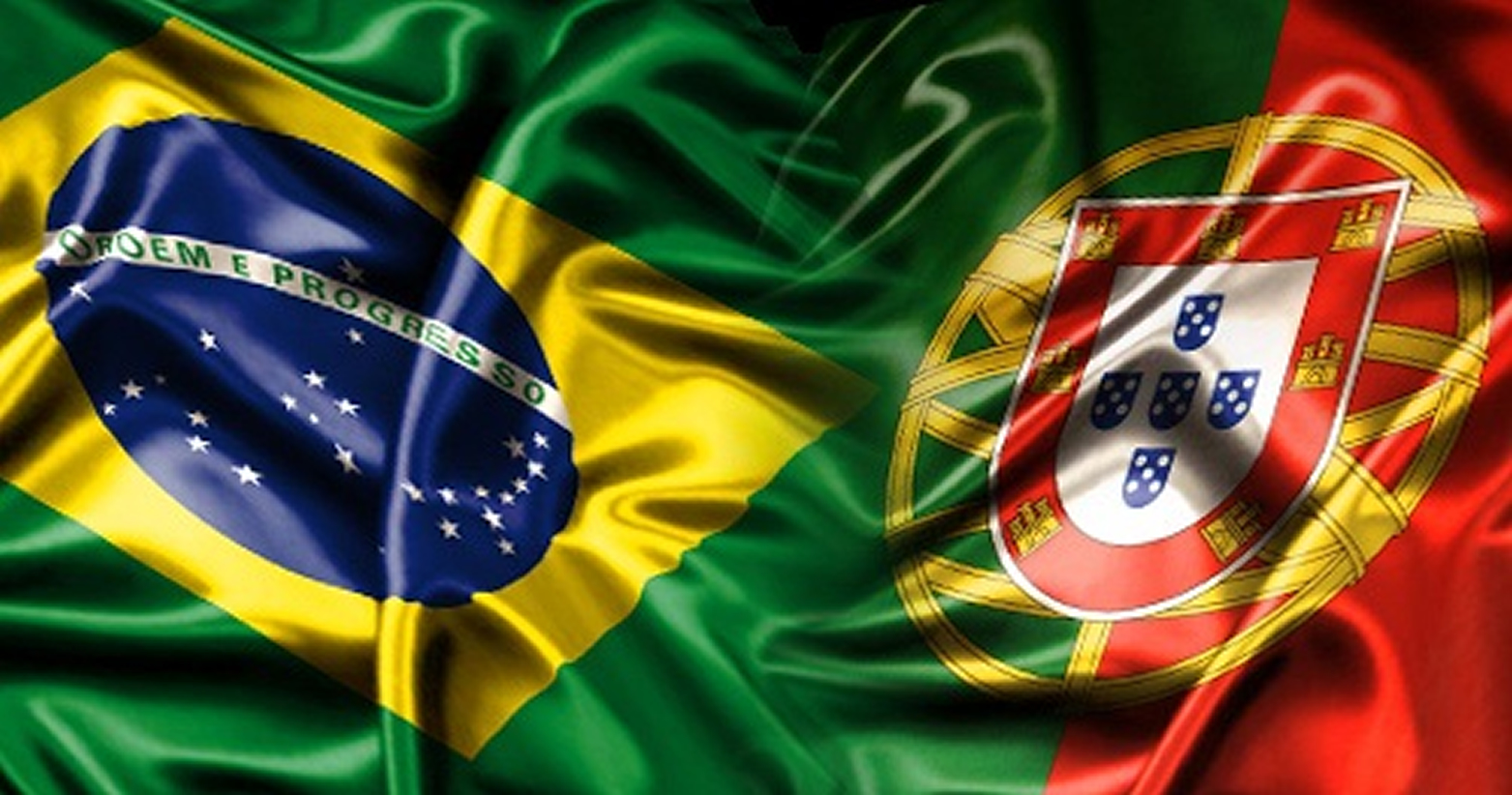
Turns out the Portuguese did more than just finance Columbus. They dominated maritime exploration in the 15th century, and that’s how little Portugal ended up with the enormous colony of Brazil. After a week of research, I now understand the root of all of Brazil’s problems. Portugal.
Everything is Portugal’s fault.
Let’s take education. Brazil does not have a single university in anybody’s top 100 Schools in World list. I recently read an article that could be summed up as “Brazilian have started buying books!” I can’t remember that last time I went to the beach and saw someone reading a book and I’m at the beach almost every weekend. Which makes perfect sense in a country that had printing presses, books, and universities banned for the first 300 years of its existence.
Yes, Portugal controlled Brazil for 300 years before it allowed a university to be built or a printing press to operate. Put another way, book circulation was banned for a century longer than it’s been legal in Brazil. Thanks Portugal!
Do you think Brazil’s government is a quagmire of ineffective bureaucracy staffed by people who are allergic to work? When the Portuguese court fled Napoleon and established itself in Rio de Janeiro, it brought between 10,000 and 15,000 people. When John Adams moved the US government from Philadelphia to Washington D.C., he moved 1,000 employees. And all those 10,000 people who came with the court expected a stipend from the government. Today, public pensions are currently bankrupting Brazil. Thanks Portugal!
Brazil is currently hosting a global event. No, not the Olympics. I’m talking about the largest corruption scheme in the history of democracy, the Lava Jato case in which federal politicians awarded contracts and got kickbacks to the tune of billions of dollars.
It’s actually totally understandable that Congressmen and their friends all expected rewards. When Prince Regent João showed up in Rio, the crown was flat broke, so he just started selling titles to wealthy Brazilian merchants. Prince João gave out more titles in eight years than his ancestors had in the previous three centuries. You get to be a Baron! And you get to be a Baron! And you get to be a Baron! (This is assuming you’d like to make a donation to the Court, of course.) Those of us at the top have to get each others’ backs, amiright? It’s Brazilian tradition. Thanks, Portugal!
I’ve wondered since arriving back in 2006 why the fifth largest country in the world in terms of land area seems to use two lanes roads almost exclusively. Why? Why am I sharing a single lane between states with all the 18-wheeled trucks? Because it was illegal to build roads between states until after João and his court arrived in 1808, 300 years after the Portuguese took control of the territory. And factories weren’t allowed. So no industrialization. Which means no trains. Thanks, Portugal!
I’ve learned all this from 1808 The Flight of the Emperor by Laurentino Gomes. It’s an engrossing telling of an unbelievable true story. One of the most striking accounts of colonial Brazil was from a woman, Maria Graham, arriving in Brazil for the first time. As her ship sailed up, she gushed over the picturesque city of Salvador with it’s beautiful white homes and striking setting on a cliffside. She called it “a city, magnificent in appearance from the sea.” Her opinion changed dramatically once walking the streets of the city. She describes Salvador as no less than “the filthiest place I ever was in.”
19th century Salvador by Joseph Alfred Martinet
While I did not consider Rio anywhere close to the filthiest place I’ve ever been (I lived in a coed dorm in college), I did go through the exact same swing in emotions when first arriving in Brazil. Looking out the plane window, I was in awe of Rio’s beauty. Then I left the airport. The view out the car window was…disappointing in comparison.
Two hundred years separates Graham’s arrival and mine, yet our reactions were nearly identical. Culture is a powerful yet often unconscious shaper of our behavior. I have a university degree in this. I shouldn’t need a reminder, but this book was just that. Now, I understand. The next time I have to argue about whether the phrase “copy of your passport” means just the information page or all pages in the book, or I bounce along a road filled with potholes but with wifi coverage, or I read about another politician who’s been suspended due to a corruption scandal, I’m not blaming Brazil. I’m blaming Portugal.
Because it’s all Portugal’s fault (#blameportugal). And they didn’t even leave a legacy of good wine. Thanks a lot, Portugal.
I’m sure you heard about the impeachment vote even if you live outside of Brazil and aren’t following international politics. You might also have seen a headline about a corruption scandal in Brazil involving billions of dollars in public funds. Maybe you’ve read something about Brazil’s collapsing economy. The country’s gotten a lot of headlines in the last few months and a person could understandably be wondering, “What the hell is going on in Brazil?”
Here’s what’s going on in Brazil with enough context to paint a painfully vivid picture and enough jokes to make it palatable. To understand the extent of the seething rage under Brazilians’ normally chill exteriors, I need to jump back in time three decades.
Brazil is a relatively young democracy. The army seized control in 1964 and stayed in power until the mid-80s. The generals perfectly followed every page of the Military-Dictator Handbook, repressing speech, organizing, and all social rights. By 1980 student, workers, and militants were pushing back, and that year there were massive strikes organized, among others, by a young Luiz Inácio Lula da Silva aka Lula. Remember him. He’ll show up again. And again. And again until it becomes painfully ironic.
The strikes and protests helped lead to a “redemocratization” and a new constitution was adopted on October 5, 1988, making Brazil’s current government younger than I am.
The National Congress in Brasilia, currently hosting many future inmates.
The Constitution divided the Federal Government into three parts just like in the US: Legislative, Executive, and Judicial. Differently than the US, both the Executive branch and the Federal Government in general are much more powerful than in the US. Don’t be fooled by the constant use of flip-flops and nicknames in Brazil. The country is extremely hierarchical. It’s a cultural legacy brought to Brazil by Portugal’s policy of ruling colonies by refusing to build universities or even roads in order to keep people in total subjugation.
The current constitution reflects this deeply embedded hierarchy by giving certain powers and privileges to members of the federal government. For example, members of Congress, cabinet ministers, and the President can only be investigated and tried by the Supreme Court. Currently 303 members of Congress are facing criminal charges or under investigation, so the Justices must be pretty busy. At least the President of the Supreme Court gets the perk of being fifth in line to assume the presidency in the event of a political disaster.
Speaking of which, Dilma’s impeachment is actually the second impeachment of Brazil’s young republic. They impeached the guy back in ’92, but given the awful state of Brazil’s economy then, a presidential impeachment probably barely made the front page. The economic situation in Brazil throughout the 80s and early 90s was terrible. Like invest in precious metals because the country is on its third currency bad. The inflation rates looked more like typos than real data. People ran to the grocery store on payday snatching items off the shelves before the clerk could put a new price sticker on it.
During these turbulent early years of the republic, the Worker’s Party, (known as PT) which got started during the strikes in 1980, was the leader of the opposition coalition in Brazil.
Embracing its roots as the voice of the working classes, PT fought against the deeply entrenched economic elite and policies that facilitated a huge wealth gap. Lula ran for president as the PT candidate four times before finally winning in 2002. You only fail when you quit, right? At this point the economy had stabilized. Lula initiated some social welfare programs that lifted millions out of poverty. China began buying everything that Brazil could produce. The economy took off. By 2006 developed countries were like “Hey Brazil, when did you guys show up to the party? We gave your chair to India a few years ago, but we can ask for it back.”
An Economist cover from 2009
For the first time in 20 years, Brazil had a growing economy and stable government. In 2011 Brazil passed the United Kingdom to become the 6th largest economy in the world. Brazilians were pumped, proud, and ready to finally take their place as a global power.
All this history is to give you some idea of the soul-crushing societal let down that happened when the shit hit the fan in 2014.
From a growth rate of 7.5% in 2010, Brazil’s economy shrank 3.8% in 2015. Today, Brazil is the 9th largest economy behind Italy, which has a fraction of the people and arable land. Unemployment is 8.2% and inflation is 9.4%, compared the government’s target rate of 4.5%. All those numbers are just to say that the country’s in its second year of recession and people are pissed.
At the same time that Brazil’s economy was headed down the toilet, the largest corruption scandal in any democratic country ever was uncovered. Now is the time for popcorn because this story makes House of Cards seem small time and easy to follow.
Back in the 90s, there was a humble money launderer who made a decent living hiding illegal income of politicians. He was arrested, convicted, served his time, and released. By the mid 00s, federal police noticed he was back in business. Apparently in Brazil, money launderers are like great Mexican restaurants. They’re rare and if you find one, you keep going back even if you know deep down it’s probably being investigated by public authorities.
From 2004-2014 political leaders through the state owned oil company, Petrobras, awarded contracts to companies that grossly overcharged the government, and the companies used some of that excess payment to say “thank you” to congressmen and party leaders for awarding them the contracts in the first place. Nothing shows appreciation like a stack of cold hard cash.
And what party was in control of Congress and the Executive at this time? PT and its coalition partners. The Worker’s Party. The party that built it’s reputation on fighting for working class citizens against the privileged elite was the driving force behind the largest theft of taxpayer’s money in the history of democracy. (I told you Lula’s story got ironic.)
Foto Oficial Presidenta Dilma Rousseff. Foto: Roberto Stuckert Filho.
PT is also President Dilma’s party.
Back in 2015 when the investigation really took off, Dilma had NOT been implicated in the investigation. Everyone around was. PT’s treasurer is currently in jail. Lula’s former chief of staff is there too. Lula himself was under investigation. But not Dilma.
She didn’t have a clue Petrobras was overpaying by billions of dollars and was the worst chairperson in history.
All possibilities made Dilma look bad. Her approval rating plummeted to 13% only 3 months after her second inauguration in 2015.
And a cover from 2015
So to recap, by July of 2015 Brazil was grappling with shattered expectations, a terrible economy, an epic corruption scandal, and a universally disliked president. The Brazilian people were understandably furious at the government for blowing the country’s best chance in a century to really improve quality of life and become a global player.
However, none of these things is grounds for impeachment. According to the Constitution, a president can only be impeached for committing a crime while in office.
So how did Dilma end up getting impeached? We’re stepping into the political muck now. Put your boots on.
October 7, 2015 The Federal Accounting Tribunal files for impeachment accused Dilma of fiscal pedaling in 2014. They claim Dilma forced the state controlled bank to make social programs payments from the bank’s own funds because the government was short on money and her administration was trying to hide that fact during an election year. Technically, the federal government cannot payoff its own debts with the bank’s funds, but it’s been done by every president. It’s very shaky legal ground, like a frozen pond in spring during an earthquake shaky.
December 17, 2015 The Supreme Court defines the impeachment process because the Chamber of Deputies can’t get its act together and form a commission of 65 deputies to consider the charges with any semblance of openness and fairness. The Court rejects two commissions formed by the Chamber, and the proceedings are paused indefinitely.
March 11 In a jaw-dropping move, prosecutors ask for preventive detention for Lula. Lula supporters clashed with police when he was being taken for questioning. There is no doubt an actual arrest would spark violence.
March 14 In what has to be the most blatant middle-finger giving from a democratically elected president, President Dilma doubles down and starts discussing appointing Lula for a cabinet position! F.U. anti-government protestors! Dilma wants to make Lula Ministro de Casa Civil, the chief administrator for the Executive and the most powerful person after the president. Oh, and remember that members of the federal government can only be investigated by the Supreme Court, so the case against Lula would be moved away from the prosecutors currently investigating him. But it’s for the good of Brazil, guys!
March 15 Plea-deal testimony from Senator Delcídio do Amaral, the head of PT in the senate, is released and he testifies that Dilma’s Education Minister offered him a bribe in exchange for not working with prosecutors. He also says that President Dilma knew all about the corruption happening at Petrobras during her time as chairwoman. I can finally fill in my Dilma square on my Lava Jato Bingo card!
How convenient for future casting directors that Moro is an attractive man in real life.
March 16 Judge Sergio Moro, in charge of the Lava Jato case, releases a recording of a call between President Dilma and Lula revealing 1) that prosecutors had tapped a former president’s phone! and 2) Dilma seems to be appointing Lula only to keep him out of jail. While everyone freaked out over the phone call, a few did question if Judge Moro should have given up completely on judicial impartiality and released recordings in an ongoing investigation from a tap with a just-expired warrant.
March 17 Lula is sworn in as Minister. A new impeachment commission is sworn in. Basically, a lot of swearing happened in Brazil this day.
March 18 Supreme Court Justice Gilmar Mendes suspends Lula’s appointment on the grounds it was a blatant attempt to keep him from going to jail. Justice Mendes said it with more legal jargon but that was the gist of his decision. Also, large protests happen across Brazil against impeachment.
Can we say “future political career”?
March 22 The Supreme Court removes Judge Moro from Lula’s case to review his decision to release the recorded conversation. The Supreme Court will now oversee the investigation against Lula. Oh well, he can console himself with the fact people are wearing his face on t-shirts.
March 29 PMDB, the largest party in PT’s coalition, drops out and pledges to support Dilma’s impeachment. PMDB is also the party of Vice President Michel Temer, so things got super awkward at the Presidential Palace.
April 11 The Commission to the consider Dilma’s impeachment votes 38-27 in favor of impeachment. The question will now be to a vote by the Full House of Deputies. Fun Fact: Of the 65 members on the Impeachment Commission, 37 are facing criminal charges themselves. I think the vote concluded with a Deputy ironically shouting “If we burn, you burn with us!”
April 13 President Dilma publicly accuses Vice President Temer of conspiring against her.
April 17 The House of Deputies votes 367 – 137 in favor of impeachment, more than securing the two-thirds majority needed to pass.
And that brings us to today. The Senate has until May 11 to vote on the issue and simple majority is enough to suspend Dilma and start a trial.
A lot of people celebrated after the impeachment, but despite the anger and disappointment with Dilma’s administration support for impeachment is at 61%. A majority but not the super majority you might expect given Dilma’s 10% approval rating.
Ideally, the only question would be “Did Dilma commit a crime by using state bank funds to make government payments?” and a trial in the Senate would answer that question. Of course, nothing happening in Brazil at the moment is ideal except maybe for vendors of inflatable Lula dolls in prison stripes.
The reason many people have no faith in the current government but don’t support impeachment is because everyone else in line to be president is way WORSE than Dilma. Let’s go through the line of succession.
Temer during the impeachment vote. He seems very cheerful. He’d probably manage to stay positive while stabbing you in the back.
Third in line for president is the Senate leader, Renan Calheiros, who is also under investigation for corruption. Among the seven charges the Supreme Court is considering against him are accepting $600,000 to stop a Senate probe into the Lava Jato case and receiving $1.7 million in bribes for a drilling contract.
I think there’s one maid working at the Presidential Palace who isn’t likely to be in jail within the year. Maybe they could offer her the job?
Brazilians are facing a very tough choice in deciding between pro and anti impeachment. Did President Dilma commit a crime worthy of losing office and even if she did…do we give power to lying, hypocritical assholes? Who do you pick when everyone is a criminal?
Some commentators say Brazilians are being duped by a media controlled by that historically entrenched elite. They argue leaders pushing for impeachment are far more corrupt and will hault the Lava Jato once back in power. While it’s true the media here is extremely conservative both politically and socially, I think it’s a pretty patronizing view of the Brazilian people to think more than 60% of the country has been fooled by a handful of smarmy, rich guys. First, Dilma’s government did engage in some shady accounting and as for the Lava Jato case, she’s either guilty or incredibly incompetent. Nobody’s impeaching a saint. Second, from what I personally have seen and read from those in favor of impeachment believe removing Dilma is only the first step, not the last, in rooting out corruption in the government.
Still, it seems unlikely Congress is going to keep impeaching presidents until they get to the President of the Supreme Court, so removing Dilma just puts someone as guilty but more conservative in power who’s likely to stay there. For those against the impeachment, there’s nothing but a line of criminally indicted men from the economic elite pushing Dilma off a cliff. And she’s not even being impeached due to corruption. She’s being impeached for dubious accounting and to those against impeachment, it’s a purely political move.
Enough corruption!
One thing is absolutely clear, no one in Brasilia is removing themselves power. The only thing they all agree on is that they did nothing wrong. If this were Japan, a third of Congress would have committed suicide by now, but alas we’re in Brazil and once elected to office a person becomes immune to shame. They used to be immune from consequences too, but that seems to be finally changing. That’s one thing, at least, Brazilians can be proud of.
There’s a famous comedy sketch in Brazil that features a home invasion with the owner held at gunpoint. The masked assailant aims at the owner and barks “Name the major tributaries on the left bank of the Amazon River!” The owner rattles off several rivers in rapid succession. The bad guy immediately lowers his gun and leaves taking nothing. The homeowner stands, exhales and says “I knew that information would be useful some day.”
Every country has its own “tributaries of the Amazon”. I had all fifty US state capitols memorized for most of fourth grade then never again. Why would I retain the capital of Wyoming? The world’s a big place and geography is only one of many subjects to master. With a background in international relations, I know where Brunei is but nothing about computer coding. That’s why I won’t judge someone for not being able to place Sri Lanka or name the capital of Azerbaijan, unless that person is on the Senate Foreign Relations committee.
But Brazil is not Sri Lanka.
Brazil is not a tiny country with a tiny population and a tiny economy. It’s a huge country with a massive economy but still nobody in the US knows anything about it. The average American knows people speak Arabic in Tunisia and Spanish in Argentina, but ask her about Brazil and she hesitates. People generally know India is important in the global economy but what does Brazil produces exactly? Mention Guatemala, Korea, or Sweden and most Americans will imagine someone with a particular phenotype. What do you think of when you hear “Brazilian”?
Several years ago, I was visiting my parents in Atlanta and I read an article in the neighborhood newsletter about a recent mugging in the area. The victim gave a helpful warning to other residents to be on the lookout for someone who looked “Brazilian”. Whaaaat?!!! The only less helpful description would be to describe that attacker as a Homo sapien.
The most upsetting fact was that my parents live in a highly educated neighborhood and still “Brazilian” was published as a helpful description of a person. Even these people wallpapering in college diplomas didn’t know the most basic things about Brazil, like the fact a Brazilian can have ancestry from anywhere.
I’ll admit a pro-Brazil bias given that my husband and daughter are both Brazilian, but knowing what I do now, I’m embarrassed by my pre-husband ignorance of Brazil. I’d like to spare others my embarrassment, so here are five basic facts every person should know about Brazil.
Language Brazilians speak Portuguese! Brazil is the largest country in South America and the official language is Portuguese, not Spanish.
Capital City The capital is Brasilia. The largest city in terms of population and economy is São Paulo. Rio de Janeiro was the capital from 1763 until 1960, which is why it’s the most frequently given wrong answer to the capital of Brazil question.
Type of Government Brazil is a democracy and it’s not just a part of the country’s name that is never actually lived up to. Brazil transitioned to a constitutional democracy in 1988 after 30 years of a military dictatorship. Brazil stabilized and entrenched the new constitution in less than a decade, which is amazing considering it takes that long to get a pothole fixed here. Currently President Dilma’s approval rating is 8% and people are demanding an impeachment. Not a revolution. Not a military invasion of the President’s mansion. Literally the entire country despises the current government, but the people want to work within the rule of law. Bravo Brazil! You guys can express your absolute and unified hatred of the current government within the confines of the constitution. Well done!
Economy Really, really terrible at the moment. So, uh, let’s just talk about exports. What does Brazil produce? The top five exports are iron ore, crude petroleum, soy beans, raw sugar, and…any guesses? Poultry. Nobody, not even my Brazilian high school students, ever guesses chickens.
Fun Fact To Impress Friends Brazil has been a colony, a monarchy, a dictatorship, a military dictatorship, and a republic. Name a type of government and Brazil has tried it. The country celebrates two independence days. The first on September 7 celebrates independence from Portugal and the second is on November 15 when Brazil transitioned from monarchy to republic in 1889.
I hope people’s general awareness about the country improves before we move out of Brazil and my daughter is expected to play the role of walking Wikipedia article on the country. What language do they speak is a really boring question to repeatedly answer.
After all, Brazil is not a tributary on the left bank of the Amazon or the capitol of Wyoming. It’s so much more important. But not many people know that.
Seriously Brazil, it’s 2015. Pay your help a living wage.
Dear reader, if you’re not in the mood for a rant, check back next week.
It all started when I received an early morning WhatsApp message from a fellow mom asking the group about rates for a substitute nanny while the permanent nanny is on vacation.
A little cultural context. Here in Brazil full-time nannies are common. This was surreal for me coming from the United States. In the U.S. full-time nannies are something only the Jolie-Pitt or Kardashian families can afford. I remember a combination of church daycares and grandparents after school and over the summers while my parents worked. Personally, I’ve never known anyone in the U.S. with a full-time nanny.
In Brazil, almost everyone I know has a full-time maid and many have a full-time nanny too. Often if the family has kids but can’t afford two employees, the maid will have childcare duties in addition to the housekeeping, grocery shopping, and cooking. Several of our friends also employ a weekend nanny because labor laws in Brazil don’t allow families to demand ask their nanny to work 7 days a week. It’s like Downton Abbey in flip-flops with more beer and better weather.
How can these middle class and professional families afford full time nannies and housekeepers in the year 2015? Minimum wage in Brazil for 2015 is $250 a month. (I’m using today’s exchange rate of 1 U.S. dollar to 3.15 Brazilian reais to put all values into US dollars.) U.S. federal minimum wage is $7.25 per hour, so assuming four 40-hour-weeks a month, the U.S. federal minimum wage per month is $1,160.
$1,160 versus $250 a month.
Now, a lower minimum wage doesn’t necessarily indicate a lower quality of life.
Maybe the cost of living is significantly lower in Brazil than the US? Maybe goods are less expensive? They’re not. The only things cheap in Brazil are coconuts and people, and even the coconuts are experiencing inflation.
Maybe there are a variety of free/very low-cost public services in Brazil? There aren’t. Public services from school to health care are abysmal. Everyone who can scrape together the cost goes private, and a full-time nanny at minimum wage is significantly cheaper than private day cares here in Vitoria.
But there’s no way people pay nannies minimum wage, right? In practice people are paying more than the legal minimum, aren’t they?
This brings us back to this morning’s Whatsapp conversation among local moms.
A mom wanted to know what other people had paid for someone to fill-in as a nanny for a month. The values reported ranged from $254 to $476 for the month. For two children. For the entire day, Monday through Friday.
But these shockingly low values are not what drove me to clutch at my hair and mutter obscenities at my computer. Nor was I upset that a family of four is looking for the highest quality childcare at the lowest possible cost.
I got upset after I sent a message saying that our kids’ pregnant preschool teacher was at the doctor again due to pain from her sciatic nerve. I commented about how what she really needed as a present was a housekeeper. My message got no response. The conversation continued about nannies until finally the original poster asked, “Did your nannies just take care of the kids or did they also clean their rooms and do laundry?” This sparked the rant.
Dear Brazilian Middle and Upper Classes, nannies are people! Housekeepers are people! Preschool teachers and assistants are people!
There are so many wonderful things about Brazilian culture, like the attitude toward children, the judicial selection process, and dental hygiene. But the way upper classes treat people in the working class is NOT one of those things. I’m so tired of listening to good, ethical people, friends, colleagues and parents I respect, refer to their nannies or maids as “them”. I’ve heard complaints about how much the maid eats, stories about getting older kids to spy on the maid and report back, and indignation about a nanny who went and got married. The underlying message is that “we” must be vigilant against “them” or they will use up our sugar and make a lot of long distance phone calls.
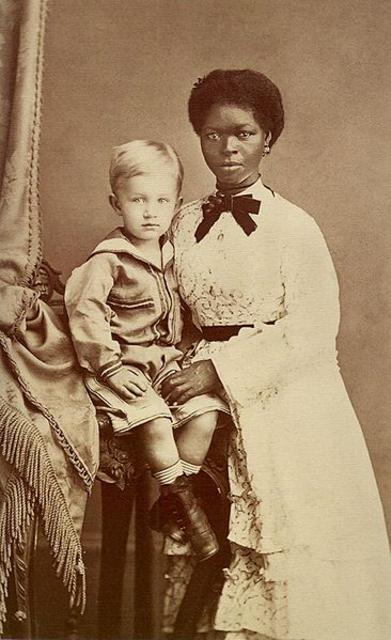
When I saw the movie The Help, I thought, “Wow, that’s like present day Brazil”. That’s what I see here. Upper-classes in Brazil often deny the basic humanity of the people working in their homes. (And to Brazilians who protest that Brazil doesn’t have The Help‘s racial component, I recommend a walk around Ipanema in the afternoon or a visit to a private daycare in Vitoria. Look at the color of the kids and look at the color of the people holding their hands.)
I believe for most people it’s unconscious. It’s how their own parents and everyone in their circle has always talked about nannies and housekeepers and drivers. They’ve internalized this division, don’t see anything wrong with it, and haven’t been challenged on it.
I’m not against paying for a housekeeper. We employ one. I’m not against paying for a nanny. I believe affordable child care is a HUGE barrier keeping women from advancing in the workforce in the U.S. and Brazil. I’m writing this while my kid is at daycare. Many of the mom’s I know are amazing professionals, and it’s only possible because they can find childcare be it a daycare or nanny. Many moms want to work. Many moms HAVE to work. Quality childcare is a necessity.
I’m against a system that keeps people from empathizing. That makes it “us” versus “them”. That causes a really nice person to ask the woman she’s paying almost minimum wage to watch her kids if she could also do the laundry.
What about the kids of the people we pay to watch our kids? Who watches them if we pay their moms $300 a month? Is it ethical to ask a woman willing to assume the enormous task of keeping two small children alive for only $350/month to also do the laundry? Is this woman really in a position to say “no”? Are we going to be annoyed if she does? If we’re paying minimal costs, why do we expect top-quality service and undying loyalty?
Beyond respecting and talking to each other as people as opposed to being constantly on guard against the machinations of “those” others who want to exploit us…I have an idea for improving things for the moms, maids, and childcare workers.
Everyone gets rid of their housekeeper.
We take the money we were paying to housekeepers and put it toward childcare, either by increasing the wage of the nanny or increasing the salary of daycare and preschool teachers. The former housekeepers come together and start cleaning-service businesses. Their former employers, now clients, hire the company for once or twice a week, and now the preschool teachers and nannies may even be able to afford the housekeepers’ services with their increases in salary. The former housekeepers can also find employment at all the new public daycares the government will open in my utopia.
And what about all the cooking and laundry and grocery shopping left in the wake of the maids? Well, I think it’s time for Brazilian men to stop watching soccer and do some freakin’ laundry.
5 of the many things that have surprised me about Brazil…
“Do you like Brazil?” I heard this question for the thousandth time last night. I don’t know why people bother to ask this question. It’s in the same category as “Does this make me look fat?” and “Did you read my last blog post?” Nobody wants an honest answer. “Do you like Brazil?” The correct response is an enthusiastic “Yes!”
At least this question has an obvious correct answer, unlike “So which country do you like better? The US or Brazil?” What am I supposed to say? I usually cop out with humor. “Neither. I’m giving up on the whole nation-state system. I’d like to start my own island tribe based on handedness.”
Another strategy I’ve developed over the years is to answer these politically loaded questions with lists: “Things I love about Brazil” or “Things I miss about the US”. Below is my favorite list. I like it because it’s personal but more unusual than the standard “Things I love about Brazil.”
Five Things That Surprised Me About Brazil
1) Stellar Dental Hygiene Brazilians are obsessed with their teeth. If you go into a restroom after lunch, there will be a wall of people between you and the sink, all of them flossing their teeth. Helpfully, many public restrooms have floss dispensers to facilitate this habit. You should brush your teeth after every meal and ideally after every snack. As an after-breakfast-and-before-bed brusher, I have the most disgusting teeth in all of Brazil. Fortunately, my husband accepts me for who I am and ascribes my poor dental hygiene and once-a-day-showering to my Anglo-Saxon ancestors’ affinity for filth. Although thanks to him, I have grudgingly become a daily flosser.
2) Your Fingers Must Never Touch Your Food When I learned that many Brazilians use a fork to eat french fries, I almost moved back to the US. Brazilians use a knife and fork for EVERYTHING! Your fingers must never touch your food. As my people created a category just for “finger foods”, this is not a custom that I’m particularly comfortable with or always able to keep in mind. I’ll be at a birthday party happily popping mini-pizzas in my mouth, when I notice everyone else at the table has a napkin delicately wrapped around their snack, creating a polite barrier between fingers and food. After 9 years, I still can’t muster that level of formality for something that came frozen out of a box. (Honestly between the finger eating and lack of teeth brushing, I’m surprised my husband agrees to go out with me.)
3) Japanese-Brazilians My initial thought when I saw my husband for the first time was “Hey, he’s white!” True story. Pretty romantic, huh? Before my husband, the only Brazilian I was aware of was Pelé, thus my unconscious assumption about how Brazilians look. I wasn’t totally wrong. According to the 2010 census, 50.7% of Brazilians do consider themselves black or mixed-race. But in addition to the 4.8 million people brought as slaves from Africa and the indigenous tribes who were already here, Brazil has had substantial immigration from Portugal, Italy, Japan, Lebanon, and Germany to name a few countries. With a history of intermarriage between the groups, Brazilians cover the entire range of possible human phenotypes.
4) Brazilians Love Volleyball! Everyone else in the world besides Americans might already know this. Probably the world loves indoor volleyball, and it’s only us Americans who are in the dark. Literally. We’d rather just sit in the dark than watch a volleyball game. But not Brazilians! If there’s no soccer game, the sports channels are covering a volleyball match. They have incredibly popular professional leagues here, and if you stay in Brazil long enough, you will find yourself at a bar with a women’s club volleyball game on the TV. Or judo. Judo is also very popular in Brazil.
5) Did You Already Add Salt? This is a question most Brazilians won’t ask because they’re going to go ahead add more salt regardless. Meal after meal, I see Brazilians get food placed in front of them and without even tasting it, they reach for the salt packets, rip one open, and rain salt down on the entire plate. Very shortly after arriving, my husband made sure to treat me to one of Brazil’s traditional meals imported from Portugal, bacalhau or codfish. Imagine a salt lick served with potatoes and onions. That’s bacalhau. I couldn’t eat it. The same was true for feijoada, a uniquely Brazilian dish involving black beans, all the leftover pieces of pig, and a few ice cream scoops of salt. Not surprisingly, Brazil has a hypertension epidemic.
Those were some of the most surprising truths I learned about Brazil. I’d come up with more, but I just ate a pretzel and must go floss my teeth.

 One reason I love writing historical fiction is the chance to discover real people I’d swear were fabricated in someone’s imagination. King João VI of Portugal is one of these people. The man was born to be the comedic relief in someone else’s story. Sure, he was also born into royalty, but he seemed so much more suited for getting laughs than governing.
 But the truly shocking and grand achievement of Dom João was surviving. When monarchs all over Europe were getting deposed at best and beheaded at worst, Dom João, the peaceful dullard, kept his crown, and he did it by being the only European monarch in history to move the capitol of his kingdom to a different continent. This man, who hated change so much his servants had to repair holes in his pants while he slept, moved the capital of Portugal from Lisbon to Rio de Janeiro.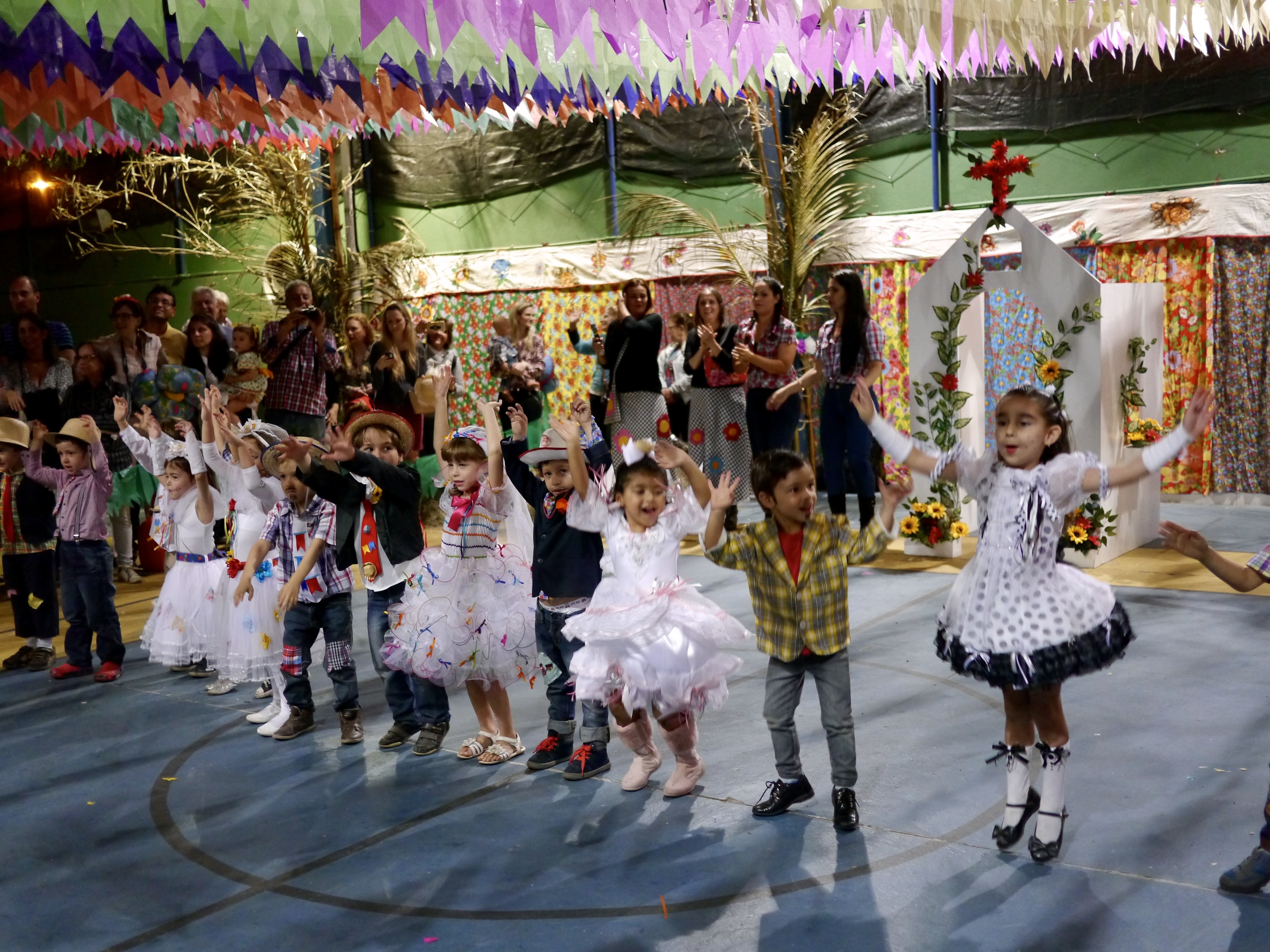
 We were walking the streets of Rio de Janeiro yesterday when my daughter piped up “Hey, it’s Festa Junina!” I shook my head and tolld her Festa Junina was last month. She insisted and pointed to a street vendor whose stall was decorated with primary colored flags and a stereo blaring forro music. My kid was right. This vendor was still celebrating Festa Junina. My husband, a native of Rio, explained it this way. “Whatever the party, it always lasts a month longer in Rio.”

 While many places in Brazil celebrate Festa Junina on the night of June 23 with an official holiday on the 24th, in the Southeast where I’ve lived, Festa Junina parties happen any Friday or Saturday during the month of June. Or if you’re a university club in Rio, every Friday and Saturday in June.
 There are fireworks, dancing, carnival games, straw hats and painted freckles (girls) or a painted moustache (boys), and usually at least one mock wedding. I haven’t read exactly how the mock weddings became a staple of Festa Junina parties, but I have a theory. Saint Anthony is considered the patron saint of marriage because he helps single women get husbands so many offerings and prayers are sent to Saint Anthony on his day, June 13. In addition to June being a time when marriage is on the brain, bringing the corn harvest to market was one of the few times people in rural areas got to meet someone they weren’t related to. Oh, and how convenient to have your wedding at the same time as the already scheduled festival! You can save tons on catering! Thus Festa Junina became a day of many weddings.
 At my daughter’s school, it’s always Year 4 that stages a mass mock wedding, and this year it was finally her turn. That meant her Festa Junina costume was a wedding dress with a veil, and she LOVED it. It also meant extra time on stage because in addition to the mock wedding, all grade levels perform a quadrilha, a traditional dance done during Festa Junina but with preschoolers is really just a lot of jumping and arm waving.
 In my personal opinion, the best part about Festa Junina is the food, but I feel that way about all carnivals and festivals. Any event that has portable grills and homemade sweets being set up on folding tables arranged around ring toss and fishing games is something I’d be delighted to attend.



 At the summer games this year in Rio de Janeiro, fans of 41 different sports will have a chance to watch competition between the best athletes in their sport. The world’s best judokas, golfers, divers, bmx cyclists, track cyclists, mountain cyclists (I had no idea there were so many different ways to cycle), trampoline jumpers, and fencers will be here in Brazil competing for gold. To be completely honest, I’m not sure what the modern pentathloners will be doing exactly, but I’m sure it’s something that I cannot.
 Portuguese and later Brazilian officials were so frightened by capoeira they outlawed any and everything related to the game. People were arrested for playing capoeira instruments, wearing the colored belts and white pants, or just whistling a capoeira song. Finally, in the 1930’s Mestre Bimba from Salvador convinced the government that capoeira was both an important cultural legacy for Brazil and (because governments respond well to financial incentives) a tourist draw. In 1937, he was allowed to open the first public and officially sanctioned capoeira school in Brazil.
 While the styles vary in speed and types of movement, both keep the same format and traditions for practicing. Capoeira is always played inside a circle of musicians, singers, other players, and spectators. The music of capoeira is performed on five instruments: berimbau, pandeiro, atabaque, agogô, and reco-reco. The musicians and singer perform continuously as players tag in and out of the circle. One more important fact! Players never actually strike each other while playing. They feint and dodge and kick, but they never land a blow. That’s why the verb “play” is used for capoeira. They’re playing, not fighting.

 There’s so much bad news coming out of Brazil lately. The economy is still in tatters. The president is impeached. The interim president is according to most sources a mysogynist, corrupt pig. (And those are the nice names people are using for him.) Any waterbased Olympic events will require the athletes to wear hazmat suits. Zika.


 I’m currently obsessed with an idea for a historical fiction novel and have spent the last week devouring books on colonial Brazil. (I know you’re jealous.) It’s been fascinating reading actually because it’s all entirely new history for me. It wasn’t until World History in high school that I even knew humans existed outside of Europe, and by “Europe” I mean Italy, France, and Britain with a brief stop in Germany for the Reformation. Any ideas I have about Portugal or South America I learned from Columbus Day themed picture books and Disney’s Emperor’s New Groove.
 A week ago,