Tag: Brazilian Food

  • Toxic Pineapples

    Toxic Pineapples

    As a nerd and compulsive reader, I’ve always been a fan of knowledge. When choosing to know something or not, I choose know it. I’m reevaluating that stance.

    Not on everything. I still want to know how to drive a car, operate a gas stove without killing myself, and long division. What I don’t want to know is the history of my food. I’m done hearing about the nauseating conditions of pig farms, toxic levels of mercury in my sushi, and exactly what is inside my hot dog.

    I love hot dogs! They’re mouthwatering. They taste like summer, baseball games, and a Saturday afternoon spent grilling out back. Hot dog haters, have you ever tasted a dog fresh off the grill, sizzling with the skin wrinkled and striped black, smothered in ketchup, mustard, and relish? No, I doubt it because if you had you’d never want to know anything about it except how savory the first bite is. You would not want hot dogs ruined by knowing exactly what parts of the pig are in them.

    I’ve accepted that I’m going to die eventually. Nothing I do will grant me everlasting life. Because something has to get me in the end, I’m totally ok with it being too many french fries, fungus laden peanuts, or toxic pineapples.

    The peanut fungus came up in a discussion with a doctor recently. I mentioned a love of peanuts and his brow creased. He asked in what quantity I ate them? Vast quantities. He frowned. Uh-oh.

    Turns out Brazilian peanuts are prone to a fungus that will eat and destroy your liver. Or something to that effect. He was speaking in Portuguese but I could understand something bad enough happens to your liver that he does not eat Brazilian peanuts.

    Thankfully, American peanuts do not have this problem, which means my hoard of Whole Foods Peanut Butter is safe.

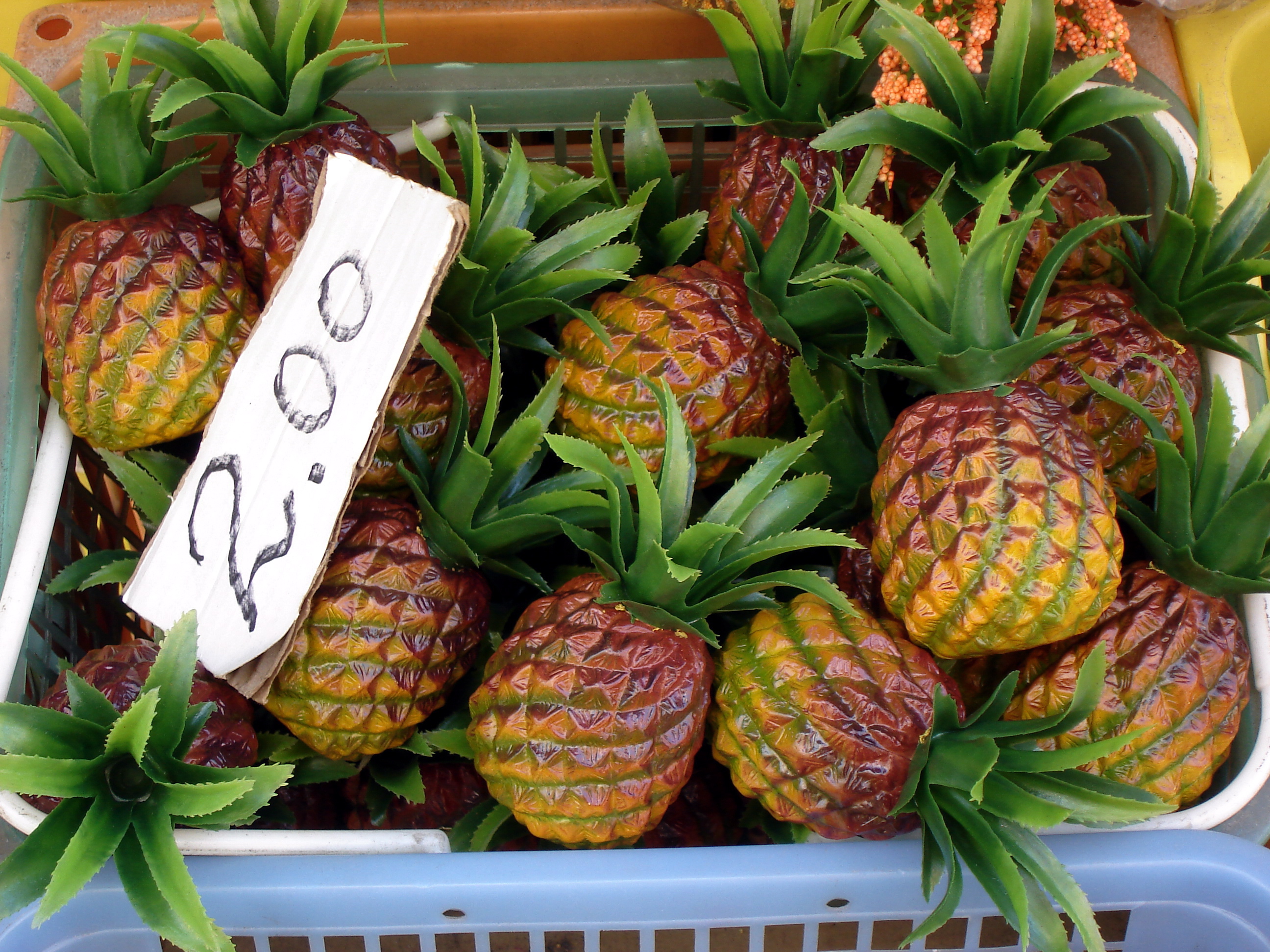
    Jumping on the band wagon of ruining foods Brynn loves, my husband started talking about pineapples. Sliced pineapple is the single greatest frozen yogurt topping. Period. I listened with growing horror as my husband told about a lawyer who works with the local farmers in our state. This lawyer learned the farmers get pineapples to ripen out of season by dousing them with pesticides.

    Wonderful. How can you buy local, when your local farmers coat your fruit in poison, not to keep the bugs off, but for the chemical reaction it produces in the fruit?

    My husband says pineapples should be ok in season. Should be but maybe not. Maybe some farmer wanted to get his pineapples to market first, so he sped things up with a little chemical enhancement.

    This is why I want to remain ignorant about my food. I’m going to go to the gym regularly, drink lots of water, eat sweets in moderation and live as long as that lifestyle lets me. That lifestyle will include hot dogs, peanuts and pineapples and I’m going to savor them in forced ignorant bliss.

  • Behind the Scenes at Garoto Candy Factory

    Behind the Scenes at Garoto Candy Factory

    It’s not been a good week for healthy or even reasonable eating. My multi-helping Thanksgiving dinner was followed by a birthday dinner that consisted solely of red wine, red meat, and chocolate petit gateau. Topping the decadence of a rare filet wrapped in presunto is difficult but if you want to try, I suggest visiting a chocolate factory.

    Today, we visited the Garoto Chocolate Factory, the fourth and final thing to do when visiting Vitoria. Garoto is the brand of chocolate here in Brazil and while technically owned by Nestle nowadays, Garoto chocolates are 100% Brazilian.

    A factory whirring and buzzing away is one of the purest examples of human ingenuity. I was frequently hypnotized by the rhythmic filling and flipping of candy trays to the point I became completely unaware the guide was speaking. The production line is amazing. Each machine is perfectly timed, measured, programmed, and maintained. Here’s the process for one single candy, the famous (to anyone who has spent a month in Brazil) Serenata de Amor.

    Serenatas are chocolate coated balls, with crispy wafer shells surrounding a hazel nut creme filling. They are the overwhelming favorite among Garotos candies.

    First on the conveyor belt are the shells in long sheets. The shells arrive on the conveyor concave. They are flipped on a ferris wheel contraption before passing through a humidifier. They are rehydrated by 5% and I would love to know how long it took to determine 5% provided the optimum crunch.

    After their trip through the sauna, the shells are filled. Tubes running across the ceiling, labeled “clear filling”, squirt the filling into each half shell before sending the sheets down the conveyor to be pressed together. The now complete balls, still together in sheets, roll through a refrigerator to cool the filling. Then they’re cut into individual balls of yumminess.

    Finally, it’s time for the chocolate.

    We followed the conveyor belt into another room and the smell alone was enough to satisfy any chocoholics craving for months. The shells pass first through a cascade of dark chocolate, are cooled and then are drenched in milk chocolate. They are sorted and distributed along the conveyor belt to four different wrapping machines. I have no idea how these machines work. Candy went in naked and came out with neatly twisted wrapper. It happened too fast for the human eye.

    Just how fast? Depending on the setting, the machine can wrap between 850 to 1200 pieces in a minute. And there are four of these machines wrapping 24 hours a day. In a single day this factory produces 3.5 tons of Serenata de Amors.

    Of course the tasting stations along the way were gluttonous and generous enough to put you off chocolate until Easter (which the factory is already producing for), but it was seeing the production, spinning and whirring, perfectly timed that I enjoyed the most. The engineering on display gives me faith in humanity. If we can build a sauna for 3.5 tons of candy, can a pill that increases your metabolism on holidays and candy factory visits be far off? That would be pretty sweet!

  • Stove Top Terror

    Stove Top Terror

    I’ve never enjoyed cooking. It’s something I’ve been forced by hunger pangs and lack of sandwich bread to do from time to time. With the exception of freshly baked cookies and pies, I’ve never cooked anything so much more satisfying than a peanut butter and jelly sandwich that it justified the extra costs in both material and labor.

    Now, I live in Brazil. If cooking was merely uninteresting before, here it’s terrifying. It’s not the spiny vegetables and fruits or recipes using the metric system. It’s my stove. People here find it acceptable to have a kitchen appliance that combines both gas and an open flame.

    I can’t remember the first dish my husband and I cooked in Brazil, but I do remember the first time I was asked to light the stove.

    “Did you light the stove?” my husband asked.

    “Sure, I turned the burner on,” I replied.

    “Did you light it?”

    “What do you mean ‘light it’?”

    “Did you light the burner? With the spark button?”

    “Spark button? What the heck’s a spark button?”

    “You turned it on and didn’t light it?!” My husband is frantically turning knobs and opening windows. “You’re letting gas pour into the kitchen! You have to turn the knob and then hold the spark button to light the burner.”

    “When you say ‘light’ you’re talking about an actual flame?” I asked with my mouth hanging open.

    Against my better judgement, I did master the simple trick of opening the gas flow and holding a button to cause sparks in front of the opening. Every time the spark button went click, click, click, I thought about what a quaint, yet potentially lethal, contraption this gaseous machine is.

    In retrospect, I was not fully appreciative of the huge technological leap that is the spark button.

    My husband and I are currently split between two apartments. Rather than purchase new appliances, we hauled a variety of pieces out of retirement including a stove which I can only assume Benjamin Franklin designed. In order to use the stove, I’m required to strike a match and hold it to the gas opening. My fear of the stove is second only to my fear of lighting matches.

    Every time I boil water I picture a massive explosion. In my head the blast rivals Hiroshima.

    Here’s how I begin every cooking attempt:

    Before using the stove, I get everything set. I double check the burner and its corresponding knob. I turn the gas on. Then I try to strike the match as quickly as possible. I hesitate on the first two strikes and they’re not hard enough to light. The third strike is too hard; the match breaks in half sending it’s lit head to the floor. I frantically and thoroughly stomp on the match. At this point, I realize the gas has been flowing for a few seconds. I imagine the mushroom cloud and turn the gas off. I’ll wait 20 minutes before starting all over.

    My husband says stoves without flames are available for purchase in Brazil. All I have to do is say the word and we’ll go get one. But then, what excuse will I have to avoid cooking?

  • The Delicious Moqueca Capixaba

    The Delicious Moqueca Capixaba

    When visiting Vitoria there are exactly four things to do: 1)spend the day at one of the nearby beach towns, 2) visit the Garoto candy factory, 3) see the 16th century Convento da Penha and 4) stuff your face with Moqueca.

    Moqueca (pronounced Mookecka) can generally be described as a fish stew. Or, more accurately, the greatest fish stew ever made. There are two kinds of Moqueca in Brazil, Moqueca Baiana and Moqueca Capixaba. The basic ingredients are the same for both, fish, onions, tomatoes, garlic, and cilantro.

    The Moqueca Baiana, from the state of Bahia, uses dende oil (a kind of palm oil) and coconut milk


    The Dende Palm

    The Moqueca Capixaba, from Espirito Santo, draws more from native Brazilian cuisine. Traditionally, it’s cooked in a pot made with black clay and tree sap. The stew is colored using arucum, a natural pigment made from the urucu flower. Moqueca Capixaba uses olive oil instead of dende and doesn’t have coconut milk.


    The urucu flower

    Which version of Moqueca is tastiest? Well, that depends on which Brazilian you ask. Unfortunately, I’ve not had the Baiana version in order to declare definitively that the Capixaba version is better, but I can say the Moqueca Capixaba is not just a dish. It’s an experience.

    If ordering a Moqueca, I recommend having a very early, light breakfast and foregoing food for the rest of the day. If you’re a calorie counter, you might as well plan on not eating for the preceding 24 hours. You should also have the afternoon blocked off for napping. There is no strolling or sight seeing after this meal.

    You’ll be able to choose what kind of fish you want, but in Espirito Santo it’s almost always a kind of hard, white fish. My husband and I always order dorado. That is a hearty fish. We also like to have a shrimp sauce. As you can see the restaurant in Ubu is pretty generous with their shrimp.

    In addition to the stew, you’ll also get white rice, piraõ (a fish juice goo, very tasty) and Moqueca Banana (amazing!). Our favorite place also includes a delicious and totally unnecessary fried shrimp appetizer.

    Everything is brought to the table in a steaming, bubbling collection of black pans. The steam rising off the stew is so thick for a few seconds you can’t see across the table. Serving yourself is like dipping into a witch’s cauldron.

    There is no better way to spend an afternoon than gorging on Moqueca followed by a long, quiet nap on the beach. It’s become our Saturday routine, weather permitting. We always love company, so shoot me an email if you’d like to join us sometime.

    The Moqueca pictures were taken at Moqueca do Garcia, on Ubu beach, directly in front of the sea. Find Ubu and you find Garcia.


  • Welcome to Vitoria, Brazil

    Welcome to Vitoria, Brazil

    Last Monday, my husband and I loaded up our suitcases, and after being delayed by a meteor, we arrived at our new home, Vitoria.

    Vitoria is the capitol of Espirito Santo, the state immediately north of Rio de Janeiro state.  Including the metro area, Vitoria has a population of roughly 1.6 million people.  That’s only about 13 million less than Rio.

    I’ll be writing more about the city and how life here compares to that in Rio as I explore the city.  For now, here are some of the neat places I’ve found in our new neighborhood.


  • Road Trip Munchies

    Road Trip Munchies

    About a year ago my husband began working in the state of Espirito Santo, just north of Rio.  As a result, road trips have become part of our weekly routine.  And you know the best part about roads trips?  Junk food!

    I believe road trips offer a brief hiatus from rules of healthy eating.  Any car trip lasting longer than two hours puts the world into a state of suspended animation allowing you to eat whatever you want without consequences.

    True road trip food must come from either a fast food chain or gas station convenience store.  (Rest station vending machines work too.)  My go to road trip munchies in the US are Yoohoo and ranch flavored corn nuts.  Mmmmm, delicious!  Sadly, neither of these exist in Brazil, so I’ve had to explore new options.

    First, candy!  Brazil has two big candy makers, Garoto and Lacta.  Garoto sells many delicious candies including mini chocolate bars, only four squares, in a variety of flavors.  In my opinion, Lacta is a second-tier candy maker. The only Lacta product worth consuming is a Bis, a type of Brazilian Kit Kat.

    Another popular snack is Japanese peanuts.  They’re roasted peanuts with a crunchy, salty shell around them.  I don’t know what the shell is made of or what exactly makes them Japanese.   They sure are tasty though.

    You can also find small bags of pretzel sticks.  Based on the exclamations points and the word “NEW” all over the packaging, I can only assume pretzel sticks only just made it to Brazil and everyone is very excited about it.

    There seems to be a lot of dried fruit.  I don’t really know.  I don’t shop in that section.

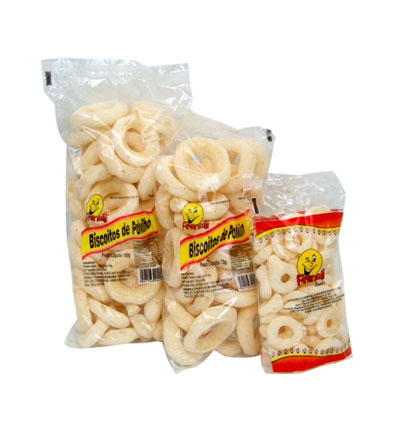
    A favorite of many Cariocas is the biscoito de vento, air cookie.  It’s salty so it’s not really a cookie but it has so little substance I’m at a loss as to exactly what it is.  It’s crispy, filled with air pockets, and dissolves immediately upon hitting your tongue.  Is it corn?  Wheat?  I can’t say but it has a very satisfying crunch.

    Finally, potato chips. I can sum up the difference between American and Brazilian chips in two words, meat flavored.  Yes, the US has BBQ flavor but it’s referring to the sauce.  When a Brazilian chip bag says “roasted meat” the chip is going to taste like pot roast.  Unmistakably and disconcertingly like pot roast.

    If you’re not a red meat fan, there is also grilled chicken and turkey breast. Even the “herb” flavored reminded me, oddly, of tandoori chicken.

    And here we have the limit of my cross-culture understanding.  I do not want my potato chips to taste like meat.  Ranch dressing, fine.  Turkey breast, no.  My tolerance goes only so far. This is one tradition I will not be adopting.  I’m going to stick with my Japanese peanuts.

  • Hosting family

    Hosting family

    Last week, I played host to my cousin who flew down from Atlanta.  It was her first trip to Rio. And she did her research.

    We drank coconuts on Copacabana beach and watched footvolley on Ipanema.  We shopped in Leblon and rode bikes around Lagoa.  We hiked up Morro da Urca and fed monkeys.  We explored the botanical gardens and got harassed by some aggressive strawberry salesmen at the market.  Salgados, acaraje, tapioca, sushi, and pounds of red meat were consumed in addition to 16 different kinds of fruit juice.  (Not even half of the 41 fruits on the menu.) Her trip ended with the obligatory visit to Cristo Redentor.

    After a week with my cousin, I now have some idea what it’s like to have a five year-old on summer vacation.

    I’ve had to translate for all of my family but, unlike other visitors, my cousin has an endless supply of energy and tendency to shout recently learned Portuguese phrases at totally inappropriate times.  A pre-departure nightmare involving a kidnapping meant leaving her on her own was out of the question.  Her first question every morning was “What are we doing today?”  So, she couldn’t read or speak to anyone, couldn’t be left alone, needed to be entertained every day, and she found the Portuguese word for armadillo absolutely hilarious.  In Rio, my cousin becomes a 23 year-old child.

    Our week went like this.  “What would you like to do today?”  “What do you feel like eating?”  “What do you want to drink?”  “Who else do you need to get gifts for?”   “The word for opossum is gambá.”  “Where do you want to go now?”  “Let me ask him where the bathroom is.”  “Not a good idea to shout ‘gambá!’ in the middle of the market.”  “What would you like to do if it rains?”  “Fui assaltada means ‘I was assaulted.’”  “What size do you want?”  “It’s 35 reais.”  “Please don’t tell the taxi driver you were assaulted.”

    On her last day, she proudly announced that this was the first time she had ever exhausted a guidebook.

    For my cousin every new experience, no matter how small, was worthy of being celebrated, turned into a joke, and discussed repeatedly.  While her constant enthusiasm is tiring it is also her most admirable trait.  She still has that childlike wonder which turns a trip to the grocery store into an adventure and pot-roast flavored potato chips into a treasure.

    Our week together in Rio was great fun!  Exhausting but great fun.  She helped me realize just how much fun Rio can be with a sense of adventure and that I will probably be sending future kids to summer camp.