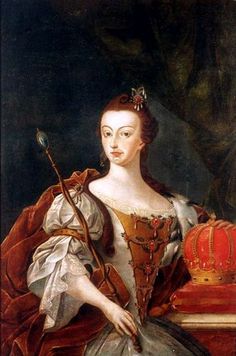
 The first woman to rule Portugal, Maria Francisca Isabel Josefa Antónia Gertrudes Rita Joana (why’d her parents stop there?) married her uncle in order to remain in line for the throne, saw her hometown destroyed by an earthquake-tsunami-fire mega disaster, calmed political unrest in Portugal by proving infinitely more competent, less corrupt, and not as prone to mass incarceration as her father and his advisors, outlived her husband and all but one of her children, and became the only European monarch to leave the content and rule her empire from a colony. Although, by the time the court fled to Brazil, she wasn’t technically in charge anymore as she’d been declared insane and unfit to rule fifteen years earlier.
Similarly to her son, Prince Regent and then King João VI, Queen Maria was as engaging and tragic as any fictional character. Also like her son, she appears in the historical fiction I’m writing, and has become a favorite character in large part because I want to give her the ending I think she’s due.
 Maria was born in 1734 and became the heir presumptive when all her brothers were still born. Now Portugal had never had a Queen rule in her own right, and they had this totally just and reasonable law that said a princess could NOT marry a foreigner and remain in line for the throne. Because obviously a man would be strong enough to resist manipulation from his Spanish wife, but a woman would be a puppet to her mustache-twirling Spanish husband. (This is hilariously ironic if you know about Queen Maria’s son and daughter-in-law.) So how can a princess marry a prince but not marry foreigner?
She marries her uncle.
Despite the family relationship and 17 year age difference, they were quite happily married. Although their son, future King João IV, might have preferred a little less inbreeding in exchange for a lot more chin.
 In 1755, when Maria was just shy of 21, Lisbon was left in smoldering ruins after being hit by so many disasters in day even Hollywood producers would call it over the top. A massive earthquake hit at 9:30 in the morning on All Saint’s Day, while the churches were packed for mass. Almost every church in the city collapsed. Thousands of survivors rushed to open squares around the port, only to be swept away by the tsunami triggered by the quake. Fires then broke out and raged for five days destroying whatever parts of the city were left.
Estimates put the death toll between 30,000 and 60,000. Three quarters of Lisbon was destroyed. The royal family was away from the city that day, and likely escaped being crushed when the Ribeira Palace collapsed. The people of Lisbon were devastated, and the tragedy would stay with Maria her whole life.
While the devastating effects of an earthquake on a devout city on a holy day caused much of Europe to start seeing earthquakes as randomly, occurring natural phenomenon and not heavenly ordained, the Portuguese, including Maria, doubled down on their religious devotion. Her Majesty was particularly devout, bordering on fanatical. She kissed the names of God, Mary, and all the saints and angels in any book she opened. She attended mass every morning and prayers every night. Maria filled her room with crucifixes and dolls of saints. (In my imagination, her room is decidedly creepy.)
 As Queen she took a much more hands on approach to governing compared to her father who had taken the “everyone listen to my advisor because I’m going hunting” approach. She rolled back a lot of her father’s more extreme measures such as mass incarceration of political opponents. She’s remembered as a good ruler in Portugal and Brazil. By all accounts Maria was kind and affectionate with her family.
But she showed signs of mental health problems as early as her teen years when records mention “bouts of melancholy and nervous agitation”. She’d been treated for episodes of delirium even before her husband died in 1786, but two years later when her eldest son, only daughter, a grandson, and her confessor of more than 30 years all died within three months, she descended inconsolable grief and never recovered.
Her maternal grandfather and uncle had fallen into madness at the end of their lives, suffering from violent mood swings and hallucinations. It’s heartbreaking to imagine, but Maria probably knew her fate during her last years of lucidity. She began ranting that she was damned and that the devil was inside her. On the assumption she was already marked for hell, her conversation became rather “unchaste” and not at all queenly. Visitors who stayed near her apartments heard “the most agonising shrieks…[that] inflicted on me a sensation of horror such as I had never felt before.” She would swing from violently punching and slapping her servants to nearly catatonic.
By 1792, she was deemed insane and control of the government was given to her only surviving son, João.
 When the Portuguese court fled Napoleon to Brazil, Maria thought she was being kidnapped and had to be carried aboard the ship by the fleet commander. She spent much of the three month voyage screaming. It sounds horrible for everyone involved.
There’s no consensus on what afflicted Maria during her last two decades. Some historians have suggested she suffered from porphyria, but contemporary research suggests severe bipolar disease. What is certain is that Maria’s death in Rio de Janeiro in 1816 finally brought the queen much deserved peace after more than two decades of torment.

 One reason I love writing historical fiction is the chance to discover real people I’d swear were fabricated in someone’s imagination. King João VI of Portugal is one of these people. The man was born to be the comedic relief in someone else’s story. Sure, he was also born into royalty, but he seemed so much more suited for getting laughs than governing.
 But the truly shocking and grand achievement of Dom João was surviving. When monarchs all over Europe were getting deposed at best and beheaded at worst, Dom João, the peaceful dullard, kept his crown, and he did it by being the only European monarch in history to move the capitol of his kingdom to a different continent. This man, who hated change so much his servants had to repair holes in his pants while he slept, moved the capital of Portugal from Lisbon to Rio de Janeiro.
 I’m currently obsessed with an idea for a historical fiction novel and have spent the last week devouring books on colonial Brazil. (I know you’re jealous.) It’s been fascinating reading actually because it’s all entirely new history for me. It wasn’t until World History in high school that I even knew humans existed outside of Europe, and by “Europe” I mean Italy, France, and Britain with a brief stop in Germany for the Reformation. Any ideas I have about Portugal or South America I learned from Columbus Day themed picture books and Disney’s Emperor’s New Groove.