
Tag: publishing
-
Journey to a Book Deal: By the numbers
 “How long did it take you to get a book deal?” I’m rarely asked that question when I have enough time for a complete answer. Or when people really want an honest answer. Nobody at Thanksgiving wants to hear “Well Aunt Hattie, it took me thirteen years from first book idea to book deal, so if you’re think about a memoir, you probably want to get on that.”
Full disclosure, I haven’t actually published a book yet. My launch date is November 22, 2022, and at the rate other debut releases are getting pushed back for production and shipping reasons, I might not have a book before Stacey Abrams is president. So the numbers I’m going to give are subject to change depending on the existence of paper nearer my launch date.
These numbers are also specific to my publishing experience as a fiction writer. Publishing is different for non-fiction. Even within fiction, picture books have different practices and expectations than novels. And none of this is applicable in anyway for self-publishing.
But for what it’s worth here are my numbers.
2009
I had my first idea for a novel and went so far as to write a detailed outline. I wanted it to be a graphic novel. Meaning totally illustrated. Basically a 200 page comic book. That I imagined a publisher would print in color. For my debut novel. Oh starry-eyed, sweet, naïve 2009 Brynn. That girl makes me laugh.
Still I will love this story until I die because it’s the idea that made me a novelist. That idea became the first book I finished in…
2015
Six years form flash of inspiration to complete, edited manuscript. In that time I had a baby, and I’m convinced I would never have developed the self-discipline to finish a manuscript without parenthood. But that’s for another post.
You know what, let’s summarize this or we’ll be here all day.
Book 1 Completed June 2015: 2 editors hired, 3 full revisions, 62 agents rejections, shelved early 2017
Book 2 – Started August 2015 completed March 2017: YA speculative fiction, 5 Beta Readers, 1 editor hired, 3 full revisions, 4 competition submissions, 54 rejections, shelved March 2018
Book 3 – Started June 2016 completed March 2018: YA historical fiction, 4 Beta readers, 1 competition submission, 39 rejections, 1 Revise & Resubmit, 1 rewrite to change from YA to Adult, Signed with agent November 2018
While signing with an agent is a huge deal if you want to traditionally, it is NOT a book deal. Because Book 3 still had to go on submission to editors at publishing houses. That’s a whole new level of rejection!
Book 3 continued: 1 revision with agent, Sent on submission May 2019…
Pause for a global pandemic, an international move and emotional havoc
…Sold to Orange Blossom Publishing Sept., 2021
 Book 3 is Jaguars and Other Game. It comes out November 22, 2022.
That’s how long it took me to get a book deal. Was anyone keeping count? That’s a total of 13 years and 155 rejections. I didn’t even include the editor rejections during Jaguars submission. I honestly don’t know that total. I just assumed every editor employed in the U.S. save one, but as everyone in publishing says “One ‘Yes!’ is all it takes!”
Depending on the paper situation I will have an actual book this year. (I’m keeping my fingers crossed.) I just sent Book 4 to my agent, which I started during Nanowrimo 2018. Honestly wasn’t sure I’d ever finish it, but turns out I do have more stories in me.
So Aunt Hattie, if you want to traditionally publish that memoir about growing up on a radish farm with your pet opossum, my advice is to start writing. Be patient. Get a thick skin and working knowledge of em dashes. Write something else. Repeat.
Now I’m off to start drafting Book 5. I really feel like I’m starting to get the hang of this writing thing.
-
My First Author Event!
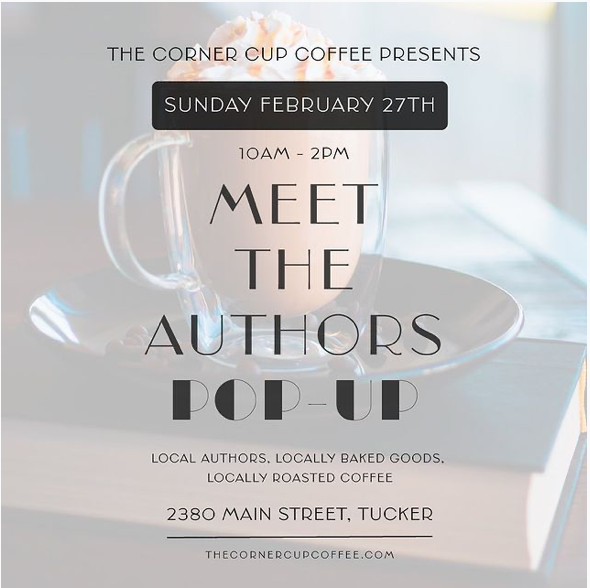
 After more than a decade of writing with the intention of building a career, I’m participating in my first author event! Corner Cup on Mainstreet in Tucker, GA from 10am-2pm Sunday, February 27. I’m going to show up in public as a writer. Not just a writer but An Author. With a novel coming out. I really want to be the cool, chill writer, rocking a blazer and sneakers. But I’ll probably be crying through the event. Or talking way too loudly at a million words a minutes. I have trouble using my indoor voice when I’m excited, and I will be very excited this Sunday.
So if you’re willing to hear me shout about my book, come out to the Corner Cup this Sunday. I’ll be selling copies of two amazing anthologies about living abroad that I contributed to and handing out my very first book swag! A little teaser for Jaguars & Other Game coming out in November 2022.
Before I began writing fiction, I wrote creative non-fiction about my experiences living in Brazil and I’m looking forward to sharing these anthologies and talking to people about how I used writing, specifically humor, to process and adapt to life abroad. In Once Upon an Expat, I talk about gym culture in Vitoria, Espirito Santo and the importance of rock-solid quads and a fabulous unitard. Giving birth prematurely in a foreign country wouldn’t seem fodder for comedy, but I’m believer in laughter as a painkiller. My essay in Knocked Up Abroad Again takes readers through my emergency c-section at 33 weeks and the 28 days my daughter spent in the NICU. Both anthologies are filled with heartfelt and humorous accounts of women from all over the world with the common experience of building a life and family in a new country and culture.
I’m also happy to talk about my experience with traditional publishing, finding an agent then going on submission (for a painfully long 28 months) and ultimately signing with a small indie press. I’ve hired editors and sensitivity readers and networked to find beta readers. I have an extensive collection of rejections from agents and editors and am always up for a good gripe session about how absurdly slow the publishing industry is. A global pandemic was able to play out in the time it took to go on submission. So if you’re looking for a fellow author to talk shop or are thinking about writing your first book, come stop by Corner Cup! I’d love to chat and make more local writer connections.
Also by buying a coffee and bagel, you’ll be supporting local businesses. Corner Cup is locally owned and operated and they give a ton of support to the community by selling the work of local artists. Their baked goods are also locally produced and delicious, (Shout out to Emerald City’s everything bagel!) so you can feel good about buying that chocolate croissant.
If you’re around Tucker this Sunday, I hope to see you. We can talk writing, swap book and pastry recommendations, and I promise to try and use my indoor voice.
-
My First Book Deal!
It finally happened!

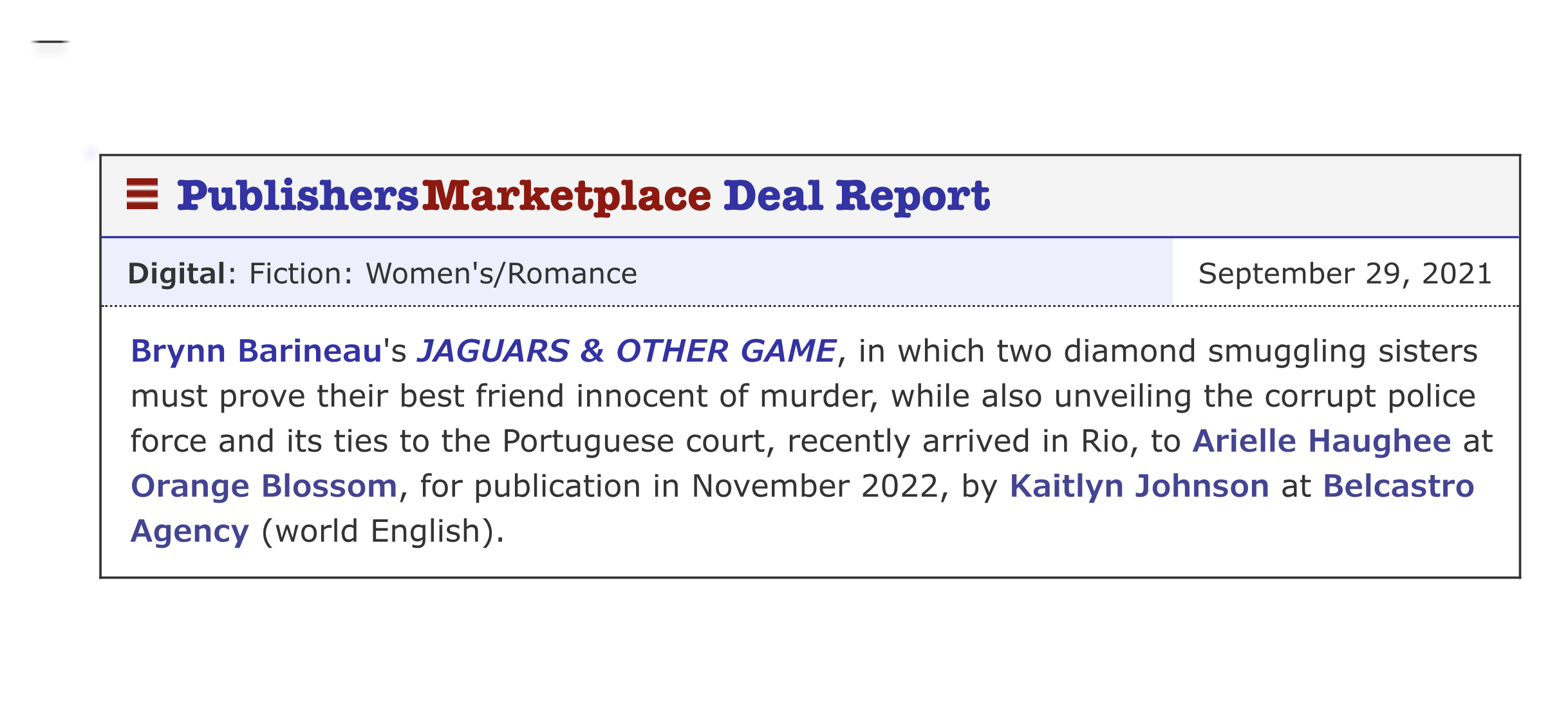
Seven years after I finished the first draft of my first novel, I signed with a publisher. I have dreamed of holding a copy of a book I wrote and seeing my name on the cover. My debut novel, Jaguars and Other Game, comes out November 22, 2022 with Orange Blossom Publishing!
Assuming my small publisher stays on track with the other books coming out earlier in the year. And assuming the supply chain is mostly back together. And let’s hope for an in-person launch event but who knows when the next Covid variant will hit. But I live in Georgia so I’m probably on for an in-person event. Florida would be more of guarantee but even then, bookstores are getting good at hosting virtual book launches. But if all stars align, there will be a launch party in-person with physical copies of my book in November.
No matter what happens, I am NOT going to worry about the nature of my book launch. I am going to be happy and celebrate for all of 2022. A professional book person who is a complete stranger to me read my words and said “Yes, this should be printed. It is worth people’s time and money.” So I’m just basking in the glow of a dream achieved.
Ha. I wish. It’s my nature to plan things out thoroughly in advance then lay in bed sick with anxiety when those plans have to change. It’s one of my adorable personality quirks being unable to chill and go with the flow.
Over the years, I’ve heard several published authors say that getting your first book doesn’t lessen the stress. It just replaces the fear of never being published with a hundred other fears. And that’s been true, especially with a small publisher. All the early marketing is on me. There’s no marketing intern in New York making my promotional graphics for social media. I have a hundred more professional to-dos than before the book deal.

2015! My first Decatur Book Festival as an aspiring author. DBF 2023! I’m coming for a local author spot. But…BUT all the new worries rest on a foundation of “I did it.” I feel as though an enormous weight has been lifted off my soul that not even signing with my agent relieved. I don’t dread the extra work. Even while the stress knot between shoulder blades grows tighter every minute I spend integrating Mailchimp with my webpage, I’m happy to do the work. I’m absolutely thrilled that I NEED to do the work. Because it’s “for my book”! I will make the damn subscription button work no matter how long it take because I have proof that working hard will pay off. The workshops and contests and style books and years of writing will not all be in vain as I dreaded they would for so many years.
No matter what happens. In-person or virtual launch. Five attendees or a hundred. 3 Goodreads reviews from my writing group or dozens of four star reviews from strangers. Ten copies sold or five hundred. No matter what happens, by the end of 2022 I will be a published author. When people ask my daughter “What does your mommy do?” She can say “She’s an author. You can buy her book.”
And I am damn proud of the book I wrote.
Jaguars and Other Game is a historical adventure in the spirit of The Three Musketeers that follows three women as they work together to track down a murderer to save a friend wrongly imprisoned for the crime. There’s romance, diamond smugglers, corrupt officials and a mad queen. It’s a story about found family and the lengths we’ll go to save those we love from injustice. And it will be available through your local bookstore, Amazon or Target on November 22, 2022.
-
What I Learned From Querying Literary Agents
 The other night my daughter and I died repeatedly in a lava lake. We were playing Yoshi’s Woolly World and trying to get a final daisy that would unlock a secret board but the lava was rising and covering the daisy and…well, we died a lot.
After death number twenty-two give or take five, my daughter said, “Mommy, let’s just quit. We’re never going to get it.”
“That’s only true if we quit,” I cried, frantically pounding the A button.
Which is true. In Yoshi’s Wolly World and in life. Someday becomes never only when we quit.
This is not a sentiment I would have slapped on a poster, covered in glitter, and waved over my head until very recently. I was much more a “Why would I waste my limited time and energy on something that’s basically impossible?” or put more honestly “Why would I try so hard to most likely fail?”
Then I started querying agents for a novel, and I learned failing isn’t the end. Failing is a step.
I remember the queasy feeling I had as I hit send on my first query. This was it. After three years of writing, revising and researching the fiction industry, I was as ready as I could be. I was NOT querying a first draft. I had revised and revised again. I researched agents and made a list tailored to the book I wrote. I sent my query to workshops and had ACTUAL literary agents critique it. I was ready, and with my hand shaking, I clicked send. Then I sent nine more.
They all said no. So did the next ten agents. And the ten after that. All form rejections.
Querying literary agents is a pretty good dry run for living with chronic reflux. Once those queries are out, checking your inbox triggers chest pains, difficulty breathing, and nausea. It didn’t matter if the query was sent six hours ago or six months ago. If I had an open query and that little red circle appeared over my inbox icon, my stomach flipped. My expectations rose.
And then I’d read the rejection. It’s amazing that pixels on a screen can stimulate the physical sensation of being punched in the gut.
The first few rejections hurt but weren’t devastating. I didn’t panic. There are varied tastes. Some agents just won’t be into a vigilante anti-hero no matter how well written. Although someone should have recognized my talent by query 20. Or 25. Certainly by 30. But the form rejections kept coming and feeding the self-doubt. Because I wouldn’t have queried a novel I didn’t think was good. So the agent rejections were a reflection not only my book but on my judgement as a writer, right?
Eventually I went in search of data because that’s what people with social science degrees do. I wanted a number, so I googled “What’s the average number of rejections authors get before signing with an agent?” I found enough numbers that I know my total rejections over three projects isn’t even that high.
But back then, I had no idea where my count would end. Would I be the author who got an agent on her 65th query for her sixth manuscript? Imagining the time and energy it would take to write and revise six novels left me breathless. Could my heart take a shot of adrenaline every time I checked my email for a decade? But giving up after one novel wasn’t even trying and I couldn’t quit without really trying.
So I wrote another book. And I queried it. I got more form rejections. They caused heart palpitations and pain. But…and this was a revelation…not as much pain as that first batch.
I realized as I neared that 100 rejections mark, that the more times I read “no”, the faster my heart rate returned to normal. By the time I was into three digit rejection numbers, the emails caused only a flutter of despair. I could tell my husband and family “Nope. Another pass” with merely a shrug. I seemed to have developed a high tolerance for “no”.
Then project number three got me my first full manuscript request and first rejection of the entire manuscript. That one was bad. My query reflux flared up. I cried. But there were more full requests and I started thinking “At this rate, eventually someone will say yes.” I’d heard “no” 130 times, but somewhere along the line my thinking had shifted from “maybe not ever” to “eventually”.
As long as I didn’t quit. I’d gone from form rejections to personalized rejections to a partial request to multiple full requests. If I kept going, one rejection at time, I’d eventually get to a yes and after four years, I did. After 138 rejections.
So here’s what I hope to pass on my daughter.
There will be some doors that never open no matter how hard a person tries. I will never be and could never have been a professional basketball player or super model. I do not have the body for either. Nor do I have the eyesight for fighter jet pilot. Some things are out of our control.
And not everyone has the luxury of failing repeatedly. They don’t have time and energy to spare on ventures that might not bring any financial return. They don’t have family to support them during the trial and errors or bail them out after the crash and burn.
Failing repeatedly is a priviledge. If you’ve got the safety net, take the leap.
Do not let fear of hearing “no” or shame from having to admit rejection in front of family and friends be the only reasons you don’t try. Hearing “no” gets easier. It’ll always sting, but it will stop defining you. Every failed attempt teaches and makes you better. And you will get better.
So tryout for the team. Audition for the roll. Submit the story. Send off the resume. The regret from never trying will be so much worse than the sting of failing. And if there answer is “no”, well, your life will go on exactly as it did before you tried. It won’t be worse and now you have the chance to learn something and try again.
Take the step. Get a “no”. Reassess and try again. And again. Get 138 “no”s. Get 500 “no”s. You’ve only truly failed once you stop trying.
That’s what I yelled while my Yoshi leapt over rising lava. And eventually we got that damn daisy.
-
My Most Brutal Agent Critique & What It Taught Me About Diverse Stories
 It happened. I finally got the brutal agent response I will talk about twenty years from now at book signings. I’m a real writer now. Yay!
I wasn’t expecting an total take down of my novel considering I wasn’t querying. I took an online workshop on historical fiction that included a critique by the agent instructor of a log line, synopsis, and first 2 pages. I’d recently finished the first draft and was eager to get feedback on what needed to be improve. Here’s what I got back.
“Unusual can be good, but in this case, Portugal may feel too foreign to American readers…I don’t know how interested American readers are going to be in this particular era and place. There is no precedent for it. That doesn’t mean you can’t start a new trend, but first it would have to be so spectacular that readers wouldn’t be able to put it down. Unfortunately, that is not the case here.”
Once I recovered from not having my first pages recognized for their genius and obvious money-making potential, I reread the email more critically.
 My first thought was “Portugal, a Christian country in Europe full of white people, may feel too foreign for Americans?” I’m still trying to figure out what about US demographics gives the agent this impression. If Portugal is too foreign what countries will Americans read about? Great Britain, obviously. France, yes. Germany? What about Russia? They’re white, but their culture is pretty dissimilar to the US.
I’m assuming the agent was thinking of white Americans. But maybe that’s unfair. The agent could have been thinking about Korean Americans. Portugal is different from Korea in so many ways from language to internet speed. Korean Americans probably have no interest in reading a story set there. I know I personally only read books set in places my DNA came from. Thank God Hogwarts is in England!
Going off that thought, maybe the large percentage of Americans who have DNA from Africa, the Middle East, Asia, North or South America would be interested in reading a story set in one of those places. This would actually be a great thing for my story.
Which leads to my second thought after rereading the email. See if you can spot the source of my confusion.
Log Line:
Three young women form an improbable friendship in order to rescue the boy, find a murderer, and thwart a coup against the Portuguese monarchy. Madness & Diamonds is a girl-power Three Musketeers set in colonial Rio de Janeiro.
My book is not set in Portugal.
Here’s the first line of my synopsis.
Victoria, a servant of The Mad Queen Maria of Portugal, evacuates Lisbon to Rio de Janeiro with the royal family and 10,000 members of the court in advance of Napoleon’s invasion.

To clarify, Brazil is the big green one. Portugal is the orange dot. The synopsis goes on to mention Rio another nine times. The most generous interpretation of events is that the agent was pressed for time or exhausted or probably both, skimmed my material in a rush and latched on to the first nationality mentioned, Portuguese. Or the agent typed Portugal but was thinking Brazil? I also considered the agent may not know where Rio de Janeiro is. (At Christmas I had to tell a homeschooling mom what continent Brazil is on, so thinking Rio is in Portugal is totally possible.)
Whatever the reason for the confusion, it’s just as well for me because if Portugal is too foreign, I can’t imagine what feedback I’d have gotten on a story set in Brazil.
In fairness, the agent cited one problem with my pages and synopsis: clarity. I absolutely agree based on her feedback that certain aspects of the story need to be made more obvious. I also know that complaining about a bad critique can make me seem petty to unprofessional. All writers get bad critiques. Get over it. And I would have except for one fact.
This agent is a Gatekeeper with a capitol G, and it was abundantly clear from the critique, this agent would never take a risk on a manuscript that was “too foreign.”
Foreign too whom? White, Christian Americans.
I joked about who the agent was envisioning when saying Portugal is too foreign for Americans, but it’s obvious what specific demographic she defines as American. What infuriates me is that the “Americans” this agent is considering will not even represent the vast majority of the population in a few years.
 The Census Bureas predicts that by 2020, the majority of kids in the United States will be members of a minority race or ethnic group. Every single person working in children’s publishing in any capacity should know this fact because while the demographics of American children have changed, children’s publishing is still overwhelmingly white. Last year only 28% of children’s books were by and/or about people of color. That percentage is actually big jump from only two years earlier. However there’s still going to have to be a massive increase in stories about POC in the next few years, if children’s fiction in the U.S. is going to reflect the diverse reality of the country’s kids.
But how is children’s publishing going to change if the Gatekeepers think Portugal is too foreign for Americans?
Literature is also a proven way to develop empathy for people different from ourselves. Only 11% of children’s books published in the last 23 years had multicultural content. In today’s globalized world, it is essential children grow up aware of the variety of people that exist in the world. Not to mention the foreign-born population in the U.S. is predicted to reach a record high in 2025, roughly 15% of all people living in the U.S. will have been born in another country. (That statistic doesn’t even include people like my daughter, who is an American born abroad.) Empathy and a global perspective are critical tools for success in today’s world.
I’m going to end with a thank you to the agent who sent this critique. I had read the data and accounts from authors of color and those trying to publish books with diverse characters and settings. I was aware of the challenges these writers and books face but I wasn’t clear on the exact form they take. Now I know, and I’m more determined than ever to finish revising my story set in Brazil. I’m going to get it published. Then I’m going to sell it to Americans. Finally, I’ll send a copy along with the book’s sales numbers to that agent.
Although even then, I won’t have any idea how Americans feel about Portugal.
-
I enjoy comics, therefore I am a geek. I think.

I admit it. I had X-men comics as a kid. A couple weeks ago as I was skimming the Internet, I saw the latest Avengers: Age of Ultron trailer. I saw it five times in a row. When I discovered in the comment stream that the movie opens on April 23 here in Brazil, a full week earlier than in the US, I squealed for joy.
Last Friday, I was browsing books on Amazon and it recommended the fourth compilation of the Saga series. I hadn’t even realized it was out! I gave thanks to the omniscient Amazon gods and ordered it immediately.
This week I’m putting the final touches on the second draft of my 216 page graphic novel.
I can no longer hide from the truth. I am a geek.
I suppose I’ve always known on some level, although I’ve repressed it for decades. My brother is a gamer and has actually attended a Dragoncon, so I think it might be genetic. I definitely don’t think it was anything my parents or society did. I grew up in an upper-middle class suburb outside of Atlanta in a congressional district that doesn’t even have a Democratic party office. There were club sports, sleepovers, and more churches than gas stations. I had everything necessary to be totally mainstream. Yet, my absolute favorite cartoons growing up were X-men and Batman. I watched reruns of Batman every day after school long after I knew I couldn’t admit it at my lunch table.
I was very confused. I liked X-men comics, but I also made top grades, was elected to student council, and played varsity sports. I didn’t have trouble making friends or shopping at the Gap. It was made clear, by people on both sides of the line, that people who liked comics and superheroes didn’t do those kinds of things. Also, I have a vagina, so I couldn’t possibly be a comics fan. I was assigned a side, which I’ve stuck with until now.
And there are most definitely sides. I’ve done my research, and the internet divides people into two distinct camps: geeks and non-geeks.
Geeks like comic. They also enjoy animé, very elaborate games that require an entirely new language of acronyms like MUDs, ADnD, and MMORPGs, dressing as characters from their favorite comic/movie/tv show/video game, and toys. Lots of toys. When not cosplaying, geeks also enjoy wearing cotton tshirts with witty quotes or logos proudly promoting their geekhood.
Non-geeks enjoy the outdoors, Starbucks, Top Gear, and yogurt. They frequently wear cotton tshirts with logos promoting their favorite sports team and/or player. They believe books with pictures are for children and adults only read celebrity cookbooks, Literature (with a capitol L), or war memoirs. When not wearing their team colors, they are wearing Old Navy or J. Crew depending on income.
Since high school, I have been living my life as a non-geek. I love Starbucks and my reading time has been devoted to Capitol-L authors such as Jhumpa Lahiri, Barbara Kingsolver, Margaret Atwood, and Toni Morrison. Then some time in my mid-20s, I came across a list of the “100 greates books of the 20th century.” I don’t remember who created the list. I think it was Times or maybe a freshman English major at Berkley. Either way, I know the list included Watchmen by Alan Moore, illustrated by Dave Gibbons. I was intrigued. How did this comic, masquerading as a novel, end up on a list of “Greatest Books”? The contradiction was there in the title, Greatest Books. This list put a comic alongside Hemingway and Alice Walker.
I was aware of the term graphic novel but didn’t understand it until I read Watchmen. Then for Christmas my brother gave me Y: The Last Man and 100 Bullets. Another year, a cousin gave me American Born Chinese. I discovered Fun Home was named the best book of 2006 by Time. Then one day I looked at my bookshelf and discovered a row of graphic novels, what my non-geek kind still refer to as comic books. I had a shelf full of comic books!
What can I say? I’m sucker for a good story. Combine memorable and complex characters with good writing and you’ve got me, even if the story is told in illustrated panels. American Born Chinese is one of the most elegant pieces of story telling I’ve ever read, and it’s a graphic novel for young adults.
I guess that makes me a geek, but I’m a little worried about what coming out as geek means. Geeks seem to make being a geek such a huge part of their identity; I’m afraid about half-assing the role. Can I love the Avengers movies without understanding the difference between The Avengers, The Mighty Avengers, and Avengers Assemble? Because I’m really busy and just don’t have the time to figure that out. Do I have to be willing to stand in line for two hours for an autograph from a Star Trek cast member? Because frankly there’s nothing short of life saving necessities that I would stand in line for two hours to get. Although I admire the passion. And the patience. I could use more of both.
Oh, and about the costumes…they look wondrous but also super impractical. If I’m going to walk miles around a conference hall filled with 100,000 people, I’d prefer something breathable. Is there a character I could portray in linen pants and a pair of Toms? No? Well, maybe I’ll write one. As soon as this non-geek geek gets her first graphic novel sold. But that’s a post for next week.
