It’s time for Multicultural Kid Blogs’ Read Around the World Series, an amazing collection of kid lit recommendations from multicultural families around the world. I’m excited to recommend the first young adult novel of this year’s series: The Hate U Give by Angie Thomas.
Today for MKB’s Read Around the World Series, I’m recommending a beautiful tale of friendship set during the Oregon Trail! It’s a beautiful book and a must read for any history or adventure lovers!
At the summer games this year in Rio de Janeiro, fans of 41 different sports will have a chance to watch competition between the best athletes in their sport. The world’s best judokas, golfers, divers, bmx cyclists, track cyclists, mountain cyclists (I had no idea there were so many different ways to cycle), trampoline jumpers, and fencers will be here in Brazil competing for gold. To be completely honest, I’m not sure what the modern pentathloners will be doing exactly, but I’m sure it’s something that I cannot.
Despite the wide variety of sports included in the Olympics, one of the most popular sports in Brazil will not be a part of the games, Capoeira.
Capoeira is a martial art that developed in Brazil in the 16th century. At least scholars believe that’s when it began. There are very few records of the earliest iterations of capoeira because it was developed by Africans transported to Brazil as slaves who used it as a means of both self-defense and cultural preservation. For most of Brazil’s history capoeira was outlawed and practiced in secret. It wasn’t until the 1940s that all official bans on capoeira were lifted, and the government acknowledged capoeira as part of Brazil’s cultural heritage.
I called capoeira a martial art, but I used the term for lack of anything better. Some people refer to it as a dance, and others call it a game. It’s a link to history and a legacy. Capoeira is all of these.
“Negroes fighting, Brazil” c. 1824. Painting by Augustus Earle depicting an illegal capoeira-like game in Rio de Janeiro
The majority of people brought as slaves to Brazil came from West Africa, hence the style of capoeira known as Angola. Slaves were not allowed to continue cultural practices from home and could not practice any activity that could be used in self-defense. Capoeira combined drum rhythms and instruments from a variety of West African cultures and set the powerful spinning kicks and acrobatics to music. Practitioners could claim capoeira wasn’t an attack. It was a dance. Even today, capoeira is always practiced to music and song.
Capoeira expanded in Brazil during the 17th century through communities of escaped slaves known as quilombos. The largest quilombo, Palmares, was home to over 10,000 people. The quilombos were havens of freedom for former slaves and many mounted fierce resistance against the Portuguese. There are few remaining records about life in the quilombos, but historians believe that capoeira was an important part of the communities’ defense.
Portuguese and later Brazilian officials were so frightened by capoeira they outlawed any and everything related to the game. People were arrested for playing capoeira instruments, wearing the colored belts and white pants, or just whistling a capoeira song. Finally, in the 1930’s Mestre Bimba from Salvador convinced the government that capoeira was both an important cultural legacy for Brazil and (because governments respond well to financial incentives) a tourist draw. In 1937, he was allowed to open the first public and officially sanctioned capoeira school in Brazil.
Mestre Bimba developed a new style of capoeira drawing moves from jiu-jitsu, boxing, and batuque, a martial art brought from Africa practiced in the state of Bahia. Mestre Bimba’s style of capoeira became known as Regional. The original style of capoeira, Angola, is characterized by a slower style of play, with lots of low kicks, while the players stay close together. Mestre Bimba’s style of Regional is played much more quickly with more aerial acrobatics. If the capoeiristas you’re watching are doing crazy fast spin and flip kicks that make your mouth fall open, that’s Regional.
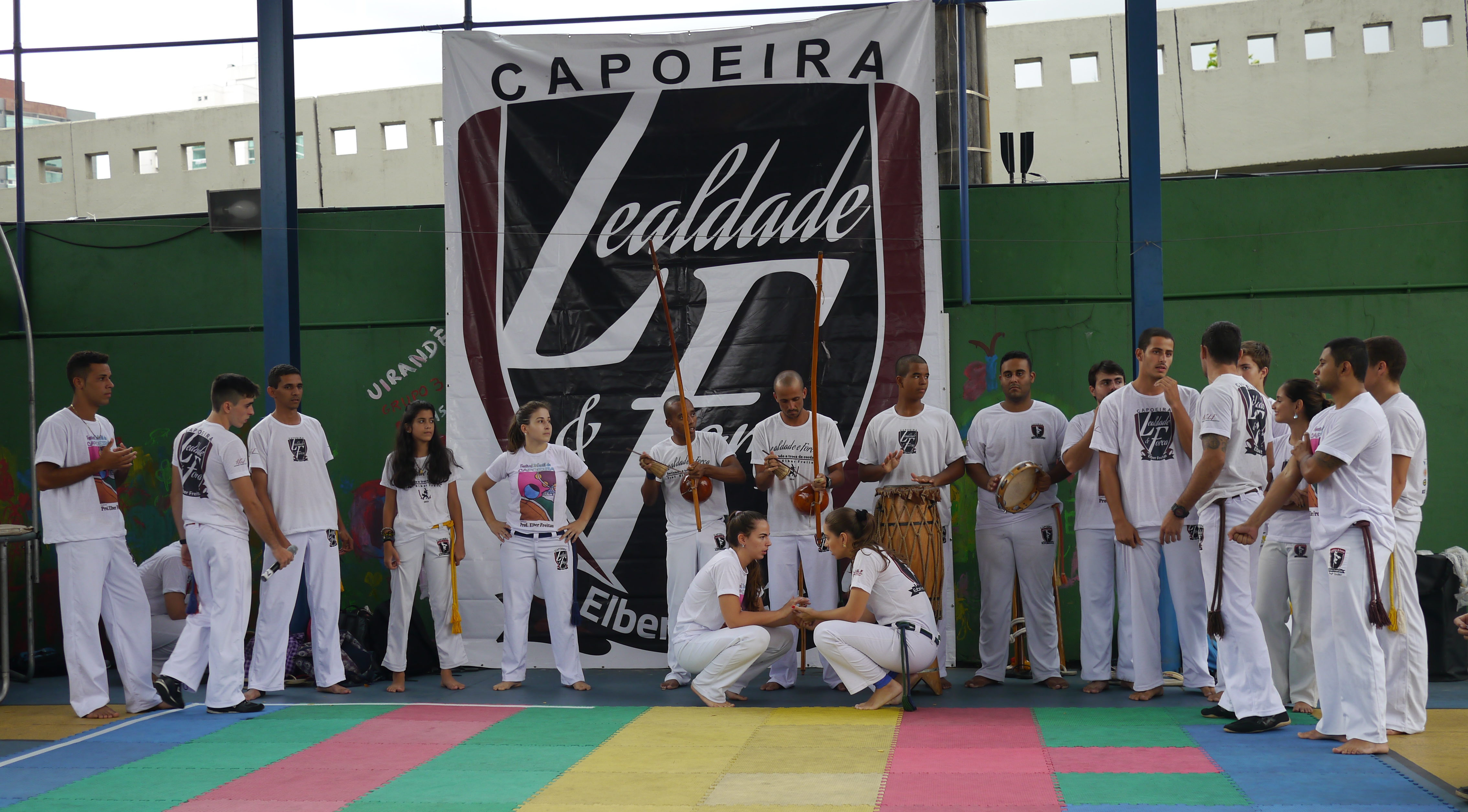
While the styles vary in speed and types of movement, both keep the same format and traditions for practicing. Capoeira is always played inside a circle of musicians, singers, other players, and spectators. The music of capoeira is performed on five instruments: berimbau, pandeiro, atabaque, agogô, and reco-reco. The musicians and singer perform continuously as players tag in and out of the circle. One more important fact! Players never actually strike each other while playing. They feint and dodge and kick, but they never land a blow. That’s why the verb “play” is used for capoeira. They’re playing, not fighting.
Last year a petition went around Brazil lobbying for inclusion of capoeira in the Olympics. Many of the most famous mestres were and are against its inclusion. They argued that capoeira is not a sport. There are no winners and losers and to change that would be to change the nature of capoeira, which focuses on community, preserving heritage, fitness, and fun.
Whether a sport, a martial art or a dance, capoeira today is practiced by men and women, kids of all ages, from everywhere in the world. The petition for Olympic inclusion failed, which means no official capoeira exhibition at the 2016 Rio Games, but without doubt there will be opportunities for visitors to watch, whether on beach or in a park square. If you happen to be in Brazil for the Olympics or if you ever happen to hear the tang tang of a berimbau, do yourself a favor and go watch. You’ll get to see impressive athletics, hear great music, and learn a bit of Brazilian history all at the same time.
If you love the Olympics, learning about world cultures, or both, check out the amazing Multicultural Kids Blog!
I’m proud to be a part of the Multicultural Kid Blogs community! It’s an amazing resource for parents and educators with multicultural kids or wanting to raise globally minded citizens. Every (northern hemisphere) summer, MKB hosts the Read Around the World Series to promote diverse books for kids. Bloggers around the world recommend books for all age ranges, picture book to young adult, and all regions of the world.
Today I’m up, and I’m excited to recommend a modern classic of Brazilian children’s literature!
The wind gusted by, and my nose was numb by the time we crossed from the parking lot and entered the Visitor’s Center at the Martin Luther King Jr. Historic Site. It was a little unfortunate my step-mom and I had picked the coldest day in weeks to visit because the MLK Historic Site is a collection of buildings up and down the block where Dr. King’s childhood home and church are located. The facilities required walking. The weather required a hat.
While peeling my gloves off in the Visitor’s Center, a helpful ranger told us that guided tours of Dr. King’s birth home are available for free but they’re first come first serve and you have to reserve tickets. Unfortunately for us, the next tour wasn’t until noon, and we had to move on before then. There was still the Visitor Center, the Tombs, exhibits from the life of Dr. and Mrs. King at Freedom Hall, as well as Historic Ebeneezer Baptist Church where Dr. King served as co-pastor with his father. More than enough to fill a Sunday morning.
Passing through twelve years of metro-Atlanta public schools, I’d learned about Dr. King and the Civil Rights movement extensively. To be perfectly honest, I wasn’t expecting to learn anything new during my visit. It would be interesting to see the buildings where Dr. King actually lived but the information would be a refresher course.
I stepped into the first stage of the Visitor Center’s overview of King’s life: Segregation. Photos, panels, and video explained the explicitly and brutally divided world Martin grew up in. On the video screen I watched footage of a young girl, book bag in hand, enter her school escorted by Federal marshals. The girl is Ruby Bridges, the first African-American student to attend an integrated elementary school in Louisiana. Well, integrated isn’t quite accurate. Bridges was the only African-American student in an all-white school.
I’d watched the footage before, but never as a mother.
This time I saw a little girl with a bow in her hair, not much taller than my own daughter, walk alone into her school. No friends, no teachers. Only four armed Federal Marshals protecting her. She barely cleared the waist of the men around her. Ruby was six years old that day. My eyes filled with tears, and I ducked my head to keep anyone from noticing.
I left the images of children berated and under armed escort and moved on to the section on Dr. King’s early activism. His first role of national significance came when he helped organize the Montgomery Bus Boycott in the wake of Rosa Park’s arrest. It was 1955. Dr. King was twenty-six.
I’d moved on from Ruby in hopes of being on more palatable ground of grown-ups being horrendous to other grown-ups, but I was staring at the face of a person whom, if I met over coffee, I would tease and welcome into adulthood. How’s that whole responsibility thing going? When I looked at the photo of Dr. King handcuffed and bent over a police desk, I didn’t see a great man. I saw a very young man.
I scanned the other photos. A group of non-violent protesters at a sit-in. Freedom riders. Marchers with their arms linked. Dr. King attending a leadership meeting of the Student Non-violent Coordinating Committee. There it was in the name: Student Non-violent Coordinating Committee. The walls were covered with pictures of kids and young people. Eighteen, nineteen, twenty year-olds. College kids were the driving force of the Civil Rights movement. Seeing the Civil Rights Movement from the perspective of an adult older than most of its leaders were at the time shocked me.
I’d learned about Dr. King and other leaders, John Lewis, Julian Bond, Andrew Young through the eyes of a child. I’d been told they were great men, and to a ten-year old, the footage and photos showed established adults. One grown-up is equal to any other grown-up. Anyone who has reached adulthood knows this couldn’t be farther from the truth.
As I wandered through the Visitor Center, King’s church, and the other buildings, the entire site became a testament to the power of young people. Kids, teens, college students and freshly minted men and women in their twenties acted on their beliefs that the world could change and could be made better. They refused to accept the world they were about to inherit.
It seems to be a favorite past time of adults to complain about the youth. There is certainly no shortage of criticism being hurled currently at young people with their selfie taking smart phones. But I did learn something during my visit to King Center. Never underestimate youth. Young people have the power of infinite possibility. Their vision hasn’t been narrowed by time. Martin Luther King Jr. did not imagine himself on the steps of the Lincoln Memorial when he called on his congregation to boycott the buses. With his twenty-six years, he imagined a more just world and acted to make it so.
The quote on Dr. King’s tomb is “Free at last. Free at last. Thank God Almighty I’m Free at last.” The dates are 1929-1968. He was thirty-nine when assassinated, a young & great man.
This post is part of an amazing series on Martin Luther King Jr. being hosted by Multicultural Kids Blog. Check out the link for fabulous educational activities and international perspectives on the legacy of Dr. King.
Seriously Brazil, it’s 2015. Pay your help a living wage.
Dear reader, if you’re not in the mood for a rant, check back next week.
It all started when I received an early morning WhatsApp message from a fellow mom asking the group about rates for a substitute nanny while the permanent nanny is on vacation.
A little cultural context. Here in Brazil full-time nannies are common. This was surreal for me coming from the United States. In the U.S. full-time nannies are something only the Jolie-Pitt or Kardashian families can afford. I remember a combination of church daycares and grandparents after school and over the summers while my parents worked. Personally, I’ve never known anyone in the U.S. with a full-time nanny.
In Brazil, almost everyone I know has a full-time maid and many have a full-time nanny too. Often if the family has kids but can’t afford two employees, the maid will have childcare duties in addition to the housekeeping, grocery shopping, and cooking. Several of our friends also employ a weekend nanny because labor laws in Brazil don’t allow families to demand ask their nanny to work 7 days a week. It’s like Downton Abbey in flip-flops with more beer and better weather.
How can these middle class and professional families afford full time nannies and housekeepers in the year 2015? Minimum wage in Brazil for 2015 is $250 a month. (I’m using today’s exchange rate of 1 U.S. dollar to 3.15 Brazilian reais to put all values into US dollars.) U.S. federal minimum wage is $7.25 per hour, so assuming four 40-hour-weeks a month, the U.S. federal minimum wage per month is $1,160.
$1,160 versus $250 a month.
Now, a lower minimum wage doesn’t necessarily indicate a lower quality of life.
Maybe the cost of living is significantly lower in Brazil than the US? Maybe goods are less expensive? They’re not. The only things cheap in Brazil are coconuts and people, and even the coconuts are experiencing inflation.
Maybe there are a variety of free/very low-cost public services in Brazil? There aren’t. Public services from school to health care are abysmal. Everyone who can scrape together the cost goes private, and a full-time nanny at minimum wage is significantly cheaper than private day cares here in Vitoria.
But there’s no way people pay nannies minimum wage, right? In practice people are paying more than the legal minimum, aren’t they?
This brings us back to this morning’s Whatsapp conversation among local moms.
A mom wanted to know what other people had paid for someone to fill-in as a nanny for a month. The values reported ranged from $254 to $476 for the month. For two children. For the entire day, Monday through Friday.
But these shockingly low values are not what drove me to clutch at my hair and mutter obscenities at my computer. Nor was I upset that a family of four is looking for the highest quality childcare at the lowest possible cost.
I got upset after I sent a message saying that our kids’ pregnant preschool teacher was at the doctor again due to pain from her sciatic nerve. I commented about how what she really needed as a present was a housekeeper. My message got no response. The conversation continued about nannies until finally the original poster asked, “Did your nannies just take care of the kids or did they also clean their rooms and do laundry?” This sparked the rant.
Dear Brazilian Middle and Upper Classes, nannies are people! Housekeepers are people! Preschool teachers and assistants are people!
There are so many wonderful things about Brazilian culture, like the attitude toward children, the judicial selection process, and dental hygiene. But the way upper classes treat people in the working class is NOT one of those things. I’m so tired of listening to good, ethical people, friends, colleagues and parents I respect, refer to their nannies or maids as “them”. I’ve heard complaints about how much the maid eats, stories about getting older kids to spy on the maid and report back, and indignation about a nanny who went and got married. The underlying message is that “we” must be vigilant against “them” or they will use up our sugar and make a lot of long distance phone calls.
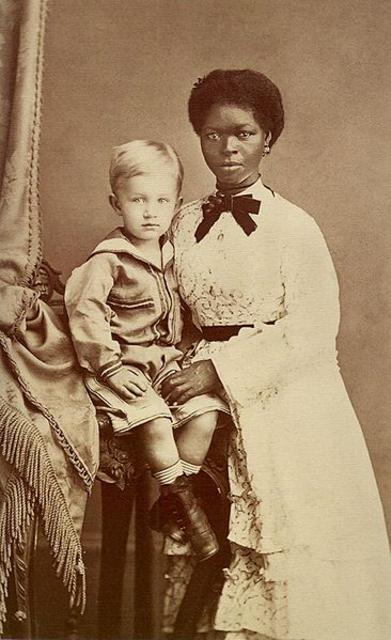
When I saw the movie The Help, I thought, “Wow, that’s like present day Brazil”. That’s what I see here. Upper-classes in Brazil often deny the basic humanity of the people working in their homes. (And to Brazilians who protest that Brazil doesn’t have The Help‘s racial component, I recommend a walk around Ipanema in the afternoon or a visit to a private daycare in Vitoria. Look at the color of the kids and look at the color of the people holding their hands.)
I believe for most people it’s unconscious. It’s how their own parents and everyone in their circle has always talked about nannies and housekeepers and drivers. They’ve internalized this division, don’t see anything wrong with it, and haven’t been challenged on it.
I’m not against paying for a housekeeper. We employ one. I’m not against paying for a nanny. I believe affordable child care is a HUGE barrier keeping women from advancing in the workforce in the U.S. and Brazil. I’m writing this while my kid is at daycare. Many of the mom’s I know are amazing professionals, and it’s only possible because they can find childcare be it a daycare or nanny. Many moms want to work. Many moms HAVE to work. Quality childcare is a necessity.
I’m against a system that keeps people from empathizing. That makes it “us” versus “them”. That causes a really nice person to ask the woman she’s paying almost minimum wage to watch her kids if she could also do the laundry.
What about the kids of the people we pay to watch our kids? Who watches them if we pay their moms $300 a month? Is it ethical to ask a woman willing to assume the enormous task of keeping two small children alive for only $350/month to also do the laundry? Is this woman really in a position to say “no”? Are we going to be annoyed if she does? If we’re paying minimal costs, why do we expect top-quality service and undying loyalty?
Beyond respecting and talking to each other as people as opposed to being constantly on guard against the machinations of “those” others who want to exploit us…I have an idea for improving things for the moms, maids, and childcare workers.
Everyone gets rid of their housekeeper.
We take the money we were paying to housekeepers and put it toward childcare, either by increasing the wage of the nanny or increasing the salary of daycare and preschool teachers. The former housekeepers come together and start cleaning-service businesses. Their former employers, now clients, hire the company for once or twice a week, and now the preschool teachers and nannies may even be able to afford the housekeepers’ services with their increases in salary. The former housekeepers can also find employment at all the new public daycares the government will open in my utopia.
And what about all the cooking and laundry and grocery shopping left in the wake of the maids? Well, I think it’s time for Brazilian men to stop watching soccer and do some freakin’ laundry.
5 of the many things that have surprised me about Brazil…
“Do you like Brazil?” I heard this question for the thousandth time last night. I don’t know why people bother to ask this question. It’s in the same category as “Does this make me look fat?” and “Did you read my last blog post?” Nobody wants an honest answer. “Do you like Brazil?” The correct response is an enthusiastic “Yes!”
At least this question has an obvious correct answer, unlike “So which country do you like better? The US or Brazil?” What am I supposed to say? I usually cop out with humor. “Neither. I’m giving up on the whole nation-state system. I’d like to start my own island tribe based on handedness.”
Another strategy I’ve developed over the years is to answer these politically loaded questions with lists: “Things I love about Brazil” or “Things I miss about the US”. Below is my favorite list. I like it because it’s personal but more unusual than the standard “Things I love about Brazil.”
Five Things That Surprised Me About Brazil
1) Stellar Dental Hygiene Brazilians are obsessed with their teeth. If you go into a restroom after lunch, there will be a wall of people between you and the sink, all of them flossing their teeth. Helpfully, many public restrooms have floss dispensers to facilitate this habit. You should brush your teeth after every meal and ideally after every snack. As an after-breakfast-and-before-bed brusher, I have the most disgusting teeth in all of Brazil. Fortunately, my husband accepts me for who I am and ascribes my poor dental hygiene and once-a-day-showering to my Anglo-Saxon ancestors’ affinity for filth. Although thanks to him, I have grudgingly become a daily flosser.
2) Your Fingers Must Never Touch Your Food When I learned that many Brazilians use a fork to eat french fries, I almost moved back to the US. Brazilians use a knife and fork for EVERYTHING! Your fingers must never touch your food. As my people created a category just for “finger foods”, this is not a custom that I’m particularly comfortable with or always able to keep in mind. I’ll be at a birthday party happily popping mini-pizzas in my mouth, when I notice everyone else at the table has a napkin delicately wrapped around their snack, creating a polite barrier between fingers and food. After 9 years, I still can’t muster that level of formality for something that came frozen out of a box. (Honestly between the finger eating and lack of teeth brushing, I’m surprised my husband agrees to go out with me.)
3) Japanese-Brazilians My initial thought when I saw my husband for the first time was “Hey, he’s white!” True story. Pretty romantic, huh? Before my husband, the only Brazilian I was aware of was Pelé, thus my unconscious assumption about how Brazilians look. I wasn’t totally wrong. According to the 2010 census, 50.7% of Brazilians do consider themselves black or mixed-race. But in addition to the 4.8 million people brought as slaves from Africa and the indigenous tribes who were already here, Brazil has had substantial immigration from Portugal, Italy, Japan, Lebanon, and Germany to name a few countries. With a history of intermarriage between the groups, Brazilians cover the entire range of possible human phenotypes.
4) Brazilians Love Volleyball! Everyone else in the world besides Americans might already know this. Probably the world loves indoor volleyball, and it’s only us Americans who are in the dark. Literally. We’d rather just sit in the dark than watch a volleyball game. But not Brazilians! If there’s no soccer game, the sports channels are covering a volleyball match. They have incredibly popular professional leagues here, and if you stay in Brazil long enough, you will find yourself at a bar with a women’s club volleyball game on the TV. Or judo. Judo is also very popular in Brazil.
5) Did You Already Add Salt? This is a question most Brazilians won’t ask because they’re going to go ahead add more salt regardless. Meal after meal, I see Brazilians get food placed in front of them and without even tasting it, they reach for the salt packets, rip one open, and rain salt down on the entire plate. Very shortly after arriving, my husband made sure to treat me to one of Brazil’s traditional meals imported from Portugal, bacalhau or codfish. Imagine a salt lick served with potatoes and onions. That’s bacalhau. I couldn’t eat it. The same was true for feijoada, a uniquely Brazilian dish involving black beans, all the leftover pieces of pig, and a few ice cream scoops of salt. Not surprisingly, Brazil has a hypertension epidemic.
Those were some of the most surprising truths I learned about Brazil. I’d come up with more, but I just ate a pretzel and must go floss my teeth.
Is your dark complexion keeping you from happiness?
Many years ago I was dating a handsome Punjabi who lived in Milan, and we took a trip to Paris. (That sentence makes me seem way more interesting than I actually am.) While leaving our hotel one morning, he offered to carry my wallet. “Thanks,” I said, “but these pants have pockets. I carry my own money. I’m not an Indian woman.” He, being a human with feelings, rightfully gave me the silent treatment for the rest of the morning. I, being an idiot, couldn’t figure out what was wrong and had to pointedly ask over lunch.
My comment was referring to my fruitless quest to find a salwar kameez with pockets during my semester in Jaipur back in 2004. I spent four months in India looking for a place to put my cash. I was trying to make a joke. I failed. To my friend, it wasn’t just not funny. It was insulting to him, to his mom, his sister, and every Indian woman, so about 500,000,000 people. Not my best moment.
I share this memory in defense of Trevor Noah, the South African comedian who will be taking over for Jon Stewart on the Daily Show. He’s gotten a lot criticism for some unfunny and unoriginal tweets about people who are overweight and Jewish. I’m still a Trevor Noah fan. Good people can be insensitive and thoughtless. These people learn from their offenses, and these offenses can be pretty glaring when moving between cultures.
Different cultures have different prejudices and sensitivities. I’ve not been to South Africa but I wonder if they have the same level of sensitivity to weight related jokes that exists (only recently) in the US. Brazil doesn’t. I don’t believe any of Noah’s tweets would raise an eyebrow in Brazil.
The truth is I’ve never been to a country that was not rampant with prejudices. Every culture has groups of people that it marginalizes, fears, or has very little contact with and thus, no sensitivity to. To make my point, here’s a global tour of prejudices I’ve encountered around the world. And since people can be the worst with all our many, many prejudices, I’ll just focus on race for now.
I once spent a summer in rural Croatia. It is the whitest place have ever been. It’s like a town populated exclusively by the audience of the Country Music Awards, except with a better grasp of geography. When I mentioned to my homestay sister that it was weird for me to be in a place with no people of any color except white, she cheerfully informed me, “Oh no, there’s one African. He plays for our soccer team. They brought him here because those people are really good at soccer.” I was also told that throwing bananas during games is just a joke. It’s all in good fun.
Morocco was the first place I discovered the product Fair and Lovely. After repeated applications, this cream will lighten the complexion of any young woman and save her from the bad husband and unhappy life resulting from dark skin. I was so horrified by it, I couldn’t bring myself to buy it as a joke. In Morocco I also learned about the two Africas. A fellow student in my program had shown me how to wrap my hair up in a scarf, and I sported the look almost daily for awhile. Eventually, my homestay mom said I should try a different style because my style was how “African women” wrapped their hair. I was momentarily confused because Morocco is in Africa, but of course she meant Sub-Saharan Africa. Black Africa. Not Arab Africa. Even in Africa you can’t be black.
India, unfortunately, also had Fair and Lovely and it was running a truly spectacular commercial. A girl, in her early teens, is on the couch watching a cricket match, pretending to call the plays into a hairbrush. Her mom appears and lovingly embraces her daughter while handing her a tube of Fair and Lovely. The girl diligently applies the cream to her face before bed. Leap to the future and a young woman with skin several shades lighter is taking her place in the announcer’s booth at a cricket match. She’s smiling, loving life, and so thankful her lightened skin has helped her get a job as a radio announcer.
White skin is also a prized commodity in Brazil. Well maybe not “white” skin, not with all the beaches and lack of clothing, but blond hair and blue eyes are prized possessions. Almost every Brazilian who sees my daughter for the first exclaims over her blue eyes. The teachers and staff at school affectionately call her “Blondie”. The staff of the preschool is almost entirely dark skinned and the students are almost entirely white.
Brazil does have very strict hate speech laws which make racist remarks a crime, and I think they do limit the amount of explicit comments directed at Afro-Brazilians. The law does not, however, seem to protect gays or anyone from the continent of Asia. If there’s a gay joke your local PC police are holding you back from, come to Vitoria, Brazil. You’ll get a hearty laugh because here men know there is nothing worse than being gay. Do you think pulling down the corners of your eyes when talking about Japan is absolutely hilarious? So do a lot of people in Brazil. Here’s a commercial for the fast food chain China in Box. Please, watch it and tell me in the comments if your mouth dropped open too.
I used to teach high school here in Vitoria, and I’ve had to stop my classes more than once to say, “Never, never do that thing with your eyes in my class.” Some students then helpfully explain that the gesture is not racist in Brazil, and Americans are too sensitive about race. I’ve heard the sentiment many times. “Americans are too sensitive about race.” Also, “Americans have a real problem with racism.” Americans are very sensitive racists.
The truth is we’re all a little bit racist or homophobic or Islamophobic. Every person has prejudices and every culture has groups it doesn’t encourage empathy with. My students here have had little to no contact with anyone from anywhere in Asia. The jokes they make reflect this. I think the solution is asking the students, asking ourselves, to consider the other group’s perspective. In short, empathy.
I know, I know. Actively respecting other people’s feelings requires thinking and we’re all so busy. It may also require us to apologize when we fail to do that thinking and offend someone, and apologizing is the worst! It implies we’re not right all the time! I also understand the temptation to blame whoever for being overly sensitive. Then we don’t have to feel guilty for hurting someone. I hate feeling guilty. It’s such a downer. Speaking of downers, we are all going to have to drop some jokes about Latinos, women, gays, foreigners, the disabled, the indigent, Catholics, Muslims…oh my god, is it even possible to be funny while respecting others? Yes, it is.
And I think Trevor Noah will learn from his mistake. I learned from mine that morning in Paris and the many more I’ve made since. Empathy requires more energy than indifference, but the result, a kinder world for all, seems worth the effort.
Something I enjoy about living in a different culture are the little reminders, even after years, that you’re not from here. Usually it’s a small thing that catches you by surprises and causes a double take. These cultural surprises are often trivial matters that you didn’t even anticipate being different, such as how socks get folded or the absence functional seat belts in the back seats of taxis.
I wonder how long a person must live in a place before the little “Wait, what?” moments taper off. I’ve been in Brazil for four and a half years but just last week I was thrown by a simple question on a medical history form.
At the dentist recently, I filled out a new patient form. I’ve become accustomed to routinely answering what I feel are very personal question such as marriage status and profession for everyone including the woman who sold me my bookshelf, but this question stopped me.
“Cor:_____________”
Cor in Portuguese means color. A medical history form handed to me by the dentist’s office asked for my color. I blinked in disbelief. I double checked with my husband. “Does this say color?” He told me it did. I asked “Ok, color of what exactly?” even though I knew the answer. He looked at the receptionist who said simply “skin.”
For an American, an American from Atlanta, Georgia who heard about slavery, the civil rights movements, and racial tensions every year in school and was in high school during the ridiculously overdue process of getting the confederate flag off of the state flag, a doctor’s office asking for skin color is shocking.
Four years in Brazil and I can still be shocked by a single word on a form. A simple piece of information that would never be asked for in my own culture. Or would it?
How often is a person in the states asked to designate her race? Isn’t the same question just phrased in what, for Americans, is a more comfortable way? Sure, we’re usually told that question is “optional” and for “statistical purposes only” but the question is still asked.
In talking to my husband afterwards, I learned that there are actually some Afro-Brazilian groups that are lobbying to get “color” included on forms. When Brazil first became a republic any mention of race was outlawed under the argument it would prevent discrimination. The result, however, was that millions of Brazilians who had been enslaved based solely on their race had no way to receive any programs targeted specifically to help them overcome circumstances created by race, thus locking them into the lowest levels of society. Now, certain Afro-Brazilian groups want “color” on forms to have data about color and race in Brazil.
So much history from a form at the dentist. That’s why, even though each cultural surprise is a clear reminder I’m living in someone else’s culture, I welcome them. Each one is a learning opportunity. Not that I always appreciate them. Learning takes energy and often I only have enough energy to be annoyed and call whatever is different stupid. (Both creativity and tolerance suffer when I’m tired.) But on good days having to pay for bottled water leads to a discussion of sewage infrastructure and a dentist’s form opens a dialogue on racial history.




 At the summer games this year in Rio de Janeiro, fans of 41 different sports will have a chance to watch competition between the best athletes in their sport. The world’s best judokas, golfers, divers, bmx cyclists, track cyclists, mountain cyclists (I had no idea there were so many different ways to cycle), trampoline jumpers, and fencers will be here in Brazil competing for gold. To be completely honest, I’m not sure what the modern pentathloners will be doing exactly, but I’m sure it’s something that I cannot.
 Portuguese and later Brazilian officials were so frightened by capoeira they outlawed any and everything related to the game. People were arrested for playing capoeira instruments, wearing the colored belts and white pants, or just whistling a capoeira song. Finally, in the 1930’s Mestre Bimba from Salvador convinced the government that capoeira was both an important cultural legacy for Brazil and (because governments respond well to financial incentives) a tourist draw. In 1937, he was allowed to open the first public and officially sanctioned capoeira school in Brazil.
 While the styles vary in speed and types of movement, both keep the same format and traditions for practicing. Capoeira is always played inside a circle of musicians, singers, other players, and spectators. The music of capoeira is performed on five instruments: berimbau, pandeiro, atabaque, agogô, and reco-reco. The musicians and singer perform continuously as players tag in and out of the circle. One more important fact! Players never actually strike each other while playing. They feint and dodge and kick, but they never land a blow. That’s why the verb “play” is used for capoeira. They’re playing, not fighting.