Category: American in Brazil

  • 7 Weeks Early

    7 Weeks Early

    Almost three weeks old!
    Almost three weeks old!

    The contractions started just before 5pm.  I didn’t know that’s what they were.  It was my first pregnancy and I’d never felt a contraction.  Everything I read about contractions emphasized back pain.  Oh the back pain!  I had no back pain. So much for preliminary research.

    What I had was pain across my lower abdomen that seemed to come in waves.  While watching my students study during the last few minutes of class for the day, I chalked the pain up to intestinal problems.  The one classic pregnancy symptom I’d had the joy of experiencing for several months was constipation.  I assumed the pain was my intestine finally in revolt, not contractions.

    Also, I was only 33 weeks along.

    I noted the increasing intensity of the pain as I caught a ride home from a fellow teacher.  I thought it odd when I finally  scurried into my bathroom at home that I didn’t really have to go.  Still, I did not think contractions.  It was 7 weeks before my due date.  I didn’t even dismiss the thought of contractions.  The thought has to enter your head in order to dismiss it and the idea of contractions never did.

    By 6:15pm however, I was in sufficient enough pain to ask my husband to call my doctor.  My doctor told me to get in a warm shower and sent my husband off to buy some pregnancy safe pain killers.  When the shower failed to lessen the pain, I began to think something was wrong.  Then there was blood.

    I called my husband.  He turned back before ever reaching the drug store.  He was on the phone with my doctor when he walked back into the apartment.  As I was yanking on clothes in the bedroom, I heard him ask “How much blood is there? If it’s just…” He stopped talking.  He’d seen the bathmat.  In less than a minute we were in the car on our way to the doctor’s office.

    Thankfully, Dr. Batistuta’s office is only five minutes from our apartment and he was working late.  It was about 7pm and the office was empty except for the doctor and his secretary, as my husband helped me climb the stairs to the exam room.  The pain was now so intense I wanted nothing more than to close my eyes and breathe.  But there were questions and Portuguese verbs to conjugate in order to answer.  I used to think speaking in Portuguese on the phone was difficult.  Speaking in Portuguese during a contraction is much harder.

    Placental Abruption.  That was my Portuguese phrase of the day.

    My doctor explained that the baby’s heart rate was elevated and that combined with the blood and contractions made him think the placenta had torn from the uterus and blood was now pumping into the uterus.  I was headed for an emergency c-section.

    After a flurry of discussion between my husband and the doctor, some quick phone calls made by his assistant, they confirmed no office with an ultrasound was open to confirm this diagnosis so we would be going straight to the emergency room.  At least, that’s what I was told happened.  I was still lying on the exam table breathing through contractions and pain that went from aching to breathtaking, never completely disappearing.

    A little before 8pm I was standing outside with my doctor trying to have small talk in Portuguese while my husband got the car.  Twenty minutes later my doctor was wheeling me into the emergency room and pushing me over to some nurses who began giving a flurry of instructions in Portuguese.  I was being prepped for emergency surgery 7 weeks before my due date and strangely enough I was not panicked.  I was too occupied with breathing through contractions and understanding the directions I was given to really dwell on worst case scenarios.  Contractions are a great distraction.  Contractions and conjugating Portuguese verbs.

    I never thought I would die.  I never thought I could die.  I never thought my baby would die.  In the moment, I never once feared for my life or my baby’s.  It was only afterwards, when researching placental abruptions, that I learned just how serious the situation was.  Not as much for me as for her.  While I lay on my side curled into a ball having a needle stuck between vertebrae, I was worried about the kinds of complications my daughter could have being born so early.  Would she have eye or ear problems?  Would she have some sort of neurological problem?  Would her lungs be working yet?

    I didn’t bring any of this up to my husband as he sat by my head in canary yellow scrubs pointedly not looking in the direction of my open abdomen.  The c-section is certainly one of the most surreal experiences of my life.  To be fully conscious while your abdomen is opened and people stick their hands in and root around your internal organs…well, surreal doesn’t quite cover it.  I felt tugging, sometimes hard tugging but absolutely no pain.  There was one hard tug and suddenly a baby was crying.  I cried for the first and only time all night.

    My daughter was born at 8:50pm on July 11.  We thought she was 33 weeks but her initial exams put her developmentally at 35 weeks.  She was just small so the ultrasounds underestimated her age.  She was 2.005kg or 4 1/2lbs.  She was on oxygen for a day and then under a UV lamp for four.  Some problems concerning her lactose tolerance resulted in her staying in Intensive care for 26 days.  But those 26 days are the subject of a future post.

    4 months old!
    4 months old!

    Yesterday, my daughter celebrated her 3 month birthday.  She smiles and coos and refuses to sleep during the day anywhere but in a someone’s arms.  That’s why there haven’t been many posts recently.  It’s hard to type with a baby in your arms.  A perfectly healthy, happy, and breathtakingly beautiful baby.


    flower

  • My Recommendation for an OBGYN in Vitoria

    My Recommendation for an OBGYN in Vitoria

    My expat identity has taken a back seat in my last few posts to the teacher or pregnant woman part of me, but after reading some blog entries from other expats in Brazil I’ve been inspired to finally write a post that has been in the back of my mind for some time.

    Coconut Water is officially recommending Dr. Paulo Batistuta for anyone in Vitoria looking for an OBGYN.

    While I’ve endorsed several Brazilian food options including açaí and moqueca capixaba, this is Coconut Water’s first official endorsement of a healthcare professional in Brazil and I’m recommending Dr. Batistuta with the same fervor I do a big bowl of açaí.

    A fairly common complaint from expats here is that doctors in Brazil don’t really explain things to you.  They tell you to get a test and bring them the results.  Unless the results require being ordered to get another test or bypass surgery, that’s all you’ll hear about them.  Another complaint specific to women in the process of childbearing is that doctors here in Brazil prefer doing c-sections to pretty much anything else.  (I’d believe even more than sex given the rate at which they are performed here.)  Some private hospitals in Brazil have c-section rates as high as 90%.

    Dr. Batistuta (Dr. Paulo here in Brazil where they use first names) defies both of these stereotypes.

    Personal anecdote.  After an early ultrasound, I noticed there was one item that had an abnormal reading, specifically low blood flow in the left uterine artery. When we took the results to Dr. Batistuta, I asked about it and Dr. Batistuta picked up a pen and immediately began sketching a uterus and arteries.  He explained what the test measured and what the result meant.  He even sketched out exactly where the placenta was attached in my uterus.  You know, the more information the better.  He assured us that this wasn’t a problem given the normal results for everything else and we’d check it again at the next ultrasound.  He was right.  Everything was normal at the next ultrasound.

    Dr. Batistuta never rushes us out the door.  I’ll pull out a list of questions.  He’ll happily answer everyone, giving me cards, books, even DVDs that will provide further information.  While I’m in the bathroom changing I can hear him and my husband chatting away about upgrading their computers’ operating systems.  We were in his office for almost an hour during our last visit.

    As for c-sections, Dr. Batistuta is one of the leading voices in Brazil for natural childbirth.  If you speak Portuguese you can watch him being interviewed on youtube.  While he will state point blank he believes the best birth for the mother and baby is one with no unnecessary medical intervention, he has also told me that ultimately the doctors and staff are there to support me and what I want.  If I ask for drugs, they will give me drugs.

    I should mention cost.  One of the great things about Vitoria is that you can get great medical care (private) for half the cost of what you’d pay in Rio or Sao Paulo.  For an office visit, Dr. Batistuta charges BR$200 ($118).  We pay this out of pocket at the visit and send a receipt to our insurance company for reimbursement.  For the actual birth, Dr. Batistuta is charging BR$4.000 ($2,353). Again, we’ll pay and get reimbursed later.  (Once the whole birthing process is said and done, I’ll do a summary of all medical expenses for giving birth in Vitoria.)

    Finally, the language issue.  Our visits are conducted exclusively in Portuguese but when I have to use an English phrase Dr. Batistuta understands.  (I suspect he is modest about his level of English and understands way more English than he lets on.)  Fortunately, my husband attends every visit and supplements my intermediate Portuguese with his native tongue thus preventing any serious misunderstandings.  I can’t say for sure how it would go if you don’t speak any Portuguese. I think everyone could muddle through but it is important to know that Vitoria is a much smaller city than Rio, Sao Paulo or Belo Horizonte and English speaking professionals are in much shorter supply here.

    If you are an expat in Vitoria looking for an OBGYN, I strongly recommend Dr. Batistuta.  He talks to his patients as intellectual equals.  He supports natural birth and medical intervention only when necessary.  He understands some English and is very patient when listening to bad Portuguese.  You can find his profile and contact info with the CECON medical group.

  • Beards Before Brains

    Beards Before Brains

    Being pregnant, I’ve become aware of several areas where evolution has either slacked off a little or failed utterly to come up with a sensible solution.  Obviously pregnancy is one of those areas.  Humans started walking upright but failed to develop a means of procreation that didn’t involve heartburn, back pain, hemorrhoids, and the inability to tie your tennis shoes.  I’m amazed were able to survive because if I were at this moment on the Serengeti trying to avoid a predator, with my diminished lung capacity and screwed up center of gravity, I’d be toast.

    Pregnancy is not the only flawed process evolution has led us to.  What master planner thought it was a good idea to combine adult bodies and still developing brains? Because this is the plight of the teenager.  A creature frequently misunderstood and the cause of many car insurance claims.  After only four months of working with teenagers, ranging in age from 14 to 17 years old, there is no doubt in my mind that I am working with children.  Children who can grow beards.

    Many if not most of my students would (and I’m sure will after they read this) vehemently disagree.  When in class I have addressed them as “children”, perhaps while they were poking each other in the ribs or making snot-like balls of glue at their desks, they have protested.  They adamantly state, “No teacher, we’re not children,” while painting their fingernails with white out.  Limited class time and a heavy curriculum keeps me from having the time to explain to them that, yes, they in fact are children and it is in no way meant to be an insult.  It is a reminder to myself that while many of my students may look like adults, towering several inches above me or with a few days worth of stubble on their chins, they do not have the brain of an adult. I need to adjust my expectations accordingly.

    Science backs me up.  Research seems to agree that 25 years is the age at which a human brain fully matures.  Recent studies have shown a significant difference between the brains of an 18 year old and a 25 year old, specifically in the prefrontal cortex.  This area of the brain is in charge of decision making, determining right-from wrong, predicting the future and exerting self-control.  All things teenagers are notoriously bad at doing.

    Again, I say that evolution really screwed up by giving people fully functioning reproductive systems before fully functional brains.  That is just really terrible planning.

    I think teenagers themselves should be out promoting this fact.  The world would probably go a lot easier on them if people started looking at them and thinking “old kid” as opposed to “young adult.”  When a kid sits quietly through a movie without disturbing anyone, they’re praised.  Well according to the research, a teenager who can think “Maybe I should not spend this movie texting my friends because it might disturb someone,” should be praised as well.  Thinking beyond themselves and predicting the future are difficult tasks for their immature brains. “Way to think about possible future consequences of your actions, little Johnny!  Good job!”

    It is hard to remember these facts.  I can’t help but expect someone with a size 12 shoe to be able to reason.  But for all the frustration that begins to bubble when I’m presented with their faulty logic (“You want me to give an extension because you were really busy the day the essay was due?  What about the other 13 days you had between when I gave the assignment and when it was due?), I truly am impressed by my students.  Because when I do remember that they are older kids with a decade’s worth of brain development still in front of them, I realize the fact they sit through 10 hours of class a day is amazing.  The fact that they spend several afternoons sitting in classes taught in a second language is amazing.

    So, I’ll do my part for my students by lowering everyone’s expectations because currently my pregnant belly and I are in the same boat as they are.  Evolution has failed us miserably.

  • You shouldn’t be teaching if you can’t figure out Facebook

    You shouldn’t be teaching if you can’t figure out Facebook

    It’s my opinion that if you can’t figure out how facebook works, you shouldn’t be teaching.

    Since becoming a teacher, any headline about the profession catches my attention and it seems like every week I read another article about a teacher getting fired or put on probation for an inappropriate tweet, blog, or facebook posting.  Out of curiosity I searched “teacher fired facebook” and got 3,490,000 hits.  “HS teacher loses job over Facebook posting” “Teacher Fired After Candid Facebook Comments”  “Teacher Sues after being fired for Facebook Pics”  It goes on and on.  One teacher took a picture of a student’s hair, posted it on facebook and added a comment making fun of the girl’s hairstyle.  Ultimately the girl’s mother saw the photo and the teacher’s comment.

    Even if I accept the fact that American culture seems to no longer have any problem with adults insulting and tearing down kids (see: the entire Internet v. Rebecca Black), I can’t accept any educated adult expecting tweets and blogs to be private.  The whole point of twitter is to communicate with many people instantaneously.  This is not the place to discuss hiring a hitman to take care of your students.

    I’ve only been teaching for four months but that is more than enough time to understand every teacher has days when she needs to vent.  Venting is healthy.  Venting fosters sanity.  Venting should NEVER be done on the Internet.  Unless you are Bill Maher and people follow you on Twitter specifically for the insults you hurl in 140 characters, do not post rants about your students, their parents or your administration online.  Talk to your partner over dinner.  Talk to your friends over drinks. Write it in a diary and save it for the bestselling memoir you’ll write when you’ve retired.  Don’t update your Facebook status.

    I agree with commenters who think teachers are held to unfairly high standard.  The Georgia teacher fired because of a picture of her drinking Guinness at the Guinness factory is an example.  Teachers are human and should not be fired for being such.  I’m just waiting for the moment my pregnant and gassy body lets one rip in front of an entire class of teenagers.  I hope it doesn’t get me fired.  The experience will be scarring enough as it is.

    However, typing and uploading your darkest thoughts in a fit of frustration or getting a few laughs from buddies at the expense of a child is unprofessional at best.  Exerting some self control is a defining characteristic of an adult.   And don’t argue an expectation of privacy because honestly, if you think something defined by the term “network” is an intimate forum, you should not be teaching.

    So I just realized I followed up a post on not judging other parents with one judging other teachers.  Hmmm.  Oh well.  No one’s perfect.  Gosh, it really is hard to keep opinions to yourself.

  • One Day as a Teacher

    One Day as a Teacher

    Here’s what I do in my new role as teacher.  I read the chapters of Great Expectations we’ll be covering, marking all difficult vocab that will probably need to be defined and difficult passages that will need to summarized as a class.  Plan class on introducing Charles Dickens and Great Expectations. Find fun youtube clip on the life of Charles Dickens.  Make adjustments to the supply and demand game that didn’t go well in class the day before.  Make new material for tweaked supply and demand game. Correct and grade 15 essays on a personal response Aesop fables.  Teach class for 3 hours.

    That was this past Wednesday.

    I realized two things after logging in to write a new post: 1) People link to my blog from pretty bizarre search terms and 2) I only wrote two posts for the entire month of April.  Last November, I cranked out more than two posts a week.  Still not anything close to the commitment of blogging all-stars, but it was still a big chunk of content for one month.  Now, I have a job and a condition called pregnancy which robs me of the energy to do anything productive past 9pm. Unless your definition of productive is eating Belgian chocolate ice-cream and streaming the previous night’s Daily Show, in which case, I make my greatest contributions to society after 9pm.

    Clearly, I’m going to have make a conscious commitment to maintaining Coconut Water.  I don’t want it sitting out languishing in the Brazilian sun developing a film of bacteria and mosquito eggs.  (Can mosquitoes lay eggs on coconut water? Probably, they’re basically invincible.)  The end result of this pregnancy is a baby, which I’m told, will devour whatever remaining free time I have and possibly my will to shower and tolerate other human beings.  The chances I’ll be getting back up to two posts a week are small.

    Or maybe not.  I will be on maternity leave for four months, and while breast feeding is supposed to beautiful, I haven’t heard anyone call it intellectually stimulating.  I might desperately cranking out posts.  In the long term though, next school year should be easier.  I won’t be new to the material and spending hours planning every class.  I’ll already have my youtube clip of Fozzy Bear reciting Robert Frost.

    The really amazing about my daily schedule right now is that I only teach part-time.  I’m in front of a class teaching 16 hours  yet find myself working all day, every day.  I think what I really need is one of those cushy full-time teaching jobs those pundits keep talking.

  • Coolest extracurricular activity ever!

    Coolest extracurricular activity ever!

    I’ve spent the last couple of days editing essays.  I’m drowning in essays.  During a break, I watched a clip of the Daily Show where they showed a commentator ranting about how teachers are paid too much for a part-time job.  I envisioned ramming a two-inch stack of ungraded essays down his throat until he chocked.  It made me happy and reminded me that I still had about 20 essays left to grade.

    When not being used as a weapon, my student’s essays are also an endless source of amusement.  I fill entire dinner conversations relating what pearls of wisdom my kids have come up with.  The essays are also helping me compile a list of potential extra curricular activities available in Vitoria for any future Brazilian-Americans I have in my house.

    It’s fascinating to see what activities teenagers in the US and Brazil share and what activities are unique not just to Brazil but to Vitoria.

    It’s no surprise a kid in Vitoria can be a soccer player but I also have competitive basketball players, skateboarders and surfers as well.  Judo is pretty popular.  There are ballet studios and acting lessons. With my guitar players, drummers, pianists and singers, I can supply any event in Vitoria with a band.  One of my students has taken cooking lessons and runs a small business catering desserts for parties.  Another is a financier in the making, having taken classes on the stock market and started his own investment portfolio.

    But I think my favorite hobby, of all the hobbies I’ve read about, is competitive oceanic fishing.  It’s not my favorite because it’s anything I’d like to be proficient at myself but because it is such an utterly foreign activity to the suburban, Atlanta culture where I grew up.  Competitive oceanic fishing!  Maybe there were some kids in my school who regularly caught trout from the Chattahoochee River but nobody was heading to Australia to compete catching marlins.  Which is exactly what one of my students did.

    I mentioned this to my husband and he said “Oh sure, Vitoria is one of the best spots for oceanic fishing along Brazil’s coast.”  Huh, a new fact about Vitoria thanks to my students’ essays.  It seems one of the perks of being a teachers is that the learning goes both ways.

    Oceanic fishing is a skill I would never have thought to offer any of my future kids.  It wasn’t part of my childhood and I would not have made it part of theirs.  Now I know.  And if the kid doesn’t like fishing, there’s always surfing, sailing, samba dancing, cooking, judo and of course, soccer.

  • New job, new blog

    New job, new blog

    Almost two months since my last post.  I know.  Bad blogger, but I have an excuse.  I got a job.  A hard job.  And the blogging had to be put aside until I found my footing.  Let me explain.

    The last time I was required to show up for work five days a week was September, 2006.  As a result, I have been blind sided, chewed up, spit out, wrung out, and manhandled by a regular work schedule.  And I’m so much happier.

    When hired as a teacher at a private school here in Vitoria, the moment called for champagne, but I have to make a rather embarrassing confession.  While I believed teaching was a better job than no job at all, I deep down thought it was beneath my potential.  I truly believed teaching was a profession people joined who didn’t think they could make it in more competitive fields.  I had a truly brilliant roommate in college who was passionate about teaching and education, but I didn’t base my assessment of the field on her.  Rather, in my facebook colored perception of reality, I based my assessment on all the mediocre students I had gone to high school with who are now, according to their profiles, teachers.  If someone who barely passed biology could go on to be a science teacher how hard can the job be?

    When I get home at night my feet are throbbing. My voice is worn out.  My patience is gone.  I don’t have energy to care about what’s for dinner let alone remain standing long enough to make it.  I drift listlessly around my apartment from 9:30 to 10 because I just can’t go to bed before 10 but I can’t think hard enough to give myself any direction.  I’m asleep by 10:30.

    It’s pretty hard.

    I now know the people in the US currently complaining about cushy teacher salaries have never really considered what teaching entails.  There’s pretty much a consensus among people who have kids that raising them is hard.  Kids don’t pay attention. They don’t think.  They lack knowledge, motor skills, and basic hygiene often into adulthood.  Ideally parents come as a two person team but often one parent ends up in charge of the kids.  Again, we agree that one parent with two or three kids, “that’s a tough job.”  Teachers have 20 kids, all to themselves, for 180 days a year.

    Think about handling a herd of those adorable, self-involved, cognitively underdeveloped munchkins.  Now think about having them all day, every day.  Did I mention you have to do more than just keep them from gluing their hair together or cracking their head open as they lean back in their chair? No, preventing physical injury is not enough.  You must also keep their attention and help them learn something they didn’t know before coming to you.  You must stimulate their creativity and logical reasoning.  You are not allowed to send the slow ones, or the obnoxious ones, or the slightly smelly ones off into a corner.  You must work with all of them.

    To sum up, a teacher must take a group of kids, keep them safe, awake, focused and then improve them.  A teacher must send the kids home as better, more knowledgeable human beings every day or she is not doing her job.  Teaching requires creativity, improvisation, patience, public speaking, stamina, organization, diplomacy, all in addition to knowledge of the subject being taught.

    Any teacher making less than a six figure salary is underpaid.

    I am underpaid. But happy.  I was wrong about teaching.  It is an immensely rewarding challenge.  One I’m thoroughly enjoying.  Not that I would say no to a six figure salary.

  • Toxic Pineapples

    Toxic Pineapples

    As a nerd and compulsive reader, I’ve always been a fan of knowledge. When choosing to know something or not, I choose know it. I’m reevaluating that stance.

    Not on everything. I still want to know how to drive a car, operate a gas stove without killing myself, and long division. What I don’t want to know is the history of my food. I’m done hearing about the nauseating conditions of pig farms, toxic levels of mercury in my sushi, and exactly what is inside my hot dog.

    I love hot dogs! They’re mouthwatering. They taste like summer, baseball games, and a Saturday afternoon spent grilling out back. Hot dog haters, have you ever tasted a dog fresh off the grill, sizzling with the skin wrinkled and striped black, smothered in ketchup, mustard, and relish? No, I doubt it because if you had you’d never want to know anything about it except how savory the first bite is. You would not want hot dogs ruined by knowing exactly what parts of the pig are in them.

    I’ve accepted that I’m going to die eventually. Nothing I do will grant me everlasting life. Because something has to get me in the end, I’m totally ok with it being too many french fries, fungus laden peanuts, or toxic pineapples.

    The peanut fungus came up in a discussion with a doctor recently. I mentioned a love of peanuts and his brow creased. He asked in what quantity I ate them? Vast quantities. He frowned. Uh-oh.

    Turns out Brazilian peanuts are prone to a fungus that will eat and destroy your liver. Or something to that effect. He was speaking in Portuguese but I could understand something bad enough happens to your liver that he does not eat Brazilian peanuts.

    Thankfully, American peanuts do not have this problem, which means my hoard of Whole Foods Peanut Butter is safe.

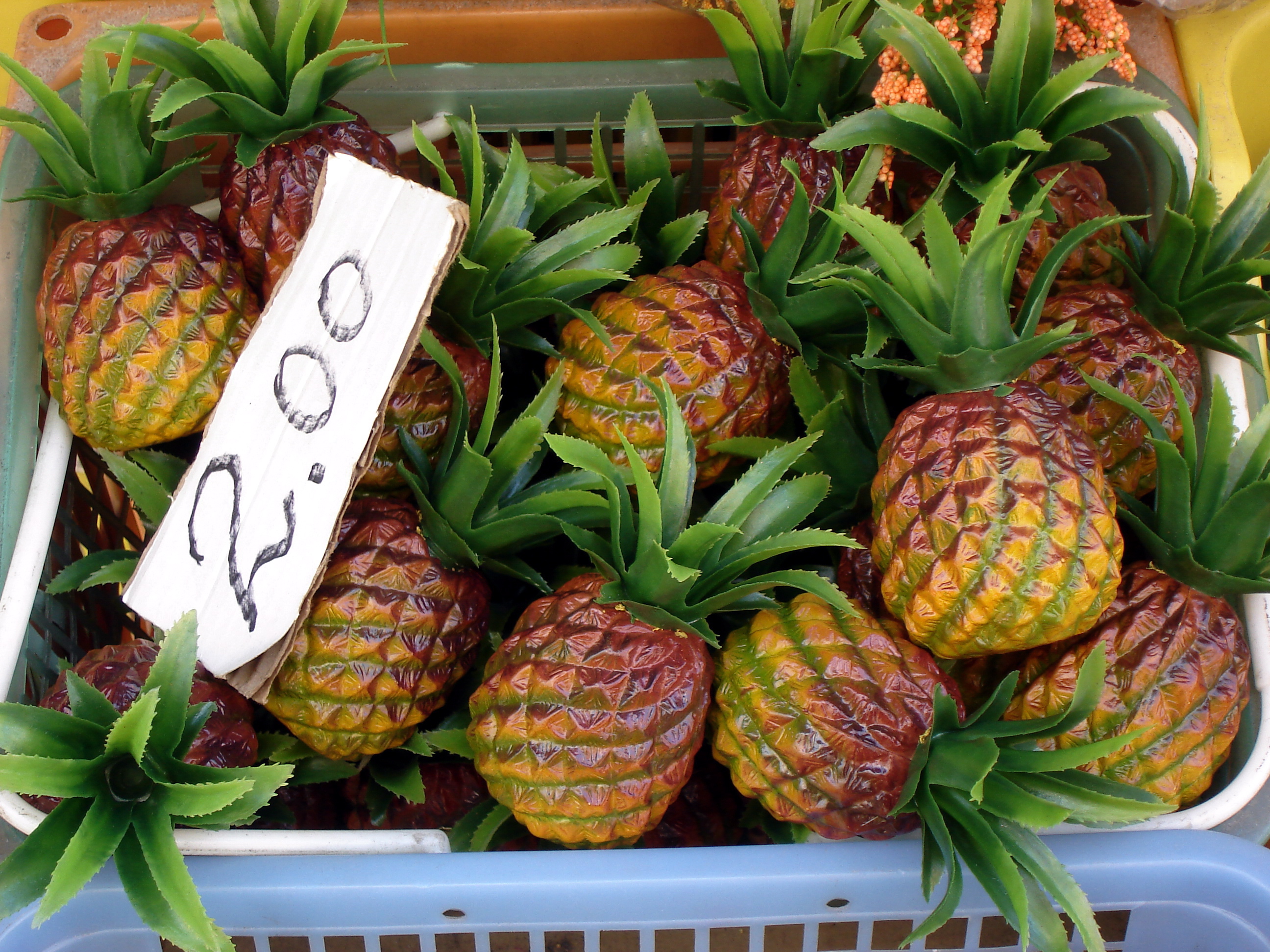
    Jumping on the band wagon of ruining foods Brynn loves, my husband started talking about pineapples. Sliced pineapple is the single greatest frozen yogurt topping. Period. I listened with growing horror as my husband told about a lawyer who works with the local farmers in our state. This lawyer learned the farmers get pineapples to ripen out of season by dousing them with pesticides.

    Wonderful. How can you buy local, when your local farmers coat your fruit in poison, not to keep the bugs off, but for the chemical reaction it produces in the fruit?

    My husband says pineapples should be ok in season. Should be but maybe not. Maybe some farmer wanted to get his pineapples to market first, so he sped things up with a little chemical enhancement.

    This is why I want to remain ignorant about my food. I’m going to go to the gym regularly, drink lots of water, eat sweets in moderation and live as long as that lifestyle lets me. That lifestyle will include hot dogs, peanuts and pineapples and I’m going to savor them in forced ignorant bliss.

  • Learning Brazilian History at  the Dentist

    Learning Brazilian History at the Dentist

    Something I enjoy about living in a different culture are the little reminders, even after years, that you’re not from here. Usually it’s a small thing that catches you by surprises and causes a double take. These cultural surprises are often trivial matters that you didn’t even anticipate being different, such as how socks get folded or the absence functional seat belts in the back seats of taxis.

    I wonder how long a person must live in a place before the little “Wait, what?” moments taper off. I’ve been in Brazil for four and a half years but just last week I was thrown by a simple question on a medical history form.

    At the dentist recently, I filled out a new patient form. I’ve become accustomed to routinely answering what I feel are very personal question such as marriage status and profession for everyone including the woman who sold me my bookshelf, but this question stopped me.

    “Cor:_____________”

    Cor in Portuguese means color. A medical history form handed to me by the dentist’s office asked for my color. I blinked in disbelief. I double checked with my husband. “Does this say color?” He told me it did. I asked “Ok, color of what exactly?” even though I knew the answer. He looked at the receptionist who said simply “skin.”

    For an American, an American from Atlanta, Georgia who heard about slavery, the civil rights movements, and racial tensions every year in school and was in high school during the ridiculously overdue process of getting the confederate flag off of the state flag, a doctor’s office asking for skin color is shocking.

    Four years in Brazil and I can still be shocked by a single word on a form. A simple piece of information that would never be asked for in my own culture. Or would it?

    How often is a person in the states asked to designate her race? Isn’t the same question just phrased in what, for Americans, is a more comfortable way? Sure, we’re usually told that question is “optional” and for “statistical purposes only” but the question is still asked.

    In talking to my husband afterwards, I learned that there are actually some Afro-Brazilian groups that are lobbying to get “color” included on forms. When Brazil first became a republic any mention of race was outlawed under the argument it would prevent discrimination. The result, however, was that millions of Brazilians who had been enslaved based solely on their race had no way to receive any programs targeted specifically  to help them overcome circumstances created by race, thus locking them into the lowest levels of society. Now, certain Afro-Brazilian groups want “color” on forms to have data about color and race in Brazil.

    So much history from a form at the dentist. That’s why, even though each cultural surprise is a clear reminder I’m living in someone else’s culture, I welcome them. Each one is a learning opportunity. Not that I always appreciate them. Learning takes energy and often I only have enough energy to be annoyed and call whatever is different stupid. (Both creativity and tolerance suffer when I’m tired.) But on good days having to pay for bottled water leads to a discussion of sewage infrastructure and a dentist’s form opens a dialogue on racial history.