Category: Travel & Inspiration

  • Visiting the Martin Luther King Jr. Historic Site: The Power of Young People

    Visiting the Martin Luther King Jr. Historic Site: The Power of Young People

    IMG_1137The wind gusted by, and my nose was numb by the time we crossed from the parking lot and entered the Visitor’s Center at the Martin Luther King Jr. Historic Site. It was a little unfortunate my step-mom and I had picked the coldest day in weeks to visit because the MLK Historic Site is a collection of buildings up and down the block where Dr. King’s childhood home and church are located. The facilities required walking. The weather required a hat.

    IMG_1148While peeling my gloves off in the Visitor’s Center, a helpful ranger told us that guided tours of Dr. King’s birth home are available for free but they’re first come first serve and you have to reserve tickets. Unfortunately for us, the next tour wasn’t until noon, and we had to move on before then. There was still the Visitor Center, the Tombs, exhibits from the life of Dr. and Mrs. King at Freedom Hall, as well as Historic Ebeneezer Baptist Church where Dr. King served as co-pastor with his father. More than enough to fill a Sunday morning.

    Passing through twelve years of metro-Atlanta public schools, I’d learned about Dr. King and the Civil Rights movement extensively. To be perfectly honest, I wasn’t expecting to learn anything new during my visit. It would be interesting to see the buildings where Dr. King actually lived but the information would be a refresher course.

    I stepped into the first stage of the Visitor Center’s overview of King’s life: Segregation. Photos, panels, and video explained the explicitly and brutally divided world Martin grew up in. On the video screen I watched footage of a young girl, book bag in hand, enter her school escorted by Federal marshals. The girl is Ruby Bridges, the first African-American student to attend an integrated elementary school in Louisiana. Well, integrated isn’t quite accurate. Bridges was the only African-American student in an all-white school.

    I’d watched the footage before, but never as a mother.

    IMG_1126This time I saw a little girl with a bow in her hair, not much taller than my own daughter, walk alone into her school. No friends, no teachers. Only four armed Federal Marshals protecting her. She barely cleared the waist of the men around her. Ruby was six years old that day. My eyes filled with tears, and I ducked my head to keep anyone from noticing.

    I left the images of children berated and under armed escort and moved on to the section on Dr. King’s early activism. His first role of national significance came when he helped organize the Montgomery Bus Boycott in the wake of Rosa Park’s arrest. It was 1955. Dr. King was twenty-six.

    IMG_1125I’d moved on from Ruby in hopes of being on more palatable ground of grown-ups being horrendous to other grown-ups, but I was staring at the face of a person whom, if I met over coffee, I would tease and welcome into adulthood. How’s that whole responsibility thing going? When I looked at the photo of Dr. King handcuffed and bent over a police desk, I didn’t see a great man. I saw a very young man.

    I scanned the other photos. A group of non-violent protesters at a sit-in. Freedom riders. Marchers with their arms linked. Dr. King attending a leadership meeting of the Student Non-violent Coordinating Committee. There it was in the name: Student Non-violent Coordinating Committee. The walls were covered with pictures of kids and young people. Eighteen, nineteen, twenty year-olds. College kids were the driving force of the Civil Rights movement. Seeing the Civil Rights Movement from the perspective of an adult older than most of its leaders were at the time shocked me.

    I’d learned about Dr. King and other leaders, John Lewis, Julian Bond, Andrew Young through the eyes of a child. I’d been told they were great men, and to a ten-year old, the footage and photos showed established adults. One grown-up is equal to any other grown-up. Anyone who has reached adulthood knows this couldn’t be farther from the truth.

    IMG_1153As I wandered through the Visitor Center, King’s church, and the other buildings, the entire site became a testament to the power of young people. Kids, teens, college students and freshly minted men and women in their twenties acted on their beliefs that the world could change and could be made better. They refused to accept the world they were about to inherit.

    IMG_1130It seems to be a favorite past time of adults to complain about the youth. There is certainly no shortage of criticism being hurled currently at young people with their selfie taking smart phones. But I did learn something during my visit to King Center. Never underestimate youth. Young people have the power of infinite possibility. Their vision hasn’t been narrowed by time. Martin Luther King Jr. did not imagine himself on the steps of the Lincoln Memorial when he called on his congregation to boycott the buses. With his twenty-six years, he imagined a more just world and acted to make it so.

    IMG_1132The quote on Dr. King’s tomb is “Free at last. Free at last. Thank God Almighty I’m Free at last.” The dates are 1929-1968. He was thirty-nine when assassinated, a young & great man.

    mlk+day+button-1This post is part of an amazing series on Martin Luther King Jr. being hosted by Multicultural Kids Blog. Check out the link for fabulous educational activities and international perspectives on the legacy of Dr. King.

  • Fortaleza, Brazil: All-I-Can-Take at the All-Inclusive

    Fortaleza, Brazil: All-I-Can-Take at the All-Inclusive

    Vacationing in Fortaleza, Brazil! A lot of a good thing.
    Vacationing in Fortaleza, Brazil! A lot of a good thing.

    I just got back from a family vacation in Fortaleza, Brazil.  Our group was made up of three generations traveling from three different cities.  It was a great trip and some memories will be with me forever.  Which is only slightly longer than all the meat I consumed will be.

    If Rio is looking to present an honest and endearing image of itself to the world during next year’s Olympic Games, they should build a barbeque pit in the international terminal and welcome each flight with a free lunch.  “Welcome to Brazil! Have a plate of meat!”

    A plate of meat, piled as high as it was wide, and a mojito made with a shot of white rum and 32 scoops of sugar was my lunch each day of our stay at the all-inclusive resort.  Because once you’ve decided on the all-inclusive vacation, you’ve clearly made self-indulgence your primary goal for the week.  No point in trying to hide it under a few leaves of arugula with olive oil.

    Of course, visiting an all-inclusive with the entire family does limit the extent to which a person can self-indulge.  Vacationing with my only-child who prefers me to any other person in the world, (She’s 4 and hasn’t met a wide range yet.) meant that I did not get the writing and reading time I would have liked.  Being unable to pass out under a palm tree with a book on my face due to parenting responsibilities, I compensated by giving my stomach completely uninhibited and unrestrained access to every buffet at every meal.

    Puddings, steak, french fries, cakes, risottos, Prosecco, sandwiches, salad, cappuccinos, tarts, omelets, shrimp, cheeses, mussels, chicken, soft drinks, sausages, pasta, mousse, fruit juices, fish, rice, beans, ice cream, croissants, pineapples, and pork were all consumed with reckless abandon.  Lunch involved at least three plates; the grilled meat got it’s own plate of honor.  Breakfast would take over an hour and I survived the long stretch between lunch and dinner by indulging in the afternoon tea, which included no tea but lots of cake.  It was four days of eating as if life was free of consequences.  All consumption and no exertion.  It was glorious and delicious.  I didn’t worry or go to the bathroom from Tuesday to Saturday.

    Actually, I did start to worry on Saturday but not because I was feeling awful.  I got worried because I didn’t feel awful.  My rational-self kept waiting for the effects of my week-long bacchanalia to catch up with me.  That part of me knew no person could eat with total abandon for long and not feel utterly disgusting.  And that part of me waited.  And waited.  Meal after meal after, I filled my plate and went back for more, my taste buds rejoicing in how life could be if I didn’t care about staying a size 8 or living past 45, and I felt fine.

    Saturday’s lunch was fish stew, fried shrimp, pork chops, rice, and french fries.  I ate some of everything washing it down with a Coke.  I enjoyed every bite and would have eaten a few more french fries if they hadn’t cleared the plates.  On the walk back to the hotel, I wondered if I should seek help.

    As we hid out from the tropical sun for a few hours in our room (because too much sun is really terrible for you), the hotel staff dropped off complimentary bottled water and coconut candy.  My husband opened up one of the candies, took a small bite, and abandoned it on the table saying “Wow, that is too sweet.”  So I immediately went over and finished it.

    I popped the last bite in my mouth, swallowed it, and thought “I will never eat anything again.”

    With that last bite of coconut candy, I hit my food wall.  The full weight of every meal landed on me and left me in a fetal position on the bed.  That was it.  I was done eating.  Possibly for the rest of my life.  It took four and a half days, but I found my physical limit for food consumption.

    I’m back home and in my normal routine that includes exercise and vegetables.  My parents have gone back to the States and my daughter is back in daycare.  I’m already looking forward to our next vacation, but perhaps a camping trip would be healthier.

    I’ll bring the s’mores!!!

    TingNewBlue

  • Flying with Preschoolers: It can always get worse.

    Flying with Preschoolers: It can always get worse.

    My only parenting standard at airports is "don't lose her".
    My only parenting standard at airports is “don’t lose her”.

    My little family of three took a trip to Rio de Janeiro this weekend.  Our nephew recently had a birthday and we needed to put in some face time with my husband’s family.  It’s only a 45 minute flight from Vitoria to Rio, but that was long enough to learn a valuable lesson.  There is no length of time short enough a three year old can’t turn it into forever.

    It’s like in Interstellar.  For the pilot and crew who have tasks to complete, 45 minutes is barely enough time to toss bags of crackers at everyone.  They’re the lucky ones down on the planet.  The parents of small children are the ones stuck in orbit who stumble off the plane with more grey hair and beards, demanding to know what year it is.  How long were we up there?  Six years?  Ten?

    For our flight home, boarding was scheduled for 6:50pm.  Right at dinner time! But my husband and I were prepared.  We had packed sandwiches…which my daughter ultimately refused to eat because we miscalculated the nap.

    The ride to the airport was about 30 minutes.  When my daughter fell asleep in the taxi, we thought “Oh good, she can take a short nap and be in a better mood.”  Only, she didn’t fall into nap-time sleep.  She fell into bedtime-for-the-night sleep, and as my grandmother says, “You don’t need to step on a snake to know it’s going to bite you.”  The same principle applies.  You don’t need to wake a preschooler up from deep sleep to know it’s going to cry.

    And cry she did.  Through the whole check-in process.  While we searched for a place to sit.  While I bought water and snacks.  Even after we resorted to the emergency M&Ms.  Eventually, she calmed down and filled her stomach with 2 tiny bites of sandwich and 5 pão de queijo.

    No longer hungry but still exhausted from the weekend, her emotional pendulum swung to the other extreme. We then had a deliriously giddy 3 year old on our hands.  While deliriously-giddy child is less emotionally exhausting than inconsolable child, she is more physically exhausting because deliriously-giddy child cannot occupy the same space for more than 3 seconds.

    Did I mention that my back locked up this weekend?  It happened while checking in at the airport for our flight to Rio.  For the first time in my life.  I couldn’t bend over, lift anything, or even take a deep breath the entire weekend.

    Because I was benched from parenting due to injury, my husband was the one running after her while I kept our place in all the various lines.  He was the one who chased her through security, from the gate to the plane, and took her on the bathroom run she needed the moment we stepped on the plane.

    Eventually the plane took off and everything was ok. For about half an hour.

    With fifteen minutes of flight time left, my daughter decided she could no longer tolerate her seat belt.  My husband and I desperately tried to head off the fit we could see coming.  She was straining and arching her back against the seat belt.  Her face was scrunched and turning red.  She stopped speaking in sentences and devolved to “No seat belt!”  Very aware of the 150 people trapped on the plane with us, I grabbed a doll and made it sing “Let It Go”.  As we got to the chorus, my daughter joined in and shrieked “Let it poopy! Let it poopy!”  She dissolved into a fit of laughter and proceeded to sing at the top of her lungs different versions of the song featuring everything from pee pee to smelly socks to farts.

    I’m certain if there had been a vote, the other passengers would have unanimously voted us off the plane.

    That was the emotional knife edge we balanced on for the remainder of the flight.  We teetered between a breakdown over the seat belt and belting out classic Disney songs rewritten to feature bodily functions. “Let it fart! Let it poopy! Let it poopy and faaaaart!” The plane eventually landed three months later, and we made it home where my daughter finally ate a peanut butter and jelly sandwich and went to bed.

    All in all, it was a pretty uneventful trip.  It could have been so much worse.

  • We’re All A Little Prejudiced: My Personal Encounters with Racism Around the World

    We’re All A Little Prejudiced: My Personal Encounters with Racism Around the World

    03380d86195895d94985f46283c97370
    Is your dark complexion keeping you from happiness?

    Many years ago I was dating a handsome Punjabi who lived in Milan, and we took a trip to Paris.  (That sentence makes me seem way more interesting than I actually am.)  While leaving our hotel one morning, he offered to carry my wallet.  “Thanks,” I said, “but these pants have pockets.  I carry my own money.  I’m not an Indian woman.”  He, being a human with feelings, rightfully gave me the silent treatment for the rest of the morning.  I, being an idiot, couldn’t figure out what was wrong and had to pointedly ask over lunch.

    My comment was referring to my fruitless quest to find a salwar kameez with pockets during my semester in Jaipur back in 2004. I spent four months in India looking for a place to put my cash.  I was trying to make a joke.  I failed.  To my friend, it wasn’t just not funny.  It was insulting to him, to his mom, his sister, and every Indian woman, so about 500,000,000 people.  Not my best moment.

    I share this memory in defense of Trevor Noah, the South African comedian who will be taking over for Jon Stewart on the Daily Show.  He’s gotten a lot criticism for some unfunny and unoriginal tweets about people who are overweight and Jewish.  I’m still a Trevor Noah fan.  Good people can be insensitive and thoughtless.  These people learn from their offenses, and these offenses can be pretty glaring when moving between cultures.

    Different cultures have different prejudices and sensitivities.  I’ve not been to South Africa but I wonder if they have the same level of sensitivity to weight related jokes that exists (only recently) in the US.  Brazil doesn’t.  I don’t believe any of Noah’s tweets would raise an eyebrow in Brazil.

    The truth is I’ve never been to a country that was not rampant with prejudices.  Every culture has groups of people that it marginalizes, fears, or has very little contact with and thus, no sensitivity to.  To make my point, here’s a global tour of prejudices I’ve encountered around the world.  And since people can be the worst with all our many, many prejudices, I’ll just focus on race for now.

    I once spent a summer in rural Croatia. It is the whitest place have ever been.  It’s like a town populated exclusively by the audience of the Country Music Awards, except with a better grasp of geography.  When I mentioned to my homestay sister that it was weird for me to be in a place with no people of any color except white, she cheerfully informed me, “Oh no, there’s one African.  He plays for our soccer team. They brought him here because those people are really good at soccer.” I was also told that throwing bananas during games is just a joke. It’s all in good fun.

    Morocco was the first place I discovered the product Fair and Lovely.  After repeated applications, this cream will lighten the complexion of any young woman and save her from the bad husband and unhappy life resulting from dark skin.  I was so horrified by it, I couldn’t bring myself to buy it as a joke.  In Morocco I also learned about the two Africas.  A fellow student in my program had shown me how to wrap my hair up in a scarf, and I sported the look almost daily for awhile.  Eventually, my homestay mom said I should try a different style because my style was how “African women” wrapped their hair.  I was momentarily confused because Morocco is in Africa, but of course she meant Sub-Saharan Africa. Black Africa. Not Arab Africa.  Even in Africa you can’t be black.

    India, unfortunately, also had Fair and Lovely and it was running a truly spectacular commercial.  A girl, in her early teens, is on the couch watching a cricket match, pretending to call the plays into a hairbrush.  Her mom appears and lovingly embraces her daughter while handing her a tube of Fair and Lovely.  The girl diligently applies the cream to her face before bed.  Leap to the future and a young woman with skin several shades lighter is taking her place in the announcer’s booth at a cricket match.  She’s smiling, loving life, and so thankful her lightened skin has helped her get a job as a radio announcer.

    White skin is also a prized commodity in Brazil.  Well maybe not “white” skin, not with all the beaches and lack of clothing, but blond hair and blue eyes are prized possessions.  Almost every Brazilian who sees my daughter for the first exclaims over her blue eyes.  The teachers and staff at school affectionately call her “Blondie”.  The staff of the preschool is almost entirely dark skinned and the students are almost entirely white.

    Brazil does have very strict hate speech laws which make racist remarks a crime, and I think they do limit the amount of explicit comments directed at Afro-Brazilians.  The law does not, however, seem to protect gays or anyone from the continent of Asia.  If there’s a gay joke your local PC police are holding you back from, come to Vitoria, Brazil.  You’ll get a hearty laugh because here men know there is nothing worse than being gay.  Do you think pulling down the corners of your eyes when talking about Japan is absolutely hilarious?  So do a lot of people in Brazil.  Here’s a commercial for the fast food chain China in Box. Please, watch it and tell me in the comments if your mouth dropped open too.

    I used to teach high school here in Vitoria, and I’ve had to stop my classes more than once to say,  “Never, never do that thing with your eyes in my class.” Some students then helpfully explain that the gesture is not racist in Brazil, and Americans are too sensitive about race.  I’ve heard the sentiment many times.  “Americans are too sensitive about race.”  Also, “Americans have a real problem with racism.”  Americans are very sensitive racists.

    The truth is we’re all a little bit racist or homophobic or Islamophobic.  Every person has prejudices and every culture has groups it doesn’t encourage empathy with.  My students here have had little to no contact with anyone from anywhere in Asia.  The jokes they make reflect this.  I think the solution is asking the students, asking ourselves, to consider the other group’s perspective. In short, empathy.

    I know, I know.  Actively respecting other people’s feelings requires thinking and we’re all so busy.  It may also require us to apologize when we fail to do that thinking and offend someone, and apologizing is the worst!  It implies we’re not right all the time!  I also understand the temptation to blame whoever for being overly sensitive.  Then we don’t have to feel guilty for hurting someone.  I hate feeling guilty.  It’s such a downer.  Speaking of downers, we are all going to have to drop some jokes about Latinos, women, gays, foreigners, the disabled, the indigent, Catholics, Muslims…oh my god, is it even possible to be funny while respecting others?  Yes, it is.

    And I think Trevor Noah will learn from his mistake.  I learned from mine that morning in Paris and the many more I’ve made since.  Empathy requires more energy than indifference, but the result, a kinder world for all, seems worth the effort.

  • Behind the Scenes at Garoto Candy Factory

    Behind the Scenes at Garoto Candy Factory

    It’s not been a good week for healthy or even reasonable eating. My multi-helping Thanksgiving dinner was followed by a birthday dinner that consisted solely of red wine, red meat, and chocolate petit gateau. Topping the decadence of a rare filet wrapped in presunto is difficult but if you want to try, I suggest visiting a chocolate factory.

    Today, we visited the Garoto Chocolate Factory, the fourth and final thing to do when visiting Vitoria. Garoto is the brand of chocolate here in Brazil and while technically owned by Nestle nowadays, Garoto chocolates are 100% Brazilian.

    A factory whirring and buzzing away is one of the purest examples of human ingenuity. I was frequently hypnotized by the rhythmic filling and flipping of candy trays to the point I became completely unaware the guide was speaking. The production line is amazing. Each machine is perfectly timed, measured, programmed, and maintained. Here’s the process for one single candy, the famous (to anyone who has spent a month in Brazil) Serenata de Amor.

    Serenatas are chocolate coated balls, with crispy wafer shells surrounding a hazel nut creme filling. They are the overwhelming favorite among Garotos candies.

    First on the conveyor belt are the shells in long sheets. The shells arrive on the conveyor concave. They are flipped on a ferris wheel contraption before passing through a humidifier. They are rehydrated by 5% and I would love to know how long it took to determine 5% provided the optimum crunch.

    After their trip through the sauna, the shells are filled. Tubes running across the ceiling, labeled “clear filling”, squirt the filling into each half shell before sending the sheets down the conveyor to be pressed together. The now complete balls, still together in sheets, roll through a refrigerator to cool the filling. Then they’re cut into individual balls of yumminess.

    Finally, it’s time for the chocolate.

    We followed the conveyor belt into another room and the smell alone was enough to satisfy any chocoholics craving for months. The shells pass first through a cascade of dark chocolate, are cooled and then are drenched in milk chocolate. They are sorted and distributed along the conveyor belt to four different wrapping machines. I have no idea how these machines work. Candy went in naked and came out with neatly twisted wrapper. It happened too fast for the human eye.

    Just how fast? Depending on the setting, the machine can wrap between 850 to 1200 pieces in a minute. And there are four of these machines wrapping 24 hours a day. In a single day this factory produces 3.5 tons of Serenata de Amors.

    Of course the tasting stations along the way were gluttonous and generous enough to put you off chocolate until Easter (which the factory is already producing for), but it was seeing the production, spinning and whirring, perfectly timed that I enjoyed the most. The engineering on display gives me faith in humanity. If we can build a sauna for 3.5 tons of candy, can a pill that increases your metabolism on holidays and candy factory visits be far off? That would be pretty sweet!

  • O Convento Nossa Senhora da Penha

    O Convento Nossa Senhora da Penha

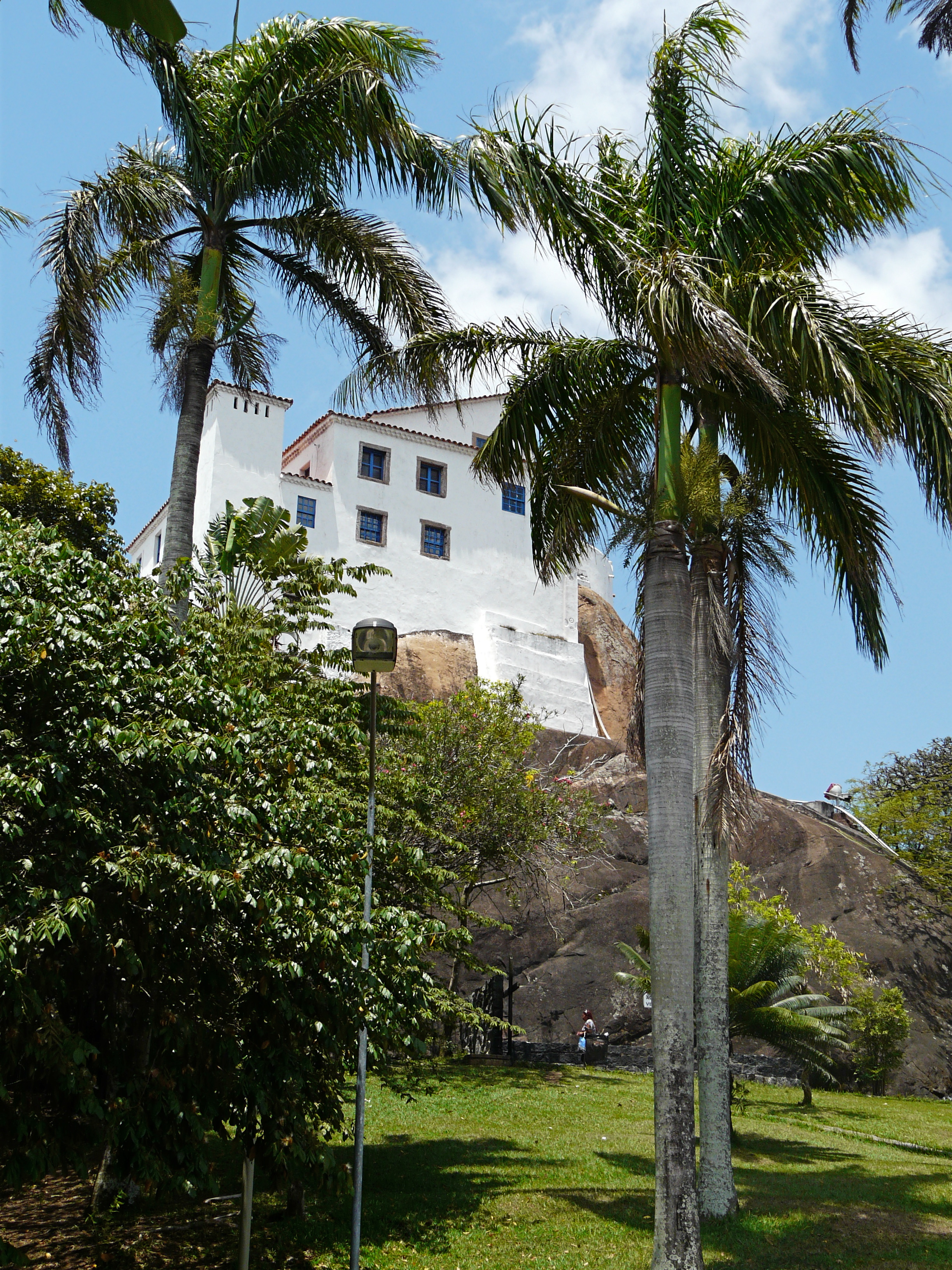
    I mentioned in a previous post the four attractions of Vitoria: 1) eating the regional fish stew more appetizingly called Moqueca, 2) visiting one of the beach towns just outside of the city, 3) visiting the 16th century Convento de Nossa Senhora da Penha and 4) visiting the Garoto Candy Factory.

    My husband and I recently did number three. We took a morning and wandered around what turned out to be a nun-free convent.

    The Convento da Penha is surprisingly not a convent at all. At least, when I heard “convent” I imagined a group of grumpy yet ultimately tender hearted women wearing black and all possessing phenomenal singing voices. I’m not Catholic but I saw the groundbreaking documentary Sound of Music and it’s contemporary follow-up Sister Act.

    Unfortunately, there are no nuns there today, nor have there ever been. The paintings of monks everywhere only confused me further. Clearly, “convento” has a different meaning in Portuguese.

    Because there was no soaring soprano, we had to be entertained by history and an interesting yet disturbing “Wall of Miracles.”

    The Wall of Miracles. People who have had their prayers answered by Nossa Senhora da Penha will post thank you messages on her wall. (No kids, Nossa Senhora is not on facebook. There’s an actual wall.)

    It’s a lovely concept that ends up being darn creepy. Many people have said thank you with pictures of the gaping wounds and mauled limbs that were saved. Or with locks of hair. Few things creep out like 30 year-old locks of hair. Gross!

    One of the older “thank you” walls, comfortingly free of human hair.

    The city of Vila Velha is just across the bridge from Vitoria. For those who know Rio, the relationship between Vitoria and Vila Velha is more like Zona Sul and Barra than Rio and Niteroi.

    People who live in Vila Velha talk about the low cost of an apartment by the beach and those in Vitoria say “Yeah, but you have to live in Vila Velha at least an hour away from anyplace you’d actually like to be.”

    Here’s one of the Convento’s original telephones they’ve successfully restored. There’s a fund accepting donations if you’d like to help with the restoration of the original snack bar.

    It’s worth visiting the Convento if only for the spectacular views of Vitoria and Vila Velha. My only complaint is that after spending an entire morning there, I still don’t know which Mary sighting Nossa Senhora da Penha refers to. Can anyone help me out here?

    Next stop on our tour of Vitoria, the Garoto Candy Factory tour! Our tour is scheduled for a week from Monday. We’ve been instructed to wear long pants and no jewelry. Sounds more hardcore than my tour of Hershey World.

  • The Delicious Moqueca Capixaba

    The Delicious Moqueca Capixaba

    When visiting Vitoria there are exactly four things to do: 1)spend the day at one of the nearby beach towns, 2) visit the Garoto candy factory, 3) see the 16th century Convento da Penha and 4) stuff your face with Moqueca.

    Moqueca (pronounced Mookecka) can generally be described as a fish stew. Or, more accurately, the greatest fish stew ever made. There are two kinds of Moqueca in Brazil, Moqueca Baiana and Moqueca Capixaba. The basic ingredients are the same for both, fish, onions, tomatoes, garlic, and cilantro.

    The Moqueca Baiana, from the state of Bahia, uses dende oil (a kind of palm oil) and coconut milk


    The Dende Palm

    The Moqueca Capixaba, from Espirito Santo, draws more from native Brazilian cuisine. Traditionally, it’s cooked in a pot made with black clay and tree sap. The stew is colored using arucum, a natural pigment made from the urucu flower. Moqueca Capixaba uses olive oil instead of dende and doesn’t have coconut milk.


    The urucu flower

    Which version of Moqueca is tastiest? Well, that depends on which Brazilian you ask. Unfortunately, I’ve not had the Baiana version in order to declare definitively that the Capixaba version is better, but I can say the Moqueca Capixaba is not just a dish. It’s an experience.

    If ordering a Moqueca, I recommend having a very early, light breakfast and foregoing food for the rest of the day. If you’re a calorie counter, you might as well plan on not eating for the preceding 24 hours. You should also have the afternoon blocked off for napping. There is no strolling or sight seeing after this meal.

    You’ll be able to choose what kind of fish you want, but in Espirito Santo it’s almost always a kind of hard, white fish. My husband and I always order dorado. That is a hearty fish. We also like to have a shrimp sauce. As you can see the restaurant in Ubu is pretty generous with their shrimp.

    In addition to the stew, you’ll also get white rice, piraõ (a fish juice goo, very tasty) and Moqueca Banana (amazing!). Our favorite place also includes a delicious and totally unnecessary fried shrimp appetizer.

    Everything is brought to the table in a steaming, bubbling collection of black pans. The steam rising off the stew is so thick for a few seconds you can’t see across the table. Serving yourself is like dipping into a witch’s cauldron.

    There is no better way to spend an afternoon than gorging on Moqueca followed by a long, quiet nap on the beach. It’s become our Saturday routine, weather permitting. We always love company, so shoot me an email if you’d like to join us sometime.

    The Moqueca pictures were taken at Moqueca do Garcia, on Ubu beach, directly in front of the sea. Find Ubu and you find Garcia.


  • Ubu, our hidden gem

    Ubu, our hidden gem

    For me, one of the greatest pleasures life in Vitoria has to offer is the opportunity to visit a gorgeous beach, on a gorgeous day. Can’t I do that in Rio? Yes, but I have to share the beach with 1 million other people. I don’t really like to share. That’s why I prefer this little, hidden gem called Ubu.

    The coast of Espirito Santo is lined with small beach towns. The relatively small population of the state will head out every weekend and drive to one of the three or four beaches within an hour of their homes. If you’re willing to drive an hour and half, you can have the beach to yourself.

    Yesterday was a perfect beach day. It was the kind of day against which all other beach days are judged. A blue sky with a few clouds like stretched out cotton balls. The temp was in the 80s and a constant strong breeze made everything perfect. There were not more than 30 people on the beach. A gorgeous beach, on a gorgeous day and we got it all to ourselves.

    I’d tell you how to get to Ubu, but then you might actually come.

    And did I mention the moqueca restaurant in front of the beach?

    The famous Moqueca Capixaba deserves and will receive its own post. To be continued…

  • Welcome to Vitoria, Brazil

    Welcome to Vitoria, Brazil

    Last Monday, my husband and I loaded up our suitcases, and after being delayed by a meteor, we arrived at our new home, Vitoria.

    Vitoria is the capitol of Espirito Santo, the state immediately north of Rio de Janeiro state.  Including the metro area, Vitoria has a population of roughly 1.6 million people.  That’s only about 13 million less than Rio.

    I’ll be writing more about the city and how life here compares to that in Rio as I explore the city.  For now, here are some of the neat places I’ve found in our new neighborhood.