Tag: Rio de Janeiro

  • To American School or Not To American School in Rio de Janeiro

    To American School or Not To American School in Rio de Janeiro

    What would expect to get for $40,000? A great car? A renovated kitchen? What about $40,000 every year for four years, $160,000? A Harvard diploma? Nope, try a high school diploma.

    The American School in Rio de Janeiro, at the high school level, costs $33,000 a year. New students pay a registration fee of $6,500, making the grand total for freshman year $39,181. This does not include bus fees or lunch. Now, if you only have a toddler, it’s much more reasonable. Just $19,600 for half day pre-school.

    A few months back I got a message asking about schools for American kids in Rio de Janeiro. Full disclaimer: I have no kids of my own. What I know about EARJ, the American school in Rio, comes from working with high schoolers applying to college in the US. And that was only for two years. My sample size is admittedly small. Weight my opinion what you will.

    I’ve never written about EARJ because I was working with kids attending the school (i.e. their parents were paying clients). They were all great kids and I thought the professional thing to do was to remain neutral on the subject.

    Now that I’m based in Vitoria, here’s my opinion. For $40,000 a year, I expect my child to be able to build a time machine to travel back to ancient Rome and discuss in fluent Latin with Julius Caesar his reasons for taking the army across the Rubicon.

    It’s not that the school is bad. On contrary, I’ve met some really bright and driven kids who go there. I’ve also been stared at by a room of blank faces when asking for the formula for the area of a circle. My problem with the American school is that you pay $40,000 for the equivalent of a solid public school education.

    In my classes, students from the British school and Brazilian private schools like Sao Agostinho ($9,900 per year), consistently out scored the EARJ kids in math. Let’s not talk about the EARJ kids’ abysmal writing scores. I now think the best way to learn English grammar might be by taking it at a Brazilian high school.

    Essays, vocabulary and reading comprehension are EARJs strong points. This makes perfect sense given American educational culture. American teens (or Brazilians who attend an American school) don’t know what to do with a semicolon but they can express their personal opinions quite fluently. We also tend to focus more on the type of critical thinking tested in reading comprehension.

    To be clear, when I say the EARJ kids score better, that doesn’t mean they’re making 800s on the practice tests. No, the scores I saw were typically average, if not a little below. And here’s the amazing thing, they seem totally unaware of the fact that they are average.

    I said earlier that the kids I’ve taught were great. I genuinely liked everyone of them. There’s just a sense of entitlement common to the EARJ culture. Pausing to look up from their iPhones and Blackberrys, kids with average SAT scores will tell you how NYU is their backup school. Or maybe Duke. Duke might be ok if Cornell turns them down.

    NYU as a backup? Maybe if you’re the next Stephen Hawking. Where are the guidance counselors?! How can these kids be in their junior year of high school with no clue as to what a competitive SAT score is? For $40,000 a year, I’d want someone my kid can dictate her essay to.

    And we’re back to what you get for your money. I would assume that one of the benefits of sending your kids to the American high school as opposed to the British or Brazilian schools, is that you have a leg up when it comes to college admissions in the US. Someone would be there to guide you through an admissions process that is complex, bureaucratic and unique. It doesn’t seem to be the case at EARJ. The kids don’t seem more knowledgeable than any other students.

    So it’s left to the SAT teachers to talk to the kids, point out the average scores, and crush their dreams. Thanks a lot, EARJ!

    My husband and I will most likely go the Brazilian school route with our kids. They will get their English lit exposure from Mommy’s Summer Reading List. Expats moving to Rio with older kids probably can’t put them into a competitive, Brazilian school like Agostinho or Bento. In that case, I’m forced to be a traitor and recommend the British school. Their students have a more solid foundation in math and English and the school’s a little cheaper.

    Of course, if Chevron is footing your tuition bill, hell, go crazy. Enroll your kids, your maid’s kids, and your dog too. The campus is gorgeous and I think each student is given her own pet monkey.
  • My Peculiar Professional Niche: Helping Brazilian Students Study Abroad

    My Peculiar Professional Niche: Helping Brazilian Students Study Abroad

    Last Friday, Veja.com, posted an article on the growing number of Brazilian students attending college abroad. I found the article from a link posted by one of my former students, who just happens to be featured in the article. Flavia, is one of the 24,000 Brazilians, who attended college abroad in 2009. She’s studying economics at Harvard. I like to think I played a very small part in getting her there.

    My peculiar niche in the great market of Rio de Janeiro was teaching Brazilians how to write the personal statement for college applications. I also taught Kaplan SAT prep classes through FK Partners, but it was the essay workshop that I loved most.

    The Fulbright/Education USA office in Rio was kind enough (desperate enough) to let me develop a workshop despite the fact I had very little experience teaching kids. I also had real doubt as to whether or not I could spend time with a room of full of teenagers and not resort to physical violence at some point. I did not like high schoolers when I was one, I was pretty sure they hadn’t improved in 8 years.

    Well, 8 years changed something because I LOVE working with teenagers. At this age they’re just starting to figure out who they are as individual people, with their own opinions and dreams. Even at their most self-absorbed moments, I find them fresh and amusing. (Of course, I’m teaching kids who are trying to attend college. The true hooligans don’t sign up for my class.)

    Flavia was in my very first workshop. I told the kids they were my guinea pigs (a metaphor I then had to explain) and they were great. Respectful of me and supportive of each other. That support turned out to be a critical element.

    It turns out a workshop on personal statements really does get personal. In two weeks, I knew what achievement my students were most proud of, what they were afraid of and their most important memories. Forget therapy. If you want to know the inner most thoughts of a group of teenagers, have them write a personal statement.

    I also love the cultural elements that come into play. You might not know, but probably are not surprised to learn, that writing about yourself in first person is a very American thing. While my students definitely struggle with prepositions, they are completely thrown by the first person. I have been told time and again that Brazilian students never write in first person.

    And this whole, “what event in your past has most shaped who you are today” self-reflective stuff. “American universities really want to know about what I learned from my mom?” “Why does my opinion matter? I’m not anyone important.”

    Can you imagine an American teenager asking why people would care about his opinion?! It’s pretty much assumed by all American teens that their opinion is in fact the only one that matters. And that’s what I love about the workshop. I get to see how a different culture interprets something so ubiquitous to my American perception. The College Application Essay.

    Unfortunately, I won’t be giving any essay workshops this fall. Our move to Vitoria has made that impossible. But I am pursuing some options that I hope will allow me to keep working with teenagers and hopefully, send a couple more Brazilians Flavia’s way.

  • Free Speech in Brazil

    If there is one group of people I would not want to piss off, it’s comedians.  They may make other people laugh but comedians themselves can be a savage and unforgiving group.  Think Tina Faye and Sarah Palin or Jon Stewart and anyone at Fox News.  A good comedian can leave someone’s ego in tatters and send him running for mommy.

    Maybe it’s that ability Brazilian politicians feared when back in July at the official start of the campaign season,  the electoral commission decided to start enforcing a law that prohibited ridiculing a candidate.  Specifically, radio and tv personalities cannot create audio or video content that degrades or ridicules a candidate, party or coalition.  The fine for a single infraction is R$200,000.

    As an American, I was shocked when I read this.  Because of course, as an American I know what true democracy is and am its de facto spokesperson when abroad.  I know the right to mock politicians is sacred.  It’s a cornerstone supporting the entire institution democracy.  Freedom to religion, property, guns, and to mercilessly ridicule politicians.

    In the midst of my righteous indignation on behalf of free speech, my husband pointed out, correctly, that free speech is a myth.  All countries regulate speech in some way.  The type of speech that gets regulated is determined by culture.  In the US, we allow the most grotesque distortions of facts to be presented as truth.  And in addition to Fox News, we also allow political satire.  We do, however, regulate speech related to sex.  You can call the President a nazi but you can’t say the word vagina.

    If there are precedents of regulating offensive speech, then it’s understandable the Brazilian legislature wants to protect the image of the candidates from harmful humor.  Right?  Turns out most Brazilians are not political candidates themselves, strongly value free speech, and really enjoy satire.  Hundreds joined comedians in a protest through Copacabana.  Legal experts throughout the country condemned the law.  One op-ed in O Globo said the law ignores the fact that truth is often presented through satire.  Also, it’s unconstitutional.

    A few people who share that opinion, 6 to be exact, are on the Supreme Court and last week voted to suspend the law.  Even the justices who dissented agreed the law was never meant to be applied to comedians, but felt its complete suspension was unnecessary.  It’s a victory for free speech and Brazilian comedians have something to smile about.

  • Flight Changed Due to “Meteor Delay”

    Flight Changed Due to “Meteor Delay”

    My husband and I arrived in Vitoria yesterday, three hours later than planned.  Our flight was eventually moved to a different airport because, according to the departure board, of a “meteor delay.”

    I can’t be certain, but I’m willing to bet had there been an actual meteor hurtling down out of the sky, I would have been much more amenable to changing airports.  A meteor crashing into Guanabara Bay would have put things into perspective and made having to pass through security at two different airports seem a comparatively minor inconvenience.  And it would have made for an awesome story.

    Alas, there was no meteor involved in our meteor delay.  You’ve probably already guessed that “meteor” is short for meteorological, which is a fancy way to say fog.  Our flight was moved due to fog.

    While not nearly as interesting as a meteor, this particular event is a curious yet common occurrence in Rio.  Cariocas call it névoa, or neblina.  It is a dry fog that blankets the entire Guanabara Bay reducing visibility in the area to almost nothing.  The névoa is a winter phenomenon and happens when the air is particularly dry over a body of water.

    I don’t have a lot of experience with fogs but the little I’ve had led me to believe fogs are always damp.  Rio’s dry fog was a truly bizarre phenomenon the first time I experienced it.  Our apartment in Rio overlooks Guanabara Bay and it’s pretty amazing to have the entire bay disappear from view.

    The fog quickly goes from amazing to pain in the ass when it closes the local airport and forces you to go across town with 150 lbs of luggage.  But we’re here.  We made it to Vitoria in one piece, as did the wine glasses.  A statement we might not be able to make if there had been an actual meteor.

  • Great Things About Rio: Open Windows

    Great Things About Rio: Open Windows

    My last post was a little down on Rio.  What can I say?  My brother’s plane was canceled because drug dealers invaded a hotel and I ran out of peanut butter.

    Today, I had a delicious lunch while sitting outside on a beautiful afternoon.  Spring has come to Rio and the temperature is perfect, warm enough to wear a tank top without a jacket but not hot enough to make you sweat.  Plus, I saw a monkey this morning and fuzzy monkeys are one thing Rio has going for it. All that is to say, today I like Rio.

    Because Rio and I are on good terms today, I thought I’d return to my Great Things About Rio series.  The spectacular weather has highlighted a common practice here, which I intend to continue whenever I return to the US.  Here in Rio, people open their windows.

    Growing up, if a window in my house was opened, an adult always raced to it, vaulting over the coffee table, while shouting “The air! Don’t let the air out!” and then slammed the window shut crushing the bluebird that had landed on the sill.  Air was apparently a very precious commodity as we suburbanites moved from one hermetically sealed environment to another.  Heated or cooled, the air could not get out.  Thus, the windows remained shut.

    I guess there is an abundance of air in Rio because people just leave the windows open.  While the air inside the apartment does escape, it is replaced by air from the outside and the outside air brings all sort of wonderful things with it.  The sounds of birds, the shouts of kids playing soccer, the smell of beans and fish being prepared, the occasional chill before a storm hits.  It’s only been in Rio that I’ve discovered a breeze blowing through your home is a marvelous thing.  How wonderful to be simultaneously cozy in your apartment and still connected to the outside world.  If I were a therapist, I would regularly prescribe opening windows.

    True, an open window can let in the seasonal swarm of termites or strains of the drunken, karaoke contest from the nearby college campus, but dealing with the occasional plague does not detract from the daily calming effects of a curtain gently drifting into the room.  Besides, an open window can always be closed when it’s amateur night on the quad.

  • Hostage Taking Leads to Flight Cancelation

    Hostage Taking Leads to Flight Cancelation

    My brother and his girlfriend spent the last week with me here in Rio.  Saturday night, I dropped them off at the airport and went back to my apartment.  Sunday morning, I got a call from my Dad.  “Did you know your brother and Lauren are still in Rio?”

    “What do you mean they’re still in Rio?!”

    “Their flight was canceled.  All they were told was that the flight crew was in no condition to fly.  Apparently something happened at the hotel where the crew was staying.”

    The “something” that happened was a mass evacuation after gang members got into a firefight with police and then invaded the lobby of the Hotel Intercontinental and took 30 hostages to the hotel kitchen.  The flight crew was staying at the Hotel Intercontinental.  Thus, my brother and his girlfriend got an extra night in Rio courtesy of US Airways and the Amigos dos Amigos gang.

    Officials at every level have been made frantic by the invasion.  Rio’s mayor and governor could not get to a microphone fast enough to reassure the world that Rio will be safe for the World Cup and the Olympics.

    For me, Saturday’s hostage taking only highlights how very fragile Rio’s stability is.  Everything in the city is at or exceeding capacity, the airport, the roads, the public hospitals. The government is notoriously corrupt. The city is among mountains making access points between neighborhoods limited and an event that blocks a single road has the potential to tie up traffic throughout the city. The situation at the Hotel Intercontinental is a good example.

    Saturday’s invasion occurred just in front of a tunnel connecting the city’s social center to its huge suburbs. Residents were basically cut off from the city for the morning. Thank God the gangs and police manage to avoid each other during rush hour.  The event also showed the trickle down effects of one outbreak of violence.  A hotel is invaded and the airport, located on the other side of the city, is having to cancel flights.

    I have my doubts about Rio’s ability to host the Olympics.  I agree with the need to diversify host cities and have the games in South America.  I just feel so much in this city is already at the breaking point, that a major event is going to break it.

    This month, Smithsonian magazine has a cover article on Rio and the challenges it is facing in preparation for the World Cup and Olympics. It’s an honest assessment by an author who clearly loves Rio.

    Of course, the Olympics could be the stimulus for real change and improvement in infrastructure but Rio’s past problems with corruption and inefficiency make me skeptical.  In the four years I have been here, I’ve seen the very slow pace at which things get done.  I know Cariocas pride themselves on a laid back attitude but the city is going to have to pick up the pace because there is a lot of work to be done.

  • I don’t think we’re in Rio anymore.

    I don’t think we’re in Rio anymore.

    Well, just when I’ve made it my personal goal to try every kind of snack food in Brazil, it looks as though our weekly road trips are coming to end.  Barring any changes of heart or collapse of the Federal government, my husband will be able to take a position in Vitoria starting in September.

    This means one apartment in one city and all our possessions in a single location.  Eventually.  Of course, we have to decide whether to sell or rent the apartment in Rio.  We’re going to rent an apartment in Vitoria as we get to know the city and decide where we would like to buy.  Some of our stuff will probably stay in Rio until we buy our apartment in Vitoria, because only masochists want to move all of their furniture twice in one year.

    But, eventually, at a now foreseeable date in the future, we and all of our stuff will be in one place.

    With this happy day in mind, my husband and I spent the weekend in Vitoria strolling around the neighborhood of Praia do Canto.  We wandered up and down the streets, taking note of the restaurants, shops, traffic, noise levels, and the many coffee shops.  My husband also literally noted down (always thinking, he had brought a notepad and pen from our hotel room) the address of apartments for sale that had the quiet street and netted balcony we are looking for.

    Praia do Canto is very, very promising.

    It wasn’t just tranquility and friendly cafes, that gave me hope of finding a home in Vitoria.  At one point, I realized I was walking around staring up at apartments without any consideration as to where I was putting my feet.  In Rio, if you take your eyes of the sidewalk for ten seconds you’ll probably be lost forever in a pot hole.  At the very least, you’ll have a sprained ankle.

    Not the case here in this tranquil, little hamlet of only 4 million people.  The sidewalks are almost entirely free of pot holes and garbage.  The city is new and the people calm.  Drivers stay in a single lane and use their blinkers when they want to move to a different one.  There was so little horn honking I wondered if the population was sedated.  When a car slowed down, came to a complete stop, and the driver waved at my husband and I to cross the street, I almost fainted in shock.

    I didn’t faint because I wanted to hurry up and get across the street in case this was some sort of trick.  Perhaps, the driver was going to floor it right when we hit the middle of road just to see us leap to safety.  But he didn’t.  He waited patiently, until we reached the sidewalk, and then slowly eased around the traffic circle.  I was amazed.

    After this series of events had happened a dozen more times and I realized coming to a stop for pedestrians was the rule as opposed to the exception, I knew this was the city for me.

  • Hosting family

    Hosting family

    Last week, I played host to my cousin who flew down from Atlanta.  It was her first trip to Rio. And she did her research.

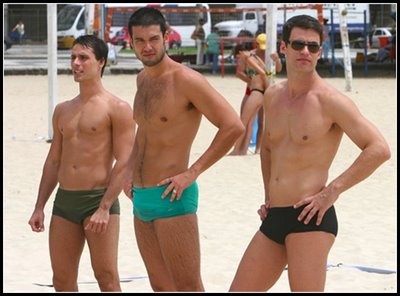
    We drank coconuts on Copacabana beach and watched footvolley on Ipanema.  We shopped in Leblon and rode bikes around Lagoa.  We hiked up Morro da Urca and fed monkeys.  We explored the botanical gardens and got harassed by some aggressive strawberry salesmen at the market.  Salgados, acaraje, tapioca, sushi, and pounds of red meat were consumed in addition to 16 different kinds of fruit juice.  (Not even half of the 41 fruits on the menu.) Her trip ended with the obligatory visit to Cristo Redentor.

    After a week with my cousin, I now have some idea what it’s like to have a five year-old on summer vacation.

    I’ve had to translate for all of my family but, unlike other visitors, my cousin has an endless supply of energy and tendency to shout recently learned Portuguese phrases at totally inappropriate times.  A pre-departure nightmare involving a kidnapping meant leaving her on her own was out of the question.  Her first question every morning was “What are we doing today?”  So, she couldn’t read or speak to anyone, couldn’t be left alone, needed to be entertained every day, and she found the Portuguese word for armadillo absolutely hilarious.  In Rio, my cousin becomes a 23 year-old child.

    Our week went like this.  “What would you like to do today?”  “What do you feel like eating?”  “What do you want to drink?”  “Who else do you need to get gifts for?”   “The word for opossum is gambá.”  “Where do you want to go now?”  “Let me ask him where the bathroom is.”  “Not a good idea to shout ‘gambá!’ in the middle of the market.”  “What would you like to do if it rains?”  “Fui assaltada means ‘I was assaulted.’”  “What size do you want?”  “It’s 35 reais.”  “Please don’t tell the taxi driver you were assaulted.”

    On her last day, she proudly announced that this was the first time she had ever exhausted a guidebook.

    For my cousin every new experience, no matter how small, was worthy of being celebrated, turned into a joke, and discussed repeatedly.  While her constant enthusiasm is tiring it is also her most admirable trait.  She still has that childlike wonder which turns a trip to the grocery store into an adventure and pot-roast flavored potato chips into a treasure.

    Our week together in Rio was great fun!  Exhausting but great fun.  She helped me realize just how much fun Rio can be with a sense of adventure and that I will probably be sending future kids to summer camp.

  • Winter Fashion in Rio de Janeiro

    Winter Fashion in Rio de Janeiro

    It’s 73 degrees and partly cloudy in Rio.  Lows are around 63 and the sea breeze is decidedly nippy.  You know what that means?  Shake out the sweaters and get the mold off that leather coat.  It’s winter in Rio!

    Of course, this only applies if you’re a Carioca.  If you are from pretty much anywhere else (ok, anywhere outside of the tropics) you grab a light jacket to wear over your tank top or opt for a long-sleeve t-shirt (the sleeves of which will be pushed up for the entire day until the sun sets).  But if you are Carioca, you’ll wear enough layers to be comfortable in deep space.

    The Carioca reaction to cool weather is charming.  The temperature drops below 80 and store mannequins are clothed in knee-length coats and turtleneck sweaters.  A drizzly rain plus a temperature of 60 degrees requires scarves, gloves, and boots.  While the Carioca may dislike having to wear closed toed shoes, it does give her a chance to wear that beautiful leather coat she bought in Buenos Aires.

    I’ll admit the last two days have been chilly.  I brought a jean jacket with me to class last night, but even with the jacket, I seemed to be dressed for an entirely different climate than the office staff.   One assistant was wearing what appeared to be a wool sweater over a long-sleeved, button-up shirt.  The office manager was dressed in a black suit, with jacket buttoned, black stockings and pumps.  While I don’t know how they avoided heat exhaustion, they both looked killer.

    And that’s what I miss about winter.  The clothes.  I do not like cold weather and unless you’re in a Lifetime Christmas special, snow is simply a cold, wet mess.  I do, however, miss the clothes.  Turtle necks, long coats tied at the waist, gloves, lined slacks, boots, sweater vests, corduroy pants, jewel toned anything.  The human race appears so much more competent in winter attire.

    Would you want the guy in the speedo and tennis shoes holding the nuclear codes?  No.  Nothing says “We’re doomed!” like a speedo accessorized with gold chains and athletic footwear.

    I do love the weather in Rio.  The lack of freezing temperatures is one of the city’s greatest assets.  But I miss the sophistication of winter clothes.  And a speedo with a parka on top does not count.