 The other night my daughter and I died repeatedly in a lava lake. We were playing Yoshi’s Woolly World and trying to get a final daisy that would unlock a secret board but the lava was rising and covering the daisy and…well, we died a lot.
After death number twenty-two give or take five, my daughter said, “Mommy, let’s just quit. We’re never going to get it.”
“That’s only true if we quit,” I cried, frantically pounding the A button.
Which is true. In Yoshi’s Wolly World and in life. Someday becomes never only when we quit.
This is not a sentiment I would have slapped on a poster, covered in glitter, and waved over my head until very recently. I was much more a “Why would I waste my limited time and energy on something that’s basically impossible?” or put more honestly “Why would I try so hard to most likely fail?”
Then I started querying agents for a novel, and I learned failing isn’t the end. Failing is a step.
I remember the queasy feeling I had as I hit send on my first query. This was it. After three years of writing, revising and researching the fiction industry, I was as ready as I could be. I was NOT querying a first draft. I had revised and revised again. I researched agents and made a list tailored to the book I wrote. I sent my query to workshops and had ACTUAL literary agents critique it. I was ready, and with my hand shaking, I clicked send. Then I sent nine more.
They all said no. So did the next ten agents. And the ten after that. All form rejections.
Querying literary agents is a pretty good dry run for living with chronic reflux. Once those queries are out, checking your inbox triggers chest pains, difficulty breathing, and nausea. It didn’t matter if the query was sent six hours ago or six months ago. If I had an open query and that little red circle appeared over my inbox icon, my stomach flipped. My expectations rose.
And then I’d read the rejection. It’s amazing that pixels on a screen can stimulate the physical sensation of being punched in the gut.
The first few rejections hurt but weren’t devastating. I didn’t panic. There are varied tastes. Some agents just won’t be into a vigilante anti-hero no matter how well written. Although someone should have recognized my talent by query 20. Or 25. Certainly by 30. But the form rejections kept coming and feeding the self-doubt. Because I wouldn’t have queried a novel I didn’t think was good. So the agent rejections were a reflection not only my book but on my judgement as a writer, right?
Eventually I went in search of data because that’s what people with social science degrees do. I wanted a number, so I googled “What’s the average number of rejections authors get before signing with an agent?” I found enough numbers that I know my total rejections over three projects isn’t even that high.
But back then, I had no idea where my count would end. Would I be the author who got an agent on her 65th query for her sixth manuscript? Imagining the time and energy it would take to write and revise six novels left me breathless. Could my heart take a shot of adrenaline every time I checked my email for a decade? But giving up after one novel wasn’t even trying and I couldn’t quit without really trying.
So I wrote another book. And I queried it. I got more form rejections. They caused heart palpitations and pain. But…and this was a revelation…not as much pain as that first batch.
I realized as I neared that 100 rejections mark, that the more times I read “no”, the faster my heart rate returned to normal. By the time I was into three digit rejection numbers, the emails caused only a flutter of despair. I could tell my husband and family “Nope. Another pass” with merely a shrug. I seemed to have developed a high tolerance for “no”.
Then project number three got me my first full manuscript request and first rejection of the entire manuscript. That one was bad. My query reflux flared up. I cried. But there were more full requests and I started thinking “At this rate, eventually someone will say yes.” I’d heard “no” 130 times, but somewhere along the line my thinking had shifted from “maybe not ever” to “eventually”.
As long as I didn’t quit. I’d gone from form rejections to personalized rejections to a partial request to multiple full requests. If I kept going, one rejection at time, I’d eventually get to a yes and after four years, I did. After 138 rejections.
So here’s what I hope to pass on my daughter.
There will be some doors that never open no matter how hard a person tries. I will never be and could never have been a professional basketball player or super model. I do not have the body for either. Nor do I have the eyesight for fighter jet pilot. Some things are out of our control.
And not everyone has the luxury of failing repeatedly. They don’t have time and energy to spare on ventures that might not bring any financial return. They don’t have family to support them during the trial and errors or bail them out after the crash and burn.
Failing repeatedly is a priviledge. If you’ve got the safety net, take the leap.
Do not let fear of hearing “no” or shame from having to admit rejection in front of family and friends be the only reasons you don’t try. Hearing “no” gets easier. It’ll always sting, but it will stop defining you. Every failed attempt teaches and makes you better. And you will get better.
So tryout for the team. Audition for the roll. Submit the story. Send off the resume. The regret from never trying will be so much worse than the sting of failing. And if there answer is “no”, well, your life will go on exactly as it did before you tried. It won’t be worse and now you have the chance to learn something and try again.
Take the step. Get a “no”. Reassess and try again. And again. Get 138 “no”s. Get 500 “no”s. You’ve only truly failed once you stop trying.
That’s what I yelled while my Yoshi leapt over rising lava. And eventually we got that damn daisy.






 The first woman to rule Portugal, Maria Francisca Isabel Josefa Antónia Gertrudes Rita Joana (why’d her parents stop there?) married her uncle in order to remain in line for the throne, saw her hometown destroyed by an earthquake-tsunami-fire mega disaster, calmed political unrest in Portugal by proving infinitely more competent, less corrupt, and not as prone to mass incarceration as her father and his advisors, outlived her husband and all but one of her children, and became the only European monarch to leave the content and rule her empire from a colony. Although, by the time the court fled to Brazil, she wasn’t technically in charge anymore as she’d been declared insane and unfit to rule fifteen years earlier.
 Maria was born in 1734 and became the heir presumptive when all her brothers were still born. Now Portugal had never had a Queen rule in her own right, and they had this totally just and reasonable law that said a princess could NOT marry a foreigner and remain in line for the throne. Because obviously a man would be strong enough to resist manipulation from his Spanish wife, but a woman would be a puppet to her mustache-twirling Spanish husband. (This is hilariously ironic if you know about Queen Maria’s son and daughter-in-law.) So how can a princess marry a prince but not marry foreigner?
 In 1755, when Maria was just shy of 21, Lisbon was left in smoldering ruins after being hit by so many disasters in day even Hollywood producers would call it over the top. A massive earthquake hit at 9:30 in the morning on All Saint’s Day, while the churches were packed for mass. Almost every church in the city collapsed. Thousands of survivors rushed to open squares around the port, only to be swept away by the tsunami triggered by the quake. Fires then broke out and raged for five days destroying whatever parts of the city were left.
 As Queen she took a much more hands on approach to governing compared to her father who had taken the “everyone listen to my advisor because I’m going hunting” approach. She rolled back a lot of her father’s more extreme measures such as mass incarceration of political opponents. She’s remembered as a good ruler in Portugal and Brazil. By all accounts Maria was kind and affectionate with her family.
 When the Portuguese court fled Napoleon to Brazil, Maria thought she was being kidnapped and had to be carried aboard the ship by the fleet commander. She spent much of the three month voyage screaming. It sounds horrible for everyone involved.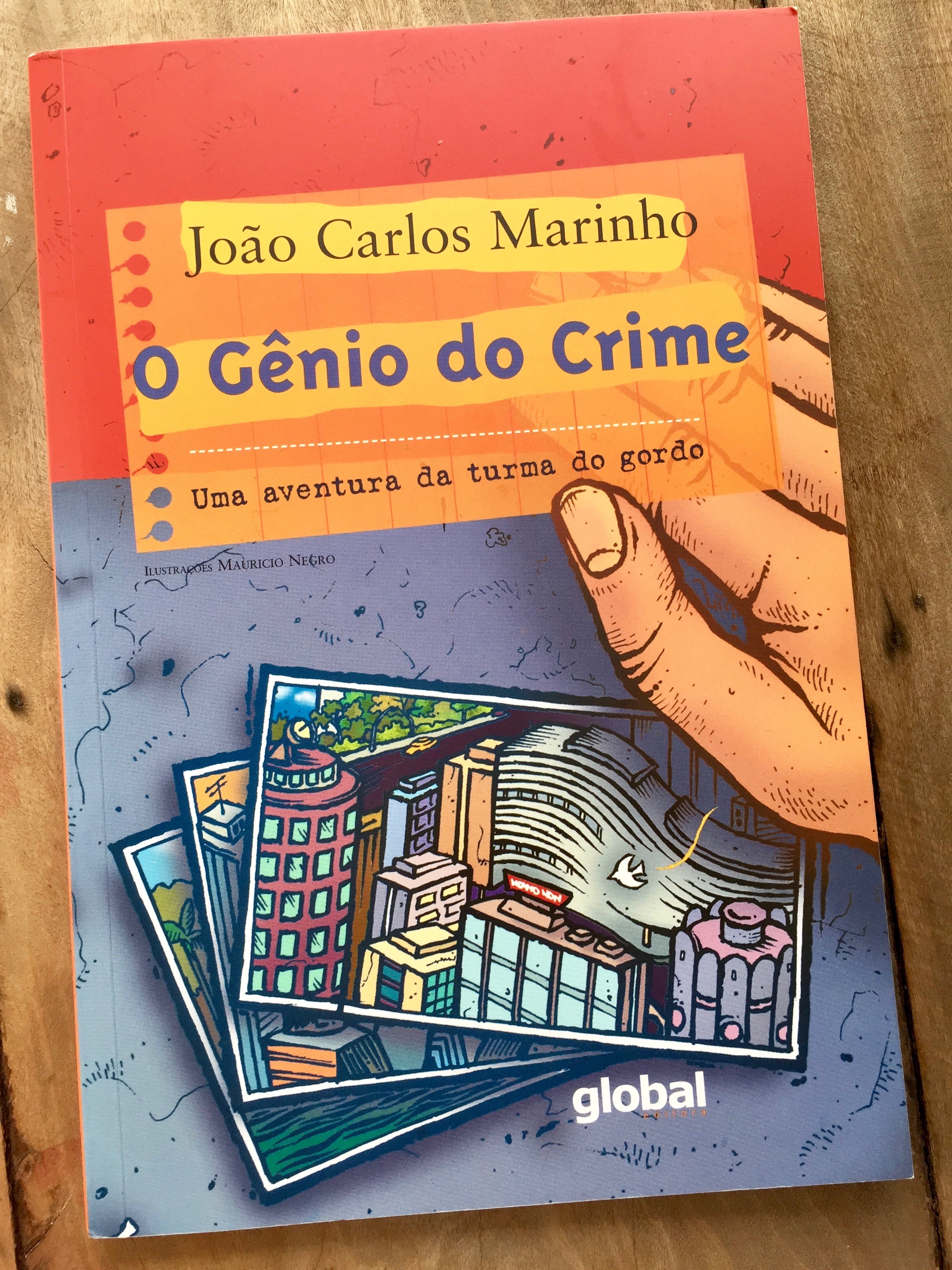
 I recently asked my husband what his favorite books were as a kid and without hesitation he said “O Gênio do Crime.” He couldn’t remember the author’s name, but he remembered in detail an ingenious system the kid detectives invented to tail a very tricky criminal. My husband remembered this book instantly after forty years, and it wasn’t about ancient Rome.
 The kids of São Paulo are on the verge of an uprising when the company manufacturing soccer trading cards stops awarding prizes for collecting because of counterfeit cards being mass produced in the city. (It’s possibly the most Brazilian crime ever.) The police have yet to find this “gênio do crime” (genius of crime), but Edmundo, Pituca, and Bolachão are determined to succeed where the police have failed and ensure the kids of Sao Paulo can continue collecting cards and prizes.
 It did not take me long after announcing my study abroad plans to realize that “abroad” for most of the people I knew meant Western Europe or Australia. Any other country was not so much abroad as another planet. The first time I mentioned Morocco to family or friends there was usually a momentary pause as people first, tried to place Morocco on a map, and second tried to figure out why I wanted to spend a significant amount of time there. Australia they could understand. It has beaches and people with funny accents. Italy has pasta and Prada. The only thing Morocco has is a city named after a Humphrey Bogart film.
 On September 3, I found myself all alone, completely lost, standing on a street corner in Rabat. That was the day of the Drop Off–the morning our program directors piled all 22 students on a bus, drove us around Rabat until we had no directional bearings whatsoever, and dropped us off one by one on random street corners throughout the city. Our first full day in Morocco and each of us was left stranded on a different street corner with no maps, no cell phones, and no idea how to even pronounce the street our hotel was on. The only thing we had was an assignment. Get back to the hotel by 1 o’clock. Welcome to Morocco and good luck.
 As I frantically looked around I noticed one opening in the wall flanked by two heavily armed Moroccan soldiers. I had heard stories about corrupt police officers in developing countries, about the actions of local military around the world who were supposed to be protecting refugees in various places, and decided the best direction to start walking would be away from the men with guns, uniform or no uniform. It would be much later before I realized this was my first decision in Morocco based entirely on a stereotype.
 Yes, that was one of the many thoughts running through my head as I tried to keep myself together. Despite all my boasting about being above the negative stereotyping of Arabs many friends and family engaged in, as I stood on the sidewalk of an unknown street somewhere in Rabat, I was genuinely afraid I was going to be harassed, beaten, or worse by those “fanatical Arabs.” So much for being a good liberal who doesn’t stereotype. I was alone, in a completely foreign country, with no knowledge of the language, or the culture, or where in God’s name my hotel was–and in that panic I embraced the most negative, racist stereotypes that had ever been presented in Western media. I wanted to go back to the time when being liberal meant eating vegan chocolate cake and discussing Said’s definition of orientalism on the quad of my $34,000 a year university in Northwest Washington, DC. While I walked, my mind kept repeating, “What am I doing here? I’m a white girl from Snellville, Georgia USA, where all the teenagers wear ‘what would Jesus do?’ bracelets. Why didn’t I study abroad in London with all of my friends?”
 As pleasantly surprising as this man’s generosity had been it was not the biggest surprise of the day. I was struck to the core when I walked into the hotel’s lobby and saw it was filled with students and all the Moroccans who had taken the time to help each of us find our way back. As we breathlessly shared our stories at increasing levels of volume, it became evident that every student made it back to the hotel through the generosity of complete strangers who were willing to take time out of their day to help another person. We had not experienced any kind of anti-American sentiment; in fact most of us had gotten incredibly positive reactions toward Americans. I hadn’t come across a flag or Bush effigy burning in the street. I had been in Morocco one full day and I had already had an exciting and liberating adventure, which introduced to many touchingly generous people and brought me face to face with my own hidden stereotypes.
 While tenaciously clinging to stereotypes, particularly if they are negative, will also blind a person to the wonderful and fascinating realities and practices of any culture. Recognizing stereotypes for what they are, imagined realities based on limited information, and preparing yourself to leave them behind as you learn and observe the reality from within the culture, are essential in order to make the transition into a new culture.
 It happened. I finally got the brutal agent response I will talk about twenty years from now at book signings. I’m a real writer now. Yay!
 My first thought was “Portugal, a Christian country in Europe full of white people, may feel too foreign for Americans?” I’m still trying to figure out what about US demographics gives the agent this impression. If Portugal is too foreign what countries will Americans read about? Great Britain, obviously. France, yes. Germany? What about Russia? They’re white, but their culture is pretty dissimilar to the US.
 The Census Bureas predicts that by 2020, the majority of kids in the United States will be members of a minority race or ethnic group.